
Selling with Jeff

Posts about:

Questioning (2)

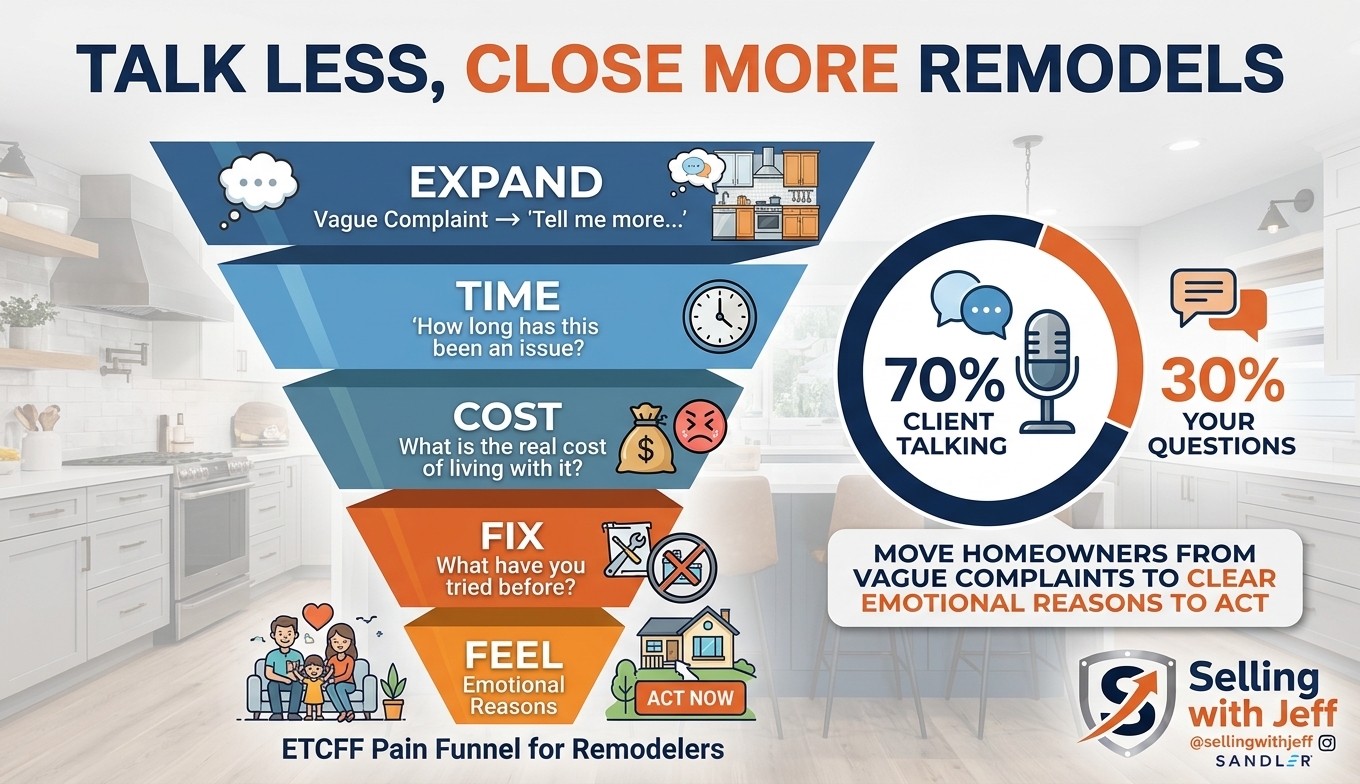
ETCFF Questions for Remodeler Sales Teams

What is ETCFF and why pain must come before budget

The ETCFF model is a five-step questioning framework (Expand, Time, Cost, Fix, Feel) that helps remodelers move beyond surface project details to the homeowner’s real emotional motivation, so you qualify harder, build urgency, and stop wasting bids on low-commitment prospects. When you slow down and walk through each letter, you uncover why they want to change, why now, and whether they are truly willing to invest.

Read More

Let’s Pretend: Sales Questions That Unlock Decisions

Turn “confused” prospects into clear decisions with one phrase

The fastest way to turn a stuck prospect into a confident buyer is to act as a decision enablement specialist and use the simple phrase “Let’s pretend…” to explore outcomes together. This lowers their guard, surfaces real risks, and lets them talk themselves into the right choice instead of arguing with your advice.

Read More

Sandler Questioning to Make Clients Remember and Commit

Why Clients Remember 80% of What They Say

Effective Sandler questioning techniques get clients talking so they remember and own key decisions. People typically remember around 20% of what you tell them and up to 80% of what they say themselves. When you ask questions instead of lecturing, clients repeat expectations in their own words, which locks the agreement in their memory.

Read More

Handle Sales Stalls with the Acknowledge–Explore–Resolve Method

Acknowledge stalls and objections without creating resistance

When a buyer pushes back, don’t rush to defend your offer; start by acknowledging the objection and lowering resistance. Top Sandler trainers emphasize that most objections are really uncertainty, not final decisions, so your job is to make it safe for the prospect to keep talking instead of shutting down.

Read More

Be Interested, Not Interesting in Post‑Sales Calls

Why “be interested, not interesting” transforms post‑sales

Being interested, not interesting in post‑sales means you focus less on talking about your product and more on asking questions that uncover how things really work for the client. That shift reduces defensiveness, exposes hidden fears like job security, and gives you the information you need to protect adoption, renewals, and expansion.

Read More