Quantifying Sales Pain Without Sounding Pushy

Shift from ‘pain’ to curiosity in sales conversations
Quantifying sales pain means turning a prospect’s vague problems into clear business impact, using their numbers and their words. You move from “they want a better price” to “this problem is costing $180,000 a year,” so the decision is no longer price vs. budget but change vs. the cost of doing nothing.
Many salespeople hear a prospect say, “I just need a price,” and either push back hard or give the quote and hope. Neither creates real engagement. Instead, aim first for genuine curiosity: do you truly understand what’s not working, how it shows up day to day, and who it affects? When you listen to learn, not to steer them to your next scripted question, your follow-ups feel natural instead of manipulative.
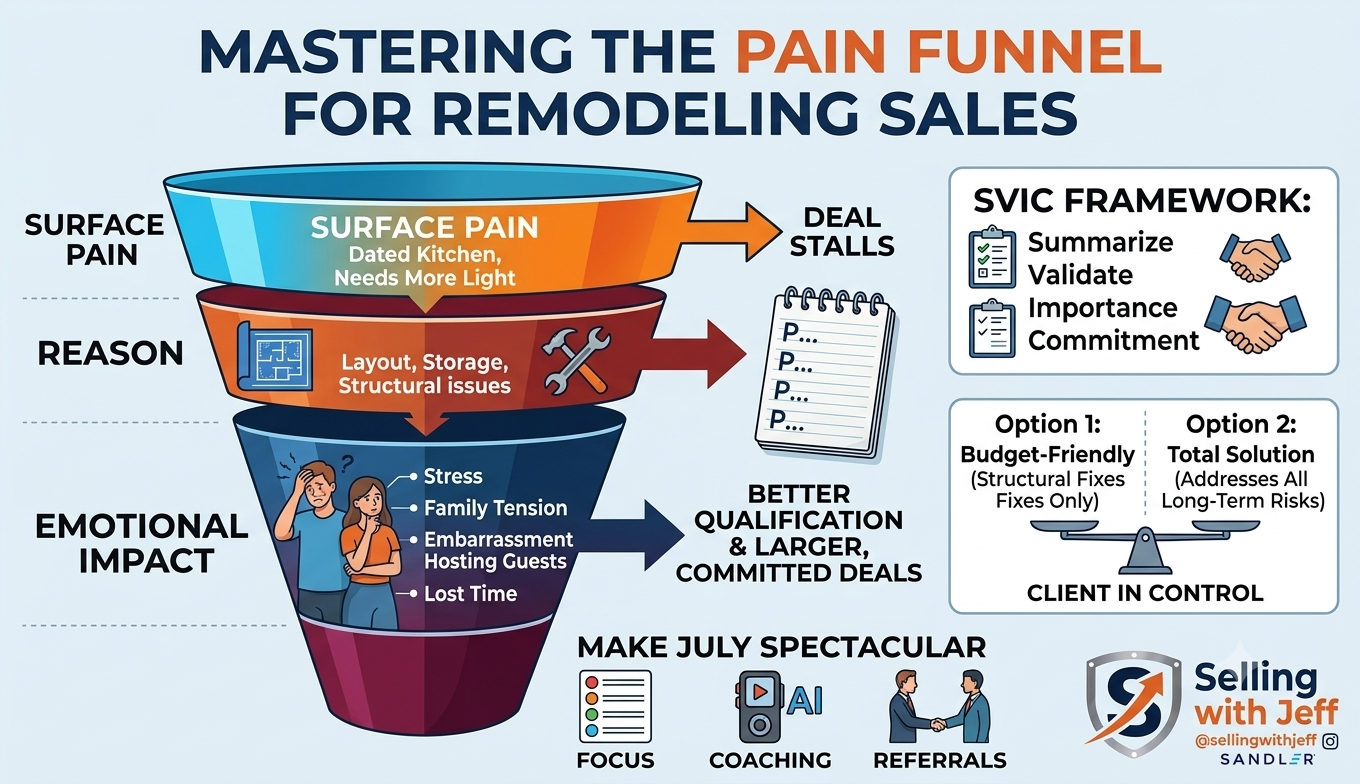
Sandler research shared in a recent article notes that while many trained reps start the Pain Funnel, fewer than 10% consistently go deep on impact and consequences. That gap is exactly where urgency dies. In your calls, notice when you “lily pad” across issues instead of staying with the one that clearly hits a nerve—like the ops manager who sighs when they talk about yet another weekend spent fixing mistakes.
You can also replace the overused word “pain” with “curiosity.” Ask yourself: “Where am I genuinely curious to learn more?” That mindset shift keeps you present. It also makes advanced questions—scope, priority, presumptive, and acknowledgment questions—sound like part of a real conversation rather than a technique.
Use a simple 4-step formula to quantify sales pain
Quantifying sales pain works best when you follow a clear structure instead of improvising math in front of the prospect. Think of it as “pain by numbers.” Here is a practical 4-step formula you can adapt for your industry and use in almost every discovery call.
-
Identify a clear pain indicator. Before you ever touch numbers, you need one concrete issue they agree is real and worth talking about. For example: “We have at least two trucks sitting idle most weeks,” or “Marketing keeps sending ‘hot leads’ that never close.” Without that shared starting point, quantification will always feel forced.
-
Define one tangible unit. Translate the problem into something you can count. With idle trucks, the unit might be the margin one truck produces per week. With no-show appointments, it might be the average revenue from one kept meeting. Ask clarifying questions like, “When you say ‘a few’ trucks, is that two, five, or fifteen?” so you’re not building a business case on vague language.
-
Add up the past. Once you know one unit, look backward. “On an average week, how many trucks are idle?” “How many no-shows do you see per month?” If one truck generates $25,000 in margin per week and it sits for six weeks across the year, that’s $150,000 in lost margin from a single vehicle. Then ask, “Is that a lot or a little in your world?” As Sandler often points out, people don’t argue with their own data when they’re the ones doing the math.
-
Project the future if nothing changes. Now shift to impact over time: “If this continues for the next 12 months, what does that add up to?” In a remodeling example from Sandler’s own content, unqualified design meetings that don’t close can easily eat hundreds of paid hours per year. Guiding the prospect to calculate that number themselves turns a fuzzy annoyance into a quantified cost they can’t unsee.
Practice pain funnels that feel natural, not scripted
Quantifying sales pain will backfire if it sounds like you’re running a calculator on the prospect instead of having a human conversation. The goal is to guide, not grill. That’s why practice matters: you’re training yourself to stay curious, listen for emotional cues, and only then bring in the numbers.
Start by role-playing full Pain Funnels—not just one or two questions—with teammates. In each practice call, give the “prospect” real context: their role, what’s frustrating them, what they’ve already tried. Then, as the “salesperson,” focus on going deeper on one problem instead of hopping laterally between many. Ask, “Can you give me an example?” and “How is that showing up for you personally?” before you ever ask, “What is one missed project worth?”
When the conversation reaches a clear issue, introduce simple, respectful engagement questions: “Do you want to talk about the impact this is having?” or “Would it be useful to put some rough numbers around this, just to see if it’s worth changing?” If they say no, you’ve learned something about priority. If they say yes, you have permission to quantify.
In practice sessions, watch for the two most common failure modes: sounding robotic and ignoring emotional signals. For instance, if a prospect visibly reacts when they talk about losing weekends to rework, stay there. Help them estimate how many weekends they’ve lost this year and what that means in overtime, burnout, or missed family time. That’s a concrete, emotionally grounded impact—far more powerful than a generic, “So what’s the cost of that?”
Over time, combine these skills with industry insights from resources like Sandler’s articles on quantifying pain (Quantifying Pain in Sales) and using the Pain Funnel (Use the Sandler Pain Funnel to Create Real Urgency). The more you practice with real numbers and real scenarios, the more natural it becomes to turn everyday complaints into compelling, prospect-owned business cases.