
Sandler Pain Funnel Skills for Remodeler Sales Teams
Why remodeler salespeople bail out of the Sandler pain funnel
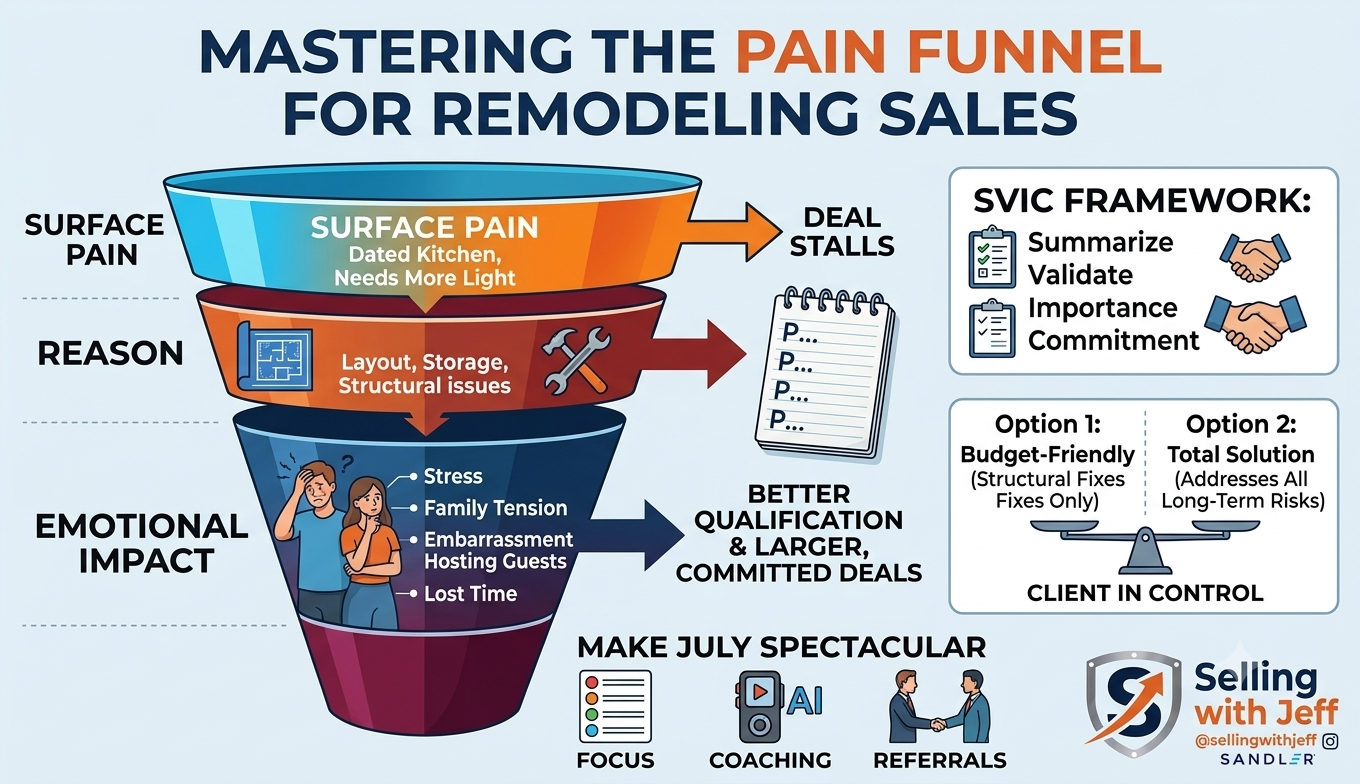
The Sandler pain funnel is a structured set of questions that takes prospects from surface complaints ("my kitchen is dated") down to the personal, emotional impact that actually drives change. Staying in that funnel longer helps you qualify better and close fewer but larger, more committed deals.
Sandler’s own material stresses that most reps stop too soon. Many sales teams move from surface pain straight to presenting options, which is exactly when deals stall or end in "think it over." In one Sandler article, trainers estimate that the vast majority of reps are comfortable only at the top of the funnel and rush past the deeper emotional impact layer.Sandler Pain Funnel: Stop Selling Too Soon explains that without that deeper impact, you sound like every other contractor who has already disappointed the prospect.
Remodelers feel this pressure even more. You see obvious fixes—better layout, structural repair, upgraded windows—and your brain jumps to solutions. The discipline is forcing yourself to stay curious: what has this problem already cost them in time, stress, family tension, and money? That information becomes the anchor for your budget and scope later.
Another expert piece compares a strong pain conversation to a medical exam: great doctors rarely tell you how much something hurts; they ask sequenced questions so you say it out loud yourself.Sandler Pain Funnel: the Question Ladder highlights that the real asset is the structure of the questions, not the individual phrases. Once remodeler reps grasp that, the pain step feels less like prying and more like professional diagnosis.
Staying in the pain funnel without feeling pushy or awkward
The easiest way to stay in the pain funnel longer is to give yourself structure. One remodeling owner in the transcript used a simple note‑taking hack: writing "P… P… P…" down the margin of their prep sheet—three pains, each with space for three follow‑up questions—to hold themselves accountable.
You can adapt that approach on every discovery call. Before each meeting, decide you will uncover at least three distinct pains (for example: daily frustration with the space, safety or structural risk, and embarrassment when hosting guests). Under each pain, plan to ask three clarifying questions: what it really looks like, how long it has been happening, and what happens if nothing changes for another year.
This doesn’t require a rigid script. In fact, Sandler cautions against sounding scripted. Instead, it’s about pacing. Senior reps in the conversation acknowledged they often "bail in the middle of the funnel" because a solution pops into their head. When that happens, use a mental speed bump: before offering ideas, force yourself to ask, "Is doing nothing an option?" and, if they say yes, "What would that mean for you?"
The team’s discussion also surfaced an important truth: different styles reach the bottom of the funnel at different speeds. A more direct rep may need fewer questions to uncover genuine emotional impact. The test isn’t how many questions you asked; it’s whether the homeowner clearly states, in their own words, that sticking with the status quo is unacceptable.
Talking about over‑budget projects without losing trust
The team also wrestled with a common remodeler problem: projects coming in well over the client’s top‑end budget—like a window and structural package expected at $35,000 that prices out closer to $56,000. This is where earlier pain work and clear structure protect the relationship.
One useful framework they referenced was SVIC: Summarize, Validate, Importance, Commitment. First, you summarize the pains you heard in your words. Then you validate by asking, "Did I get that right, and did I miss anything?" Next, you ask about importance: "Where does fixing this sit among all the projects on your list?" Finally, you confirm commitment: "Are you willing and able to commit the time, disruption, and investment to solve it?"
By the time you reveal the price, you’re not just showing a number; you’re connecting it directly to problems they agreed are urgent and important. When the proposal is above their stated budget, you can use a calm takeaway: "We’ve built a solution that addresses everything you told us matters. It is above your top number. Would you still like to see it?" This tests commitment without pressure.
Whenever possible, pair that with a second option that meets the budget but doesn’t check every box—such as fixing the most urgent structural issues now and postponing aesthetic upgrades. Then you can say, "Here’s a version that fits what you said you’re comfortable investing, and here’s the version that resolves all the long‑term risks. Which path makes more sense for you right now?" Clients feel in control, and you stay aligned with their interests.
Turning a good month great with focus, coaching, and referrals
Finally, the team shifted from looking backward at dashboards to planning how to make July "spectacular." Their commitments point to a practical playbook any remodeler sales team can copy: sharper focus, real coaching, and deliberate referral asks.
On focus, several designers admitted they "jump around" during the day and lose momentum. One simple fix was a color‑coded daily list that only gets updated once, with clear red‑level priorities that must be completed before new tasks get added. That kind of flywheel thinking—protecting momentum instead of constantly context‑switching—usually yields more signed contracts with fewer late‑night design marathons.
On coaching, one rep had already started recording both phone and in‑home meetings and dropping transcripts into AI for feedback on talk time, filler words, and missed pain questions. Combining that practice with a Sandler‑specific AI coach gives you something even stronger: objective feedback on whether you really reached the bottom of the pain funnel and how often the client talked versus the salesperson.
Finally, the group agreed to a very specific, measurable behavior: each person will ask for at least two referrals during the month—from current clients, past clients, or even their personal network. That simple, trackable target often produces one or two extra opportunities per rep. When you layer those fresh introductions on top of better pain conversations and cleaner over‑budget talks, you turn "let’s hope for a great month" into a concrete, repeatable plan.