Remodeling Pipelines: Stop Chasing Bad‑Fit Design Work
Why thin pipelines tempt you to chase bad‑fit remodeling work
In a slow remodeling sales pipeline, the answer isn't chasing every maybe. You protect margin by enforcing clear budget, scope, and design-fee gates, even when your calendar is light. That discipline keeps you from over-designing bad-fit projects and preserves time for work that can actually close.
Every remodeler has been there: the porch prospect who swears 80k is the max, your gut says the project will land at 120k+, and you still burn hours designing because, “Well, we’re not that busy.” That’s exactly how you teach yourself bad habits you’ll regret when the pipeline fills.
Industry benchmarks say a healthy close rate on sales-qualified remodeling leads is roughly 25–35%, not 80–90% across the board, according to Sandler remodeling data. When you relax your standards just because you’re light on leads, you don’t really improve that close rate; you just spend more time on people who were never going to buy.
Your job is to behave like a pro whether you have two hot opportunities or twenty: same questions, same gates, same willingness to walk when the fit isn’t there.
Install hard exit gates around budget, scope, and fit
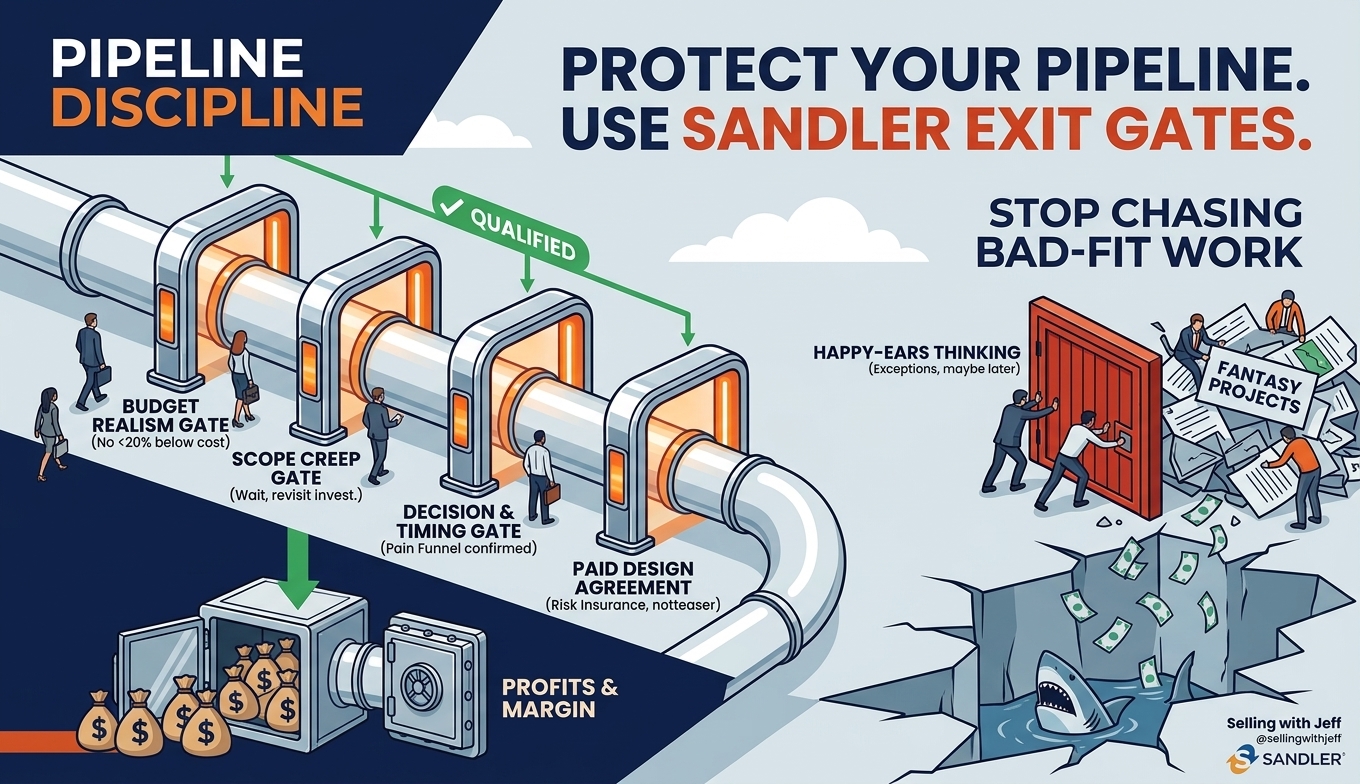
When your calendar is open, your brain invents exceptions: “Yes, her max is 80k and this will be 120k+, but she seems really nice.” That is happy‑ears thinking. You need explicit Exit Gates that tell you when to stop.
At minimum, build three non‑negotiable gates into your process:
- Budget realism gate. You won’t proceed if their stated budget is more than 20–25% below what similar projects actually cost. Analyses show 80–91% of residential renovations already overrun initial budgets by 10–33% (budget‑range research). Starting from a fantasy number is malpractice.
- Scope creep gate. If the wish list keeps growing but the budget never moves, you pause. “It sounds like the project has doubled. Before we design more, can we revisit the investment range?”
- Decision and timing gate. Use a Sandler PAIL‑style agenda and Pain Funnel to confirm who decides, why now, and what happens if they don’t move forward.
If a prospect fails a gate, you have permission to step back instead of hoping they’ll magically find another 30k.
Sell your design agreement as real risk protection, not a teaser
A design agreement is not a down payment on their dream; it’s a paid discovery step. You and the homeowner trade guesses and HGTV numbers for researched scope, drawings, selections, and a price that reflects reality, not optimism.
Consider the couple who budgeted “around 400k,” signed a 15k design agreement, then fell in love with an expanded kitchen, upgraded suite, and exterior work. When the design priced at 640k, they felt misled—even though the work was beautiful, as described in one Sandler case study. The problem wasn’t the design; it was the expectation.
In your Upfront Contract, say it plainly: “This agreement buys us a thorough investigation—site visits, trade walkthroughs, photorealistic renderings, and a detailed scope with real pricing. It does not guarantee we can achieve every idea inside your first budget number.” Then ask, “Are you okay with that?”
When you position the design fee as risk insurance instead of an entry ticket, serious buyers lean in and price‑shoppers opt out early—which is exactly what you want.
Protect designer time with Sandler behaviors, not busywork
Designers in the field often live under a utilization metric—75% of hours must be billable to client jobs. When leads are thin, the temptation is to pad that number by over‑servicing long‑shot prospects. That keeps the spreadsheet happy and your margin miserable.
Treat designer hours like cash. Your Exit Gates define which projects are worthy of deep design; your Sandler behaviors define how you fill the top of the funnel so you’re not desperate. That means a prospecting “cookbook” with scheduled blocks for follow‑ups, centers‑of‑influence, and explicit referral asks, not just waiting for marketing.
Firms that chased “free design” watched design‑to‑construction conversion drop from 80–90% into the 40–50% range (free‑design analysis). The same thing happens when you quietly turn paid design into unlimited design.
Your goal is simple: fewer, better‑qualified design agreements; higher design‑to‑build conversion; and designers who spend their 75% on projects that can actually turn into profitable construction contracts.