Stop Losing Deals to Free Design and AI Concepts
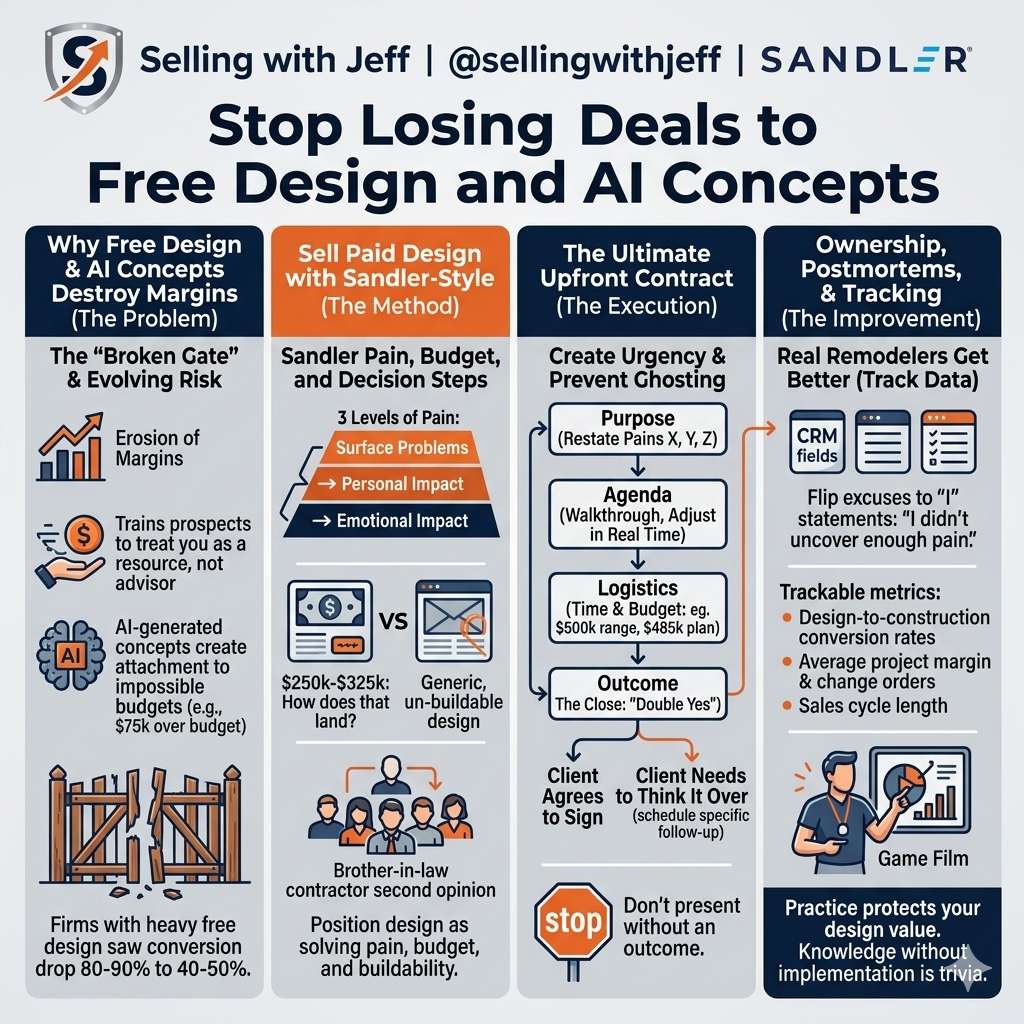
Why free design and AI concepts quietly destroy your margins
Free design and generic AI concepts feel like a fast way to win remodeling deals, but they usually erode margins, lower design-to-build conversion, and train prospects to treat you as a free resource instead of a trusted advisor. Protecting your design value starts with understanding what you’re really giving away.
When you hand out floor plans or AI-generated renderings before there’s real commitment, you’re not “being helpful”—you’re doing unpaid consulting. In remodeling, most of the profit comes from construction, not design fees. Firms that shifted to heavy free design saw design-to-construction conversion drop from 80–90% into the 40–50% range, which is unsustainable when your designers and project managers are already stretched.
Across industries, the same pattern shows up. A 2025 benchmark found roughly 28% of B2B deals die in the qualification stage when sellers chase unfit opportunities instead of enforcing clear gates in their process (Development Corporate). In remodeling, “free design” is exactly that: a broken gate.
There’s a second risk: expectations. Once a homeowner sees a gorgeous AI concept, they emotionally attach to it. If pricing work shows it’s $75,000 beyond budget, any attempt to pull back scope feels like you’re taking something away. Teams in your market have already seen buyers get angry when the “concept” they fell in love with can’t be built inside their stated range.
So does that mean you should ignore AI? No. It means you treat AI as a tool inside a paid, budget-aware process, not as a giveaway. Some high-volume bath companies, for example, charge a modest $500 conceptual package fee as a “monkey’s paw” step. They’ve learned that if a prospect won’t invest even that much, they almost never move forward to build.
The real problem isn’t AI or concepts. It’s positioning. When you stop giving design away, and instead define a clear, paid design process, you change the relationship from “vendor providing free drawings” to “partner co-designing a solution that actually fits pain, budget, and buildability.”
How to sell paid design with Sandler-style pain, budget, and decision steps
The fastest way to sell paid design is to run disciplined Sandler-style discovery: uncover emotional pain, agree on a realistic budget range, and clarify the decision process before you ever talk about drawings. Paid design then becomes the logical next step—not a surprise fee.
Start with pain. Most reps skip too quickly to ideas and features. Instead, stay in the problem. Ask questions about what’s not working in their home, how long it’s been an issue, and what happens if they do nothing for another year. Go at least three levels deep: surface problems, personal impact, and emotional impact. One remodeling firm studied lost deals and discovered over a quarter of them traced back to shallow discovery and weak qualification, not pricing (RevOps Co‑op).
Next is budget. Don’t guess. Don’t design “to see where we land.” Use simple budget ranges and comparisons: “Projects like what you’re describing usually fall between $250,000 and $325,000. How does that land?” Prospects who refuse any budget conversation are waving a red flag that they may be shopping for free ideas, not a partner.
Then clarify decision process. Who needs to say yes? How will they compare you to competitors? Will they ask friends, siblings, or a brother-in-law contractor for a second opinion? The buyer in your session who almost backed out on Monday morning did so because a relative questioned why she’d signed “with nothing in her hand.” If you don’t map those influences ahead of time, they’ll blow up deals at the last minute.
When you’ve done pain, budget, and decision well, positioning paid design is straightforward:
- Tie it directly to the pains they admitted (“Our design process exists to solve A, B, and C without surprise overruns.”).
- Emphasize that design is iterative, not a one-shot “here’s your floor plan.”
- Contrast your process with generic AI design by asking, “If another firm uses AI to sketch something that can’t be built within your budget, is that helpful—or just setting you up for disappointment?”
From there, introduce options. You might offer a low-cost conceptual package (e.g., a limited AI-assisted concept within a wide accuracy band, clearly labeled as such) plus a fuller paid design phase. The rule is simple: any time your 20–25+ years of design and pricing judgment are involved, the meter is running.
Use an ultimate upfront contract to create urgency and prevent ghosting
An ultimate upfront contract is a scripted conversation you run before any big presentation that confirms purpose, agenda, logistics, and outcome, so you stop chasing “think it over” decisions and start running real yes/no meetings.
The structure is simple but powerful. Right before you present a design agreement or construction agreement, you briefly restate why you’re meeting, review the pains they shared, confirm time and budget, and then agree on what will happen at the end. That “outcome” is the closing piece remodelers often skip, which is why prospects disappear after you email a proposal.
Here’s how that sounds in practice:
- Purpose – “Today we’re reviewing the plan to solve the issues you told me about: X, Y, and Z.”
- Agenda – “I’ll walk you through how the design addresses each problem. I’ll ask for your input as we go so we can adjust in real time.”
- Logistics – “You told me your comfortable range was up to $500,000. To give you everything we discussed, this comes in at about $485,000. We’ve got 60 minutes together—still good?”
- Outcome (the close) – “If we’re within that range and you feel we’ve solved the problems we discussed, would anything stop you from moving ahead with the design agreement today?”
If they say yes, you confirm it again: “So just to be clear, if everything lines up, we can sign and collect the initial check before I leave?” This “double yes” dramatically reduces last‑minute wobbles because you’ve aligned expectations out loud.
If they hesitate—“We’ll need to think about it”—you normalize that and schedule a specific follow‑up before you present anything: “Totally fine. Before we start, when should we reconnect to decide one way or the other?” Deals where the follow‑up is scheduled and accepted ahead of time close at far higher rates than proposals emailed into a void, where doubt and competing voices creep in.
You can also use the upfront contract to handle budget gaps in the room instead of through endless email edits. For example: “To give you everything you wanted, this version is about $30,000 above the range we discussed. As we review, just let me know which problems you’d rather not solve now.” It’s a gutsy line, but it keeps the focus on trade‑offs, not discounts.
Ownership, postmortems, and tracking: how top remodelers actually improve
Top-producing remodelers treat every lost or stalled deal as a performance review on themselves, not on the prospect. They run postmortems, rewrite excuses as “I” statements, and track the numbers on free versus paid design so emotion doesn’t drive strategy.
Most sales teams rarely perform true postmortems. They mark a deal “closed lost” and choose a client-blaming reason like “no budget,” “no urgency,” or “not enough pain.” That feels good in the moment, but it blocks growth. The strongest companies in your space flip those reasons into ownership language:
- Instead of “client didn’t have enough pain,” they log “I didn’t uncover enough pain.”
- Instead of “no budget,” they log “I didn’t build enough value to justify the budget.”
- Instead of “no urgency,” they log “I didn’t reach third-level pain that would create urgency.”
A few remodeling firms have gone so far as to require that every closed-lost reason starts with “I…” in their CRM. It’s uncomfortable, but it drives better behavior faster than any script tweak because it forces reps to look at their own process first.
The same discipline should apply to the free-design debate. If you experiment with AI concepts or low-fee conceptual packages, decide ahead of time exactly what you’ll track and how often you’ll review it:
- Design-to-construction conversion rates for AI-aided concepts vs. traditional paid design.
- Average project margin and change orders for each path.
- Sales cycle length and ghosting rates before and after you introduced concepts.
If AI-driven concepts truly convert better at healthy margins, double down. If they generate more designs but fewer builds and worse P&Ls, you’ll have hard data to change course before “industry pressure” quietly erodes profitability.
Finally, build practice and feedback into your culture. Use tools to review call recordings, score how well reps ran pain/budget/decision, and where the upfront contract broke down. Think of it as “game film” for sales. As your trainer said, knowledge without implementation is just trivia. When you repeatedly practice the conversations that protect your design value—and own the misses—you’ll close more of the right remodeling clients without ever needing to give your best work away for free.