When to Present Proposals In Person Using Sandler

Use qualification to decide if a proposal is worth presenting
A qualified opportunity is one where the client has a clear problem you can solve, money that’s close enough to your range, a compelling reason to act, and an agreed next step. If any of these are missing, you’re drafting a bid for someone else’s job or for a project that will quietly die.
For a small team (like three sellers inside a 20‑person firm), the first decision isn’t dollar amount, it’s qualification. Before you even think about format (Zoom, kitchen table, or email), apply a simple four‑point filter from the Sandler approach: do they fit your ideal profile, do they have the right kind of pain, is there roughly enough budget, and is there a financially sensible reason to move forward now?
In practice, that means treating a $9,000 punch‑list project with weak pain as lower priority than a $40,000 deconstruction with strong schedule or safety risk. A 2020 analysis of construction sales teams by Salesmate found that better qualification increased win rates by over 50% (Salesmate). Use that as your cue: proposals get your time only when the deal is clearly winnable.
Apply Sandler pain, budget, and decision before proposal
Every time someone asks for a proposal, run through three Sandler compartments: Pain, Budget, Decision. If you can’t answer all three in detail, you’re not ready to write or present.
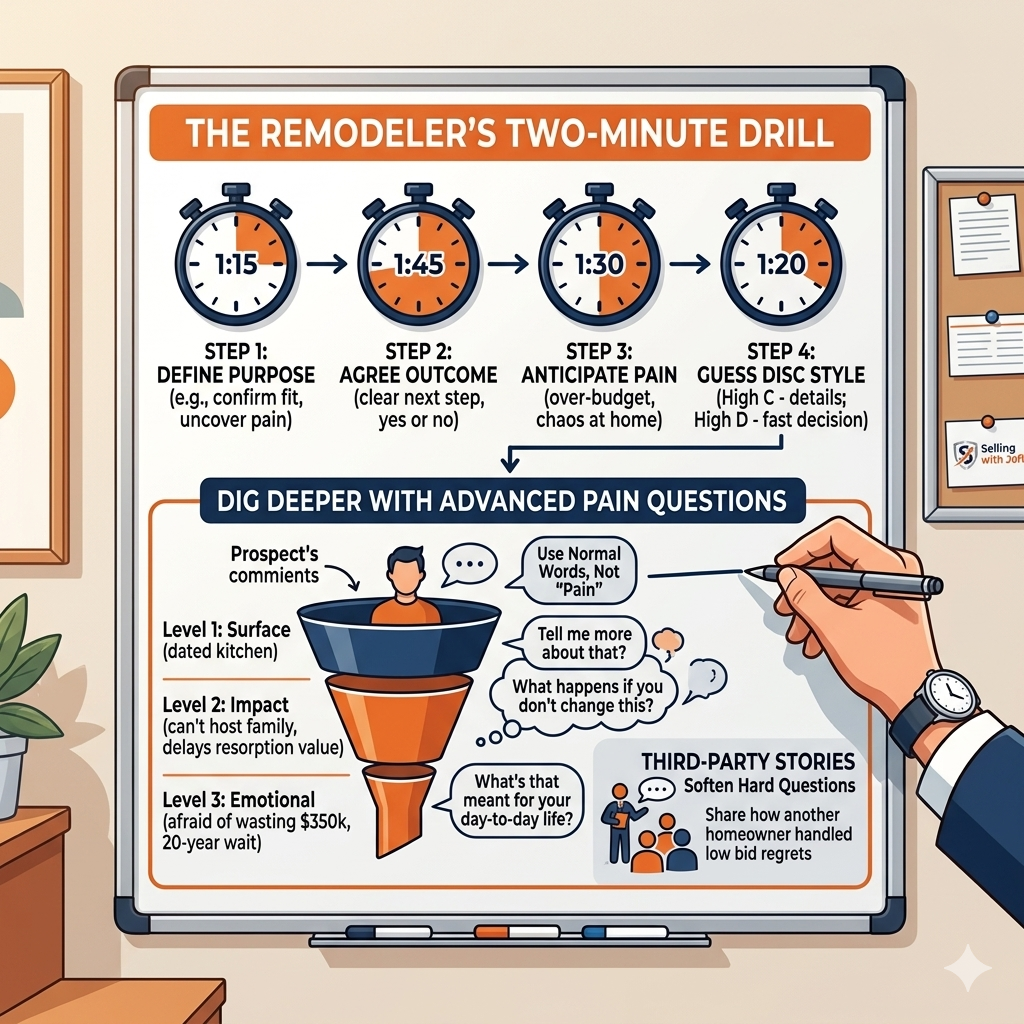
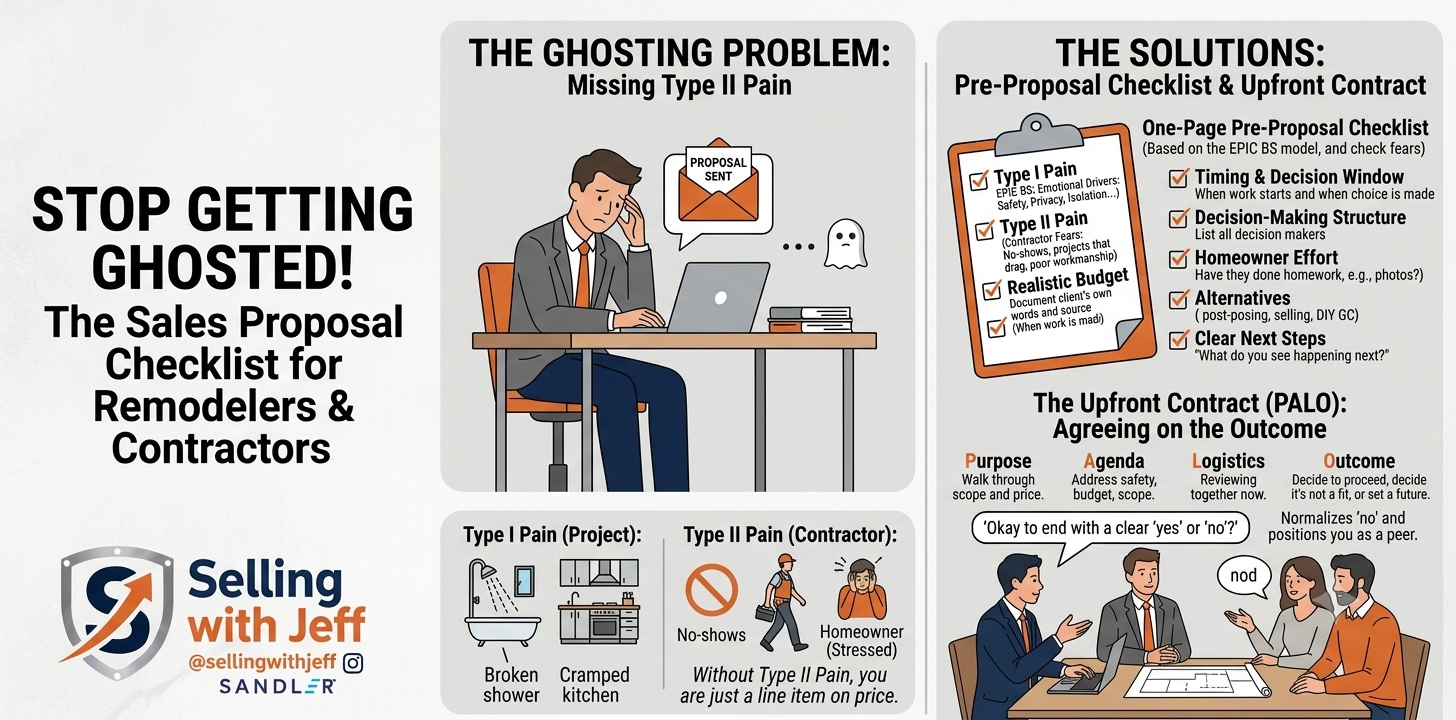
Start with pain. Don’t open with “What were you thinking of doing?” Instead, diagnose like a doctor: embarrassment about their current space, cramped layouts, safety issues, or broken promises from past contractors. The EPIC BS framework from Sandler (embarrassment, privacy, isolation, cramped, broken promise, safety) gives you six concrete areas to explore. If you can’t name at least one real emotional or financial consequence, the project probably won’t survive a full quote.
Next, budget. Flip the usual order: pain, then budget, then scope. Ask, “Roughly how much are you planning to invest to fix this?” and design scope to fit their range. In one of Chip’s real examples, a contractor ignored a stated $250,000 budget and presented $350,000; the clients said no, and felt unheard. Finally, confirm decision process before you draft: who signs, what other bids they’ll consider, and what they will do after you send the proposal.
Presenting proposals in person vs. email for higher close rates
Use your Sandler data to decide how to present. When pain is strong, budget is aligned, and the decision process is clear, present in person or on Zoom and bring the future to the present. Before you ever hit “send,” ask, “If I send you a proposal that includes A, B, and C at the investment we discussed, what will you do next?” Anything but a clear commitment (“we’ll sign and move it to the CFO”) means you’re not ready to send.
For low‑complexity work with modest upside, email is fine—as long as qualification is tight and you still secure a next step. For full‑house or multi‑trade work, treat the proposal meeting as the fulfillment step in the Sandler submarine: you mirror back their pains, show how the scope matches their budget, and confirm timeline and decision. Industry surveys of B2B sales consistently show complex deals closing more often when the proposal is walked through live instead of dropped in an inbox (Indeed).
Practically, you might decide: under $10k, well‑qualified, and simple scope → email plus scheduled phone debrief; anything above that, or with multiple stakeholders or high emotional risk (kitchens, whole‑house, structural work) → live presentation with a clear post‑sell step before you leave.
Raising your price with confidence on new and existing clients
When you raise your rate—whether cost‑plus percentage or fixed‑bid margins—your mindset usually matters more than your client’s. A 3% increase drops almost entirely to the bottom line; on a $500,000 annual book, that’s $15,000 of additional pre‑tax profit with zero extra jobs. Presented calmly and confidently, most clients accept small, clearly framed adjustments.
Tie price changes to something objective: inflation, wage increases, insurance, or code changes. For existing clients, use a negative reverse to surface concerns: “I don’t imagine a 3% adjustment from July would be a major issue for you, would it?” If they push back, you can explore options; if they don’t, you’ve just normalized the new rate.
With repeat accounts, reward loyalty through predictability, not discounts. Make clear that staying in your system protects them from larger jumps later. And remember the Sandler principle: it’s better to lose a job because your price honestly reflects the value and risk you carry than to win a job that quietly erodes your margins and your team’s confidence.