Why custom home sales are won on pain, not process
Effective custom home sales start by uncovering the homeowner’s emotional pain and lifestyle goals, then connecting your solution to those specific issues before you ever walk through your internal process or pretty slides. When clients feel you truly understand their daily frustrations, they trust your price and your path forward.
Most custom builders and design-build firms are proud of their process. You’ve spent years refining phases, milestones, and handoffs. But when you lead with that process in a sales meeting, it lands as abstract and generic. The homeowner doesn’t yet see themselves in it; they see another firm talking about themselves.
In the transcript, a design-build team lost a custom home to an architect even though the prospect admitted a design-build firm was probably a better fit. The feedback? The architect felt more consultative and personal, while the design-builder felt “very process-focused.” The team defaulted to presenting their steps instead of sitting in the client’s world.
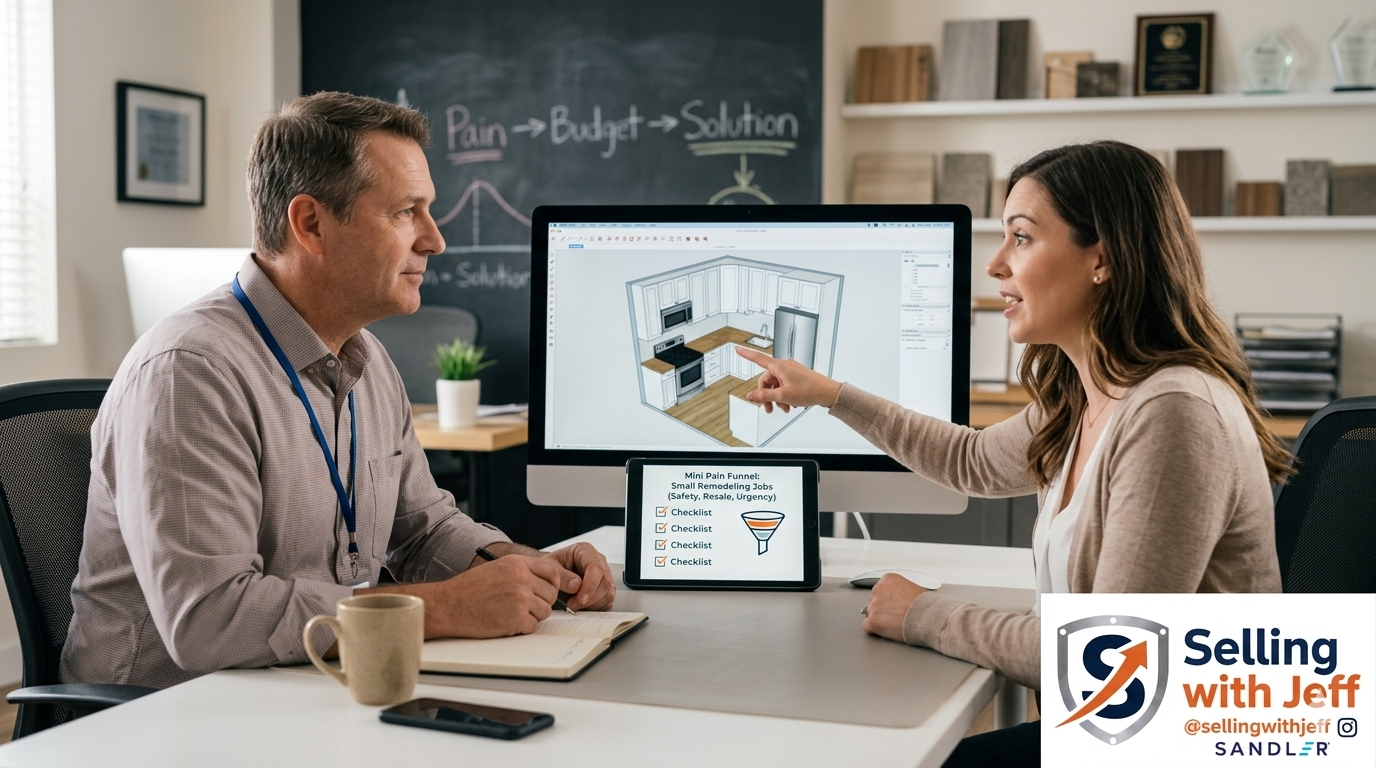
Pain-based selling flips that script. Instead of, “Here’s how our design phase works,” the conversation becomes, “Tell me what isn’t working in your current home. When does it frustrate you the most? Who’s impacted?” Sandler research with remodelers shows that when you reach this emotional layer, “let us think about it” stalls drop and close rates climb because your price is now tied to a felt outcome, not a wish list. You can see this approach laid out in detail in Use the Pain Funnel to Sell Custom Homes.
For custom homes, these pains are often lifestyle-driven: aging parents moving in, kids boomeranging back, remote work chaos in the kitchen, or embarrassment about hosting friends. When you begin there—and keep looping back to those pains in every meeting—you become the guide to a different way of living, not just a firm with a well-documented process.
Turn “you said” into a consultative custom home conversation
To run truly consultative custom home conversations, capture the client’s exact words about their pain and goals, then structure your presentation as a series of “you said / here’s our approach” moments that connect their story to your solution. This keeps meetings personal, even when they’re remote or hybrid.
In the coaching session, one builder described an AI-generated summary slide deck that helped win two custom homes worth over $5 million combined. The secret wasn’t fancy graphics. Each slide followed a simple pattern: “You said ___, here’s our approach to that.” Every recommendation was anchored to something the client had already told them.
That pattern is powerful because it proves you listened. Instead of a one-way presentation, it feels like a reflection: “We heard you. Here’s how we’ll help.” It also makes virtual or hybrid meetings more human. When one spouse is remote and the other is in the room, calling back each person’s words—“You told us working from the kitchen island isn’t sustainable” or “You said you’re embarrassed to host clients at home”—pulls everyone into the same emotional frame.
You can practice this before you ever meet a prospect. Take a past project and write a short script: three to five “you said / here’s our approach” pairs based on the real pains that client shared. Then, in your next discovery call, listen specifically for quotes you could plug into that structure. This shifts your mindset from “I need to explain our process” to “I need to collect their language so I can present back a plan they recognize as their own.”
Finally, make sure your slides (if you use them) reflect this order. Title slide, a simple hero image of the future home, then pain-and-approach pairs. Process slides move to the back, only surfaced if the client asks, “So how will this work, step by step?”
Stop designing the pony: connect dreams to a real budget
If you price or design every need, want, and wish without a clear budget, you create a dream the client can’t afford, damage trust, and lose the project. Use structured budget questions to anchor design in a realistic investment range before you ever “design the pony.”
In the conversation, the team described the classic trap: homeowners say, “Just design everything we’ve talked about, then we’ll pare back once we see the number.” On the surface, it sounds reasonable. In practice, it’s lethal. Designers will always be able to out-design any budget. The result is a beautiful plan that’s tens or hundreds of thousands beyond reach.
Once clients fall in love with that version of the project and then discover it’s far outside their range, they feel crushed and misled. They may not say it out loud, but trust is gone. Instead of scaling back with you, they often freeze or shop around, wondering who can build the dream for less.
This is why seasoned custom builders insist on real budget conversations before serious design work. Construction costs routinely rise 10–20% in just a few years, while homeowners often quote numbers from old projects or TV shows. When you avoid budget, you inherit all that confusion. A Sandler article on custom home budgets shows that skipping this step leads directly to stalled decisions, scope fights, and ghosting; see Magic Budget Questions for Custom Home Builders.
A practical move: when a client says, “Let’s just see where it comes in,” respond with a playful but firm example—“Okay, then we’ll base our design fee on a $1 million project; does that feel like the right starting point?” Their reaction forces a real number onto the table. From there, you can sort scope into needs, wants, and wishes, and design only what fits—or explicitly label the “pony” items as future phases.
Sequence emotion, budget, and process to boost conversions
Custom home projects convert at the highest rates when you follow a simple sequence: build trust, uncover pain, confirm budget, then walk through process—never the other way around. This order aligns with how people actually buy: emotionally first, intellectually second.
Industry benchmarks suggest that an 85–90% conversion rate from design to construction is a gold standard for healthy design-build firms, while many sit in the mid‑50s and assume they simply need more leads. Research on design-build trust shows that tightening the emotional and budget steps between proposal, kickoff, and concept pricing usually moves the needle faster than any marketing tweak; see Design-Build Trust: Stop Losing Clients After Design.
The sequence from the transcript mirrors the Sandler “submarine” idea:
- Trust and rapport. Start every relationship by being interested, not interesting. Ask how they make decisions, what scares them about building, and what a successful project would feel like a year after move-in.
- Pain. Stay with their struggles at home until you understand the emotional drivers: embarrassment, safety fears, stress, or family dynamics.
- Budget. Only after pain do you move to investment. Use budget questions to confirm a range and test seriousness. If they refuse to talk numbers at all, consider disqualifying the opportunity.
- Process. Once they’re emotionally committed and roughly financially aligned, walk through how you’ll deliver—your design agreement, milestones, and communication rhythms.
When you respect this order, your process no longer competes with their pain; it supports it. Clients feel, “They get us, they’re being honest about money, and they have a clear way to get us there.” That’s when custom home sales stop feeling like risky one-offs and start looking like a repeatable, profitable system.