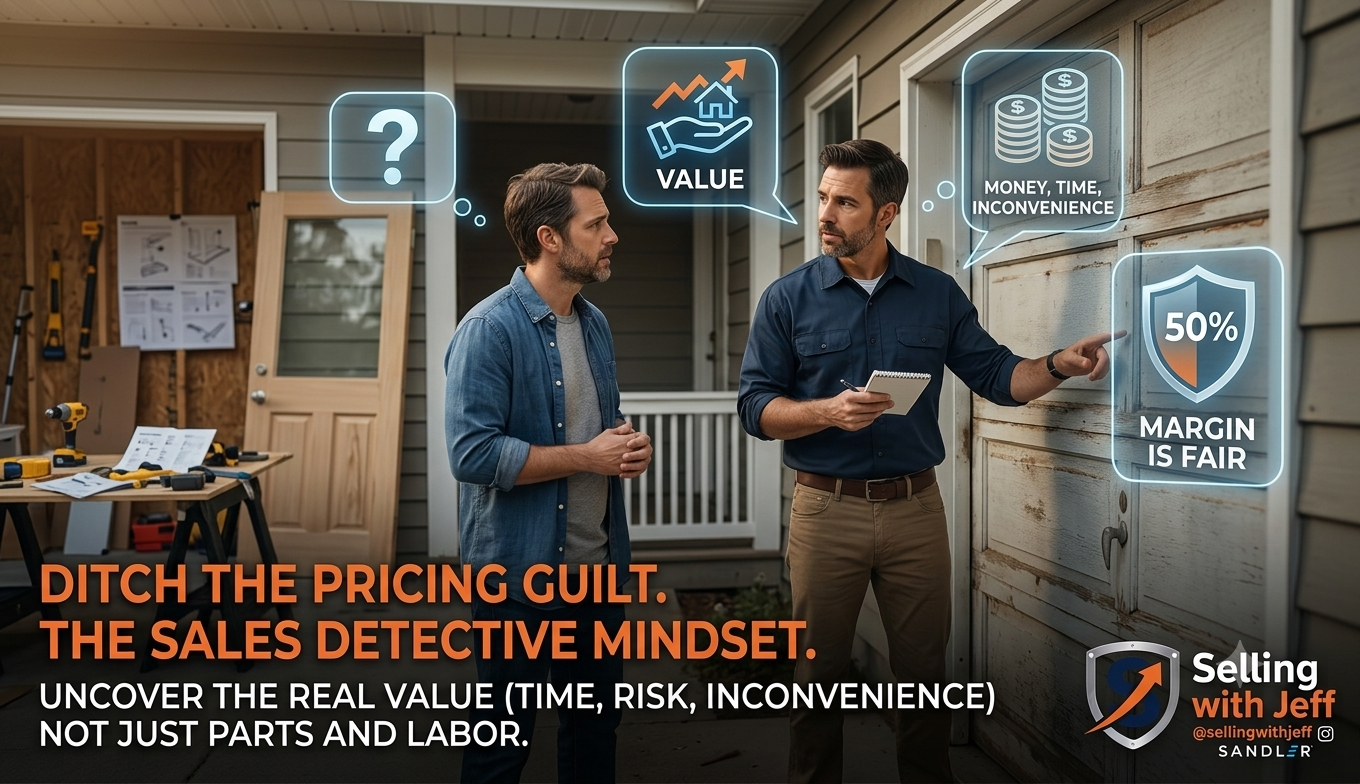
Remodeling Sales Trust: A Sandler Playbook for Faster Decisions

Redefine Trust in High-Ticket Remodeling Sales
Effective building trust in remodeling sales means treating trust as a measurable asset: you open each meeting with clear expectations, honest risks, and a simple next step. When homeowners experience you as steady, candid, and structured, decisions speed up, price fights drop, and projects actually start.
Stephen M.R. Covey’s work on trust shows that when trust rises, decision speed rises and costs fall; when trust drops, everything slows and costs increase (Speed of Trust summary). In a $150,000 kitchen, that shows up as extra design hours, more “just one more question” meetings, and heavier discounting.
Your job in the Sandler Selling System isn’t to charm people into liking you. It’s to guide them through a disciplined process—bonding & rapport, Upfront Contract, Pain, Budget, Decision—that helps them feel safe making a big decision now, not someday.
Run a Two-Minute Drill Before Every Meeting
Most remodelers walk into appointments hoping rapport “just happens.” Prospects feel that. They sense when you’re winging it. A simple two-minute drill before every call turns bonding and rapport from a vibe into a plan you can repeat and coach.
Use four fast questions:
- Purpose: Why does this meeting exist? (“Confirm fit for a full design engagement.”)
- Desired outcome: What micro-decision do you want by the end? (“Agree on paid design or a clean no.”)
- Guessed pains: What problems are likely driving this conversation? (“Outgrown kitchen, resale anxiety, past contractor nightmare.”)
- Guessed DISC style: Are they probably fast/slow, people/task?
This prep changes how you open. Instead of, “So, tell me about your project,” you can say, “Today, my goal is to understand what’s not working with your current kitchen, outline a process, and decide together whether it makes sense to move into design.” That kind of Upfront Contract builds more trust than ten minutes of small talk.
Use Ego States and DISC to Stay in Control
You’ve met the homeowner who says, “We’ve got three bids already. Why are you so high?” That’s Critical Parent energy. If you answer from your Adaptive Child—defensive, justifying—you lose control. Transactional Analysis says effective selling lives in the logical Adult, delivered with a nurturing tone.
A stronger response sounds like: “If you can get the same project for less, you absolutely should. I would. The only reason to keep talking is if there’s a chance the proposals aren’t truly apples to apples. Would it make sense to walk through the differences together?” Calm, logical, and respectful.
Layer DISC on top. A high‑D prospect trying to cut your one‑hour visit to 45 minutes needs a pattern interrupt: “We’ll probably know in 30 minutes whether this even deserves a second meeting. Let’s stop there.” A high‑C engineer considering a major addition needs slower pacing and phrases like “thorough,” “detailed,” and “roll up our sleeves.” Adapting your state and style is how you bond without becoming a pushover.
Turn Trust into Clear Next Steps, Not “Think It Over”
Most “think it overs” aren’t indecision; they’re fear of the wrong decision. Your structure has to address the buyer’s three whys: Why change? Why now? Why you? When those stay fuzzy, the safest move is delay—or going with the cheapest bid.
Start by mapping current vs. desired state. Ask, “Walk me through what’s frustrating about this kitchen today,” then, “If we were standing here in two years and this project had gone perfectly, what’s different?” Help them paint the picture, then name the obstacles between the two.
When it’s time to recommend next steps, don’t negotiate. Offer two, never three clear options: “Option A is a full design agreement at $X with Y timeline. Option B is a lighter feasibility package to pressure‑test budget and scope.” Research on decision psychology and sales shows too many options stall action (rapport insights). Fewer, well-framed choices—backed by the trust you’ve built—turn vague interest into real decisions.