
Sales Detective Mindset to Beat Pricing Head Trash
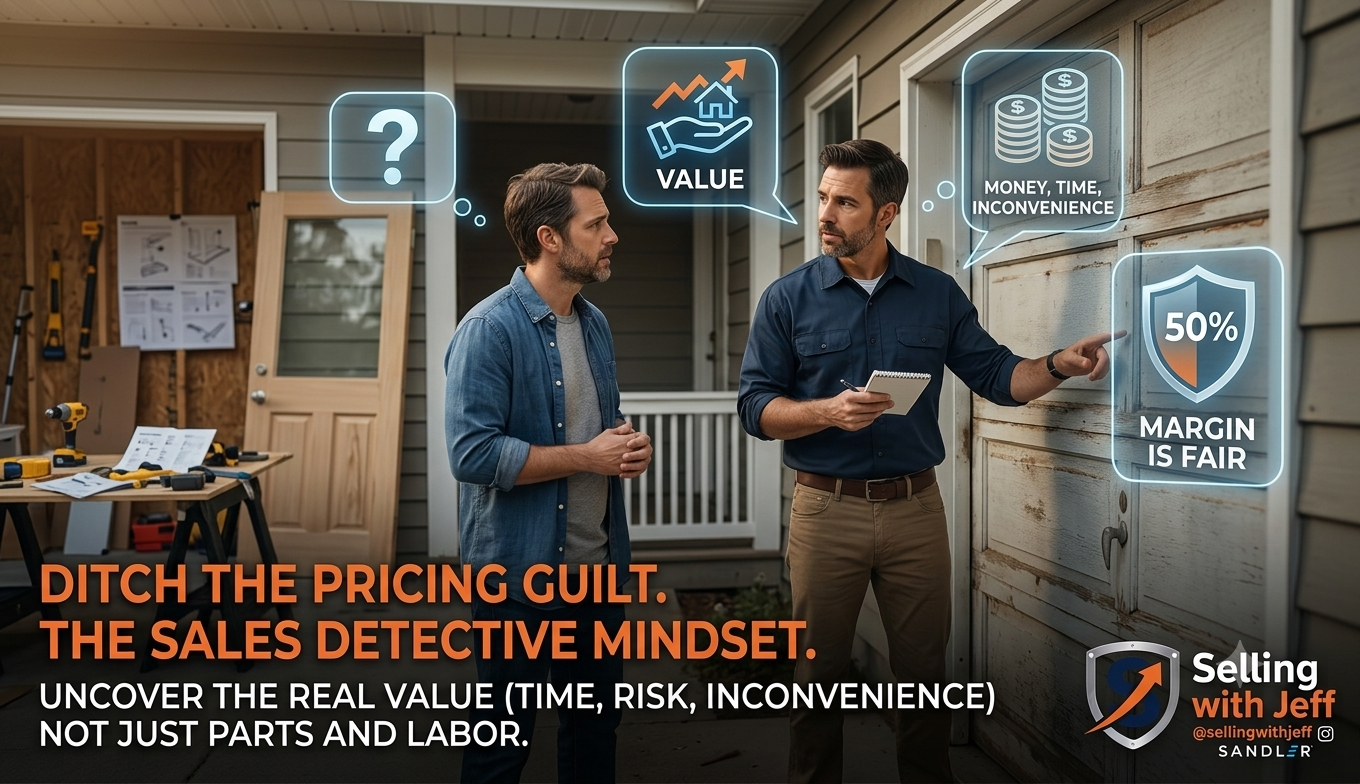
Stop pricing guilt: what a sales detective really sells
The sales detective mindset means you stop guessing what a homeowner values and start uncovering it with questions. When you understand their real problems, risks, and frustrations, your price becomes a fair investment instead of a guilty secret—especially on “simple” service jobs like a single door, window, or small repair.
Think about the contractor replacing a side garage door. On paper, it’s a half-day job with one trade. In reality, the homeowner is paying to make an annoying, sometimes unsafe problem disappear without burning a Saturday at the hardware store. A garage‑door firm that shifted from $325 average tickets (and losing money per job) to about $2,300 by focusing on full solutions, not parts, is a great example of this value shift.
Research on discovery in complex sales shows most buyers feel reps don’t uncover the real problem before presenting solutions. Sandler’s guidance is the opposite: slow down, act like a curious beginner, and let the prospect do most of the talking so you see what “expensive” or “simple job” really mean in their world (Sandler on objections).
Sell money, time, and inconvenience—not just parts and labor
When you only look at your 50% margin in dollars, head trash kicks in: “It’s just a door. I’m barely on-site. Am I ripping them off?” A sales detective frames the deal as a three-part investment: money, time, and inconvenience. Your price covers all three, not just the hardware and the crew.
Use a simple thought experiment with yourself (and sometimes with the client): could they do it themselves? Sure—but only after multiple trips to the store, watching videos, and living with a half-finished opening. That “cheap DIY” day can easily cost 6–8 hours and a lot of frustration. Many professionals will happily pay a premium to avoid that scenario.
You can even ask, “Have you thought about doing this yourself?” When they say, “No way, that’s beyond me,” they’ve just told you that time, risk, and inconvenience matter more than squeezing every dollar. In high‑trust remodels and design‑build work, the best clients nearly always value schedule and sanity above the last 10–15% of price (Sandler on risk and disruption).
Use diagnostic and investigative questions to prove your value
Detectives don’t accept the first witness statement; they ask better questions. In sales, that starts with diagnostic (yes/no) questions and moves into investigative (open-ended) questions that uncover pain, risk, and impact.
Diagnostic questions (closed):
- “Have you remodeled or used a contractor for this type of work before?”
- “Has this door or window been an issue for a while?”
Investigative questions (open):
- “Walk me through what’s not working with this door today.”
- “How do you want to use this space that you can’t right now?”
Each answer is evidence. When a client says, “We had a bad experience with a ‘Chuck in a truck’ who never called back,” or “I took time off work just to be here,” they’re telling you why a reliable, professional service is worth more than a bargain rate. Top performers who avoid late‑stage price wars do this work early: they develop pain, budget, and decision process before talking numbers (Sandler on preventing price wars).
Build conviction so 50% margins feel fair (to you and the client)
Pricing head trash usually isn’t a math problem; it’s a conviction problem. If you don’t fully believe your 50% margin is fair, you’ll telegraph doubt, discount too fast, or over‑explain. A sales detective builds conviction by lining up evidence before ever sharing a price.
Use a quick checklist before you present numbers:
- Have I uncovered surface pain (what they want), reasons (why now), and emotional impact (how it affects family, safety, or peace of mind)?
- Did we talk about all three parts of investment: money, time, and inconvenience?
- Do we both know what decision we’re trying to make today—move forward, adjust scope, or pause?
When you can honestly say, “We’re solving a real problem, saving them serious time, and making their life easier,” a 50% margin isn’t something to hide. It’s the price of doing the work right, the first time—so the client never has to think about that door, window, or repair again.