
Diagnose What’s Behind “We Have No Idea” on Budget
When homeowners say they have no budget, they’re rarely clueless; they’re protecting themselves. A remodeling budget conversation that works treats that line as a trust signal, not a roadblock: you slow down, uncover their pain, and show you’ll protect their money instead of weaponizing their number.
Homeowners have reasons to be guarded. Many have watched a contractor ask for a range, then “magically” land a proposal a dollar under their top number. Others grew up in families where you simply didn’t talk about money. In that context, “We have no idea—that’s why you’re here” is really, “We don’t know if we can trust you yet.”
Your job as the professional is to normalize that hesitation and reframe the conversation. Instead of pushing for a number, acknowledge it: “Totally fair. Remodeling costs are confusing, and you don’t want to be taken advantage of.” Then pivot to why budget matters: “If I guess wrong, I’ll either over-design and waste your time, or under-design and disappoint you.”
Industry syntheses of renovation projects show that 80–91% overrun their original budget, with typical overruns of 10–33%, according to analyses summarized in recent remodeling budget research. Framing budget as a tool to avoid becoming part of that statistic helps homeowners see you as an ally, not an adversary.
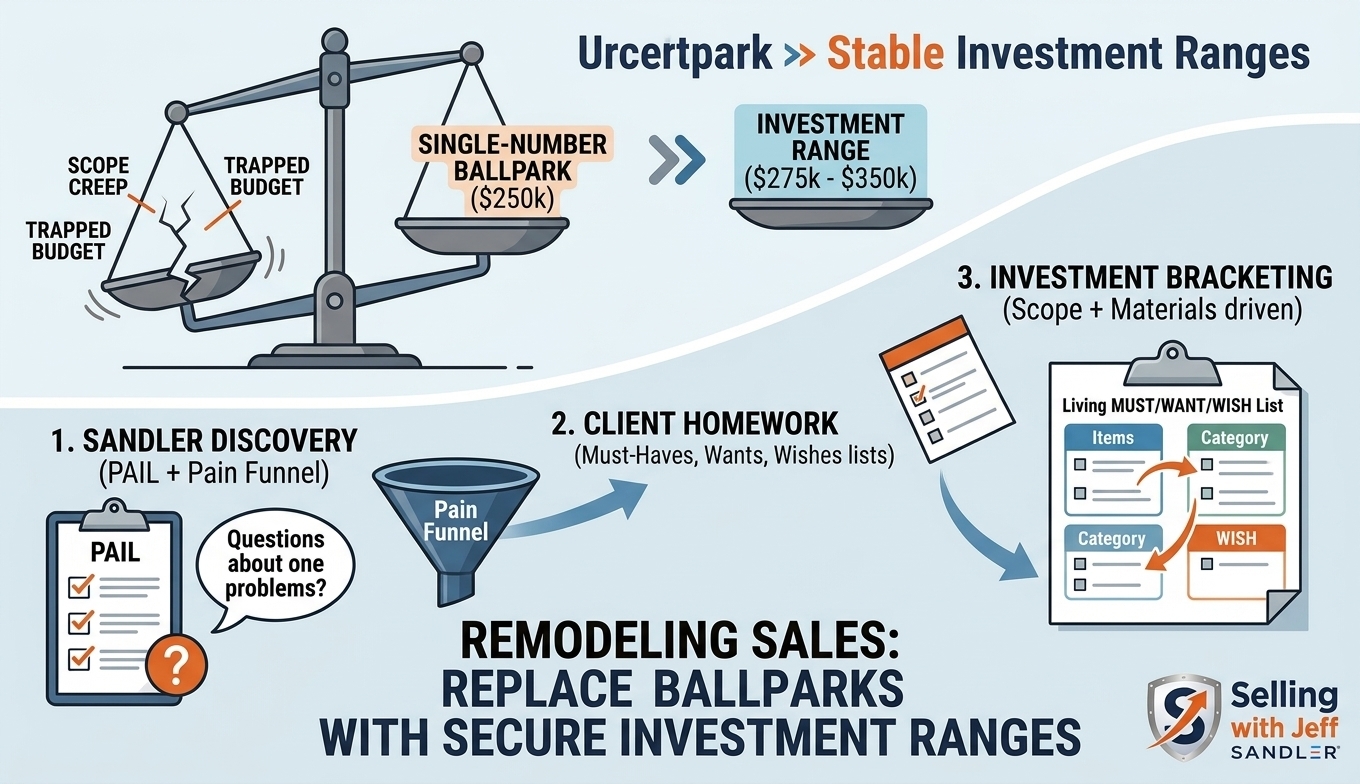
Run the Sandler Pain Funnel Before Any Money Talk
If you go straight from, “Thanks for having me out” to, “So what’s your budget?”, you’ve skipped the Sandler Pain Funnel and earned the resistance you get. The cure is sequence: PAIL-style agenda, upfront contract, then a slow, disciplined dive into why they want to change the space at all.
Sit down before you tour the house: “Before we look at the kitchen, would you mind if we talk for a few minutes about what’s not working and what you’re hoping this changes?” Then work down the Pain Funnel: how long it’s been a problem, who else is impacted, what they’ve tried, what happens if they do nothing.
For example, a client who “just needs stairs off the deck” usually isn’t buying treads and risers. They’re buying less dirt tracked through the house, fewer arguments with kids, and time saved cleaning. When you can restate that better than they can, you’ve earned the right to connect money to outcomes instead of square footage.
Only after that do you transition: “Now that I understand what this is costing you in time, stress, and family life, it probably makes sense to talk about the investment side so we don’t design something that doesn’t fit.” One Sandler-based analysis of remodelers found that when reps moved budget to the end of a thorough, trust-based visit, eight of their last ten homeowners volunteered a real range without being pushed, as reported in field observations.
Turn Budget Silence into Clear, Honest Investment Ranges
Once you’ve earned the budget discussion, you still have to get past silence and gamesmanship. This is where Sandler tools like negative reversing, third-party stories, and “homework” before the visit turn vague answers into usable ranges without pressure.
On the phone, don’t just book the in-home; assign homework: “I’ll show up prepared and on time. Could you two do one thing for me before I come—have the slightly awkward talk about what you’d be comfortable investing, and make a short list of needs, wants, and wish-list items? That way we’ll both know by the end of the visit whether this makes sense.”
In the meeting, if they still say, “We really have no idea,” you can soften it with a personal third-party story: “When my wife and I bought our first car, we didn’t know what it should cost, but we did decide what we were comfortable spending before we walked into the dealership. Have you done anything like that for this project?” You’re not lecturing; you’re modeling decision behavior.
When you sense they’re hiding the number (“You just tell us what it costs”), use a negative reverse and third-party story together: “Sounds like someone once gave you a number and then magically came in just under it. Has that happened to you?” Then contrast your approach: “Our job is to design to the investment you choose, not to stretch it. If we’re way apart, we’d both rather find that out early.”
Use Process to Protect Your Margin, Not Cheaper Prices
Even when you get a real range, you’ll sometimes be the highest number on the table. That’s not automatically a problem; it’s a test of whether your process is strong enough to justify the delta—or honest enough to walk away.
First, anchor budget to risk, not vanity. Explain, in plain English, how your contract structure protects them. For example, a fixed-price agreement on a well-defined scope usually gives homeowners more budget certainty than an open-ended cost-plus deal, where they pay actual costs plus a fee and carry most of the overrun risk, as outlined in guides like this comparison of fixed-price vs. cost-plus construction.
Then ask non-negotiable questions: “If another builder is $100,000 less, what would have to be true for that to still feel like a smart decision? What would make it absolutely not worth it?” You’re not trashing competitors; you’re forcing them to name the communication, scheduling, and quality failures they’re afraid of.
Finally, protect your own margin with clear exit gates: “If it turns out the project you want can’t be done in the range you’re comfortable investing, what would you want to do—press pause, phase the work, or look at smaller options?” That keeps you from “value engineering” yourself into an unprofitable job and positions your process as a guardrail for both of you, not a sales tactic.