Cost Certainty: Stop Losing Remodels to Cheaper Bids

Sell cost certainty, not the cheapest remodeling bid
Homeowners don’t actually want the cheapest remodel; they want cost certainty—confidence that the number they sign is the number they’ll pay. Instead of validating a competitor’s low estimate, shift the conversation to who can give a fixed, all‑in price for an agreed scope and protect the homeowner from unpleasant surprises.
A simple way to explain this is to contrast estimate‑based competitors with your fixed‑price approach. Cost‑plus or loose estimates move as real invoices roll in; a true fixed‑price contract sets one agreed total before construction and only shifts when scope changes, as outlined in resources like this custom home contract guide. In a large primary bathroom, for example, a competitor might toss out $125,000 as a rough number. You can say, “No one on earth can know the final cost before design. Our process is about giving you a firm price with cost certainty before you sign construction.”
Make the trade‑off explicit: “You can pick a lower, flexible estimate, or a slightly higher, fixed price that caps your risk.” Most financially savvy clients—including your best‑fit ones—quietly prefer the second option once it’s clearly laid out.
Use design agreements to discover the real cost together
A design agreement is not a paid proposal. It’s a low‑risk way for homeowners to discover what their dream project really costs, and then lock in a fixed price. When you present it this way, you’re selling clarity and control, not drawings.
Anchor the DA as a discovery tool. For instance: “We’ve seen bathrooms like yours come in as high as $200,000, depending on tile, fixtures, and layout changes. The design agreement is how we work together to find your exact number and then convert it to a fixed‑price construction contract.” Use concrete examples: “If you decide to add a steam shower that runs about $25,000, we’ll pause, confirm your new budget, and only then update the design. You’re in control the whole way.”
Avoid tight ranges like “$125–145K” that invite disappointment. Instead, talk about “up to” an amount and remind them that their choices move the number. That framing turns you into a guide helping them trade off scope, finishes, and budget—rather than a salesperson defending why you “missed” an early range.
Change your budget talk track when competitors are cheaper
When a homeowner quotes a competitor’s lower number, don’t validate it. Use questions that gently introduce doubt and reposition your value. You’re not attacking the competitor; you’re testing whether that price is real or just hopeful.
You might ask, “Is that $125,000 a fixed price that’s guaranteed, or more of an estimate?” Follow with, “When you asked how often their projects actually finish at that number, what did they say?” Even if you know they never asked, that presumptive question forces them to see the difference between a guess and a commitment. Be ready with your own data: for example, what percentage of your fixed‑price projects finish within the original contract when scope doesn’t change.
Walk them through a clear scenario: “If we sign construction at $185,000, that’s the number unless you add scope. Many builders sign you up at a lower estimate, then bill cost‑plus. If things run long or materials spike, your cost climbs—not theirs.” When you consistently frame conversations this way, you lose fewer design agreements to unrealistic low bids.
Engineer client introductions so you don’t chase “more leads”
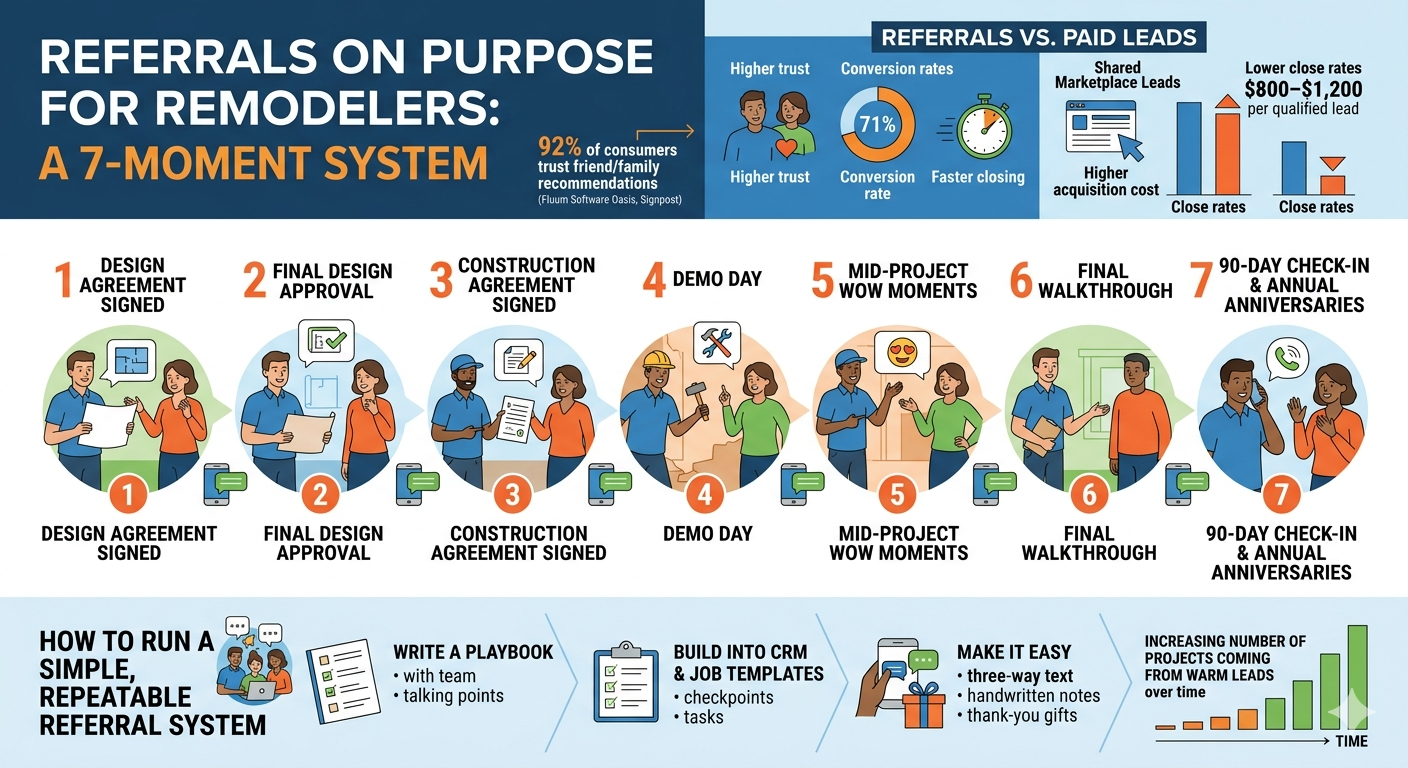
Most remodelers who say they need more leads actually need better leads and a stronger sales process. Warm introductions from current clients are almost always your best opportunities: they arrive trusting you more, move faster, and argue less about price.
Industry data backs this up. Remodeling referral analyses consistently find that referred leads close 3–5x more often than cold or paid digital leads and at roughly 10–15% higher gross margins, according to a Sandler referrals guide for remodelers (Sandler referrals system). Another study cited by Sandler reports referred opportunities closing at about 26% vs 9% for non‑referred once both reach a true sales conversation (Referrals in Remodeling).
Build a simple introduction plan tied to project milestones. Ask right after signing the design agreement (“Who else do you know who hates their bathroom as much as you did?”), at final design approval, and on demo day—when excitement is highest and neighbors are literally wandering over to look. Offer to host a casual “demo party” with pizza; have hard hats and mini‑sledgehammers for kids while you quietly meet their parents. A few such events a year can generate multiple high‑quality introductions without spending another dollar on ads.