
Referrals in Remodeling: How to Ask and Actually Get Them
Why referrals beat cold leads for remodelers
Referral leads in remodeling convert far better than cold leads because trust arrives pre-installed: referred prospects are warmer, decide faster, and usually fit your ideal client profile more closely than strangers from ads or lists. A simple, repeatable referral ask can quietly become your highest-ROI prospecting channel.
For a design-build or remodeling company, the math is too strong to ignore. Research shows that referred leads often close 3–4 times higher than cold leads, with close rates around 26% vs. 9% once both reach a real sales conversation, according to Sales Gravy. Another analysis found that warm referrals can produce 10x more clients from 10x fewer prospects than cold outreach alone, because response and meeting rates are dramatically higher (Rhythm of Business).
In day-to-day remodeling work, you already see this. The best new projects usually come from past clients or their close friends: they show up with context, they’ve seen your work in a real home, and they arrive pre-sold on your process. Contrast that with a cold web inquiry that ghosts after the first proposal review.
Despite this, most remodelers still treat referrals as happy accidents. Designers and project managers tell themselves, “Sales will handle it,” or “I’ll ask once the project is done,” and then the dust, schedules, and job issues get in the way. In the transcript above, the team even admitted they promised to ask for two referrals—and then simply didn’t.
The opportunity is to turn referrals from random into routine. That means two things: first, understanding how clients actually experience change, and second, giving your team a simple script they can remember in the moment, not a complex marketing program they’ll never use.
When you combine those two, every designer meeting, concept review, or warranty check-in becomes a quiet engine for new, high-quality work.
The LEAD framework: a simple way to ask for referrals
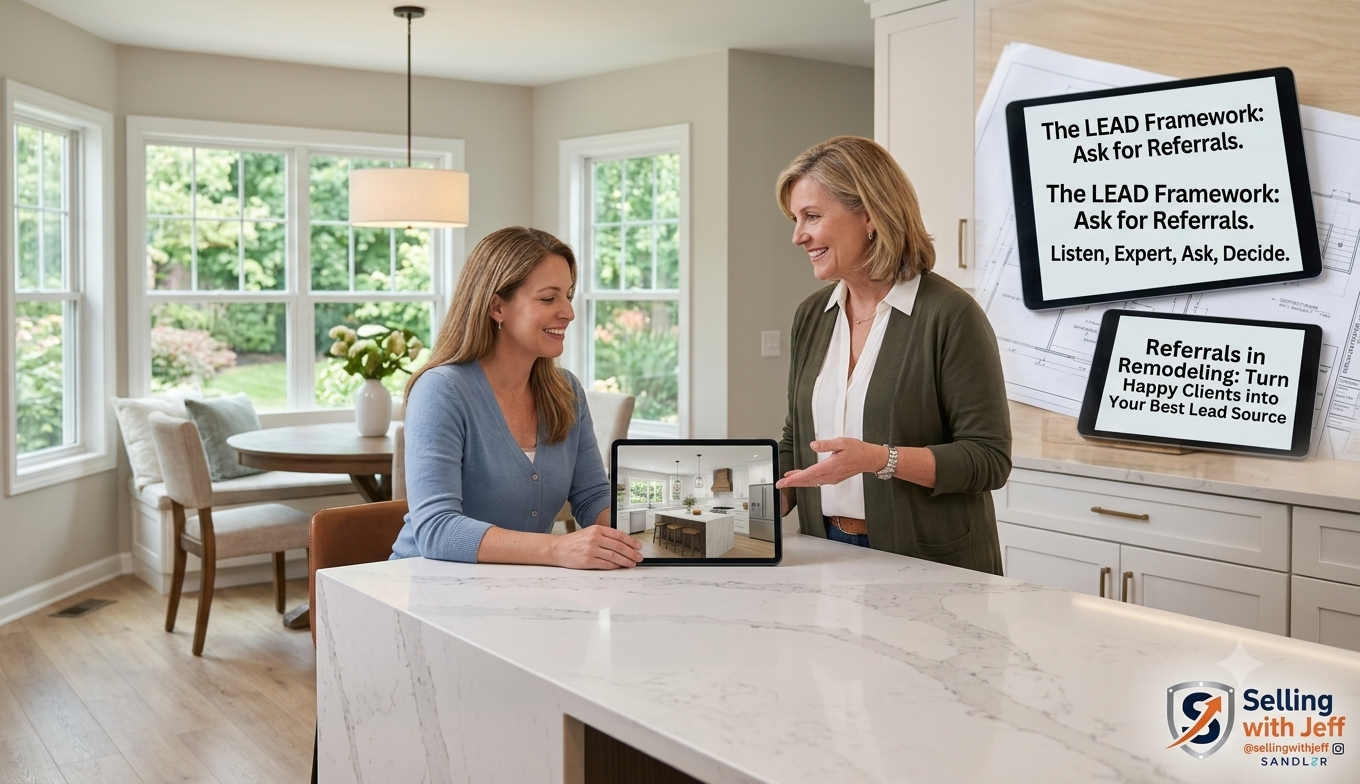
The LEAD framework makes asking for referrals simple and repeatable: you ask clients to Listen for pain like theirs, position you as an Expert, Ask if the friend would take your call, and let that friend Decide whether to keep talking—no pressure, just a guided introduction.
In the session captured in the transcript, the trainer distilled referral selling into one memorable acronym: LEAD. For busy designers and project managers, this turns a vague “I should ask for referrals more” into a concrete, four-step micro-conversation.
Here’s how LEAD breaks down:
- L – Listen. Ask the client to listen for people describing the same problems they had. For example: “Would you listen for friends or neighbors who say things like, ‘I hate facing the wall at my sink,’ or ‘Our kitchen is so chopped up that only one person can cook at a time’?” This anchors them in real phrases, not abstract “someone who needs a remodel.”
- E – Expert. Ask them to mention that they know an expert who solves those problems. “If you hear that, would you let them know you worked with a team that specializes in fixing cramped, outdated kitchens?” This transfers their trust in you.
- A – Ask. Crucially, you’re not asking, “Will they call me?” You’re coaching them to ask, “Would you be open to taking a quick call from our designer?” That one shift—from “call them” to “would you take their call?”—dramatically increases follow-through.
- D – Decide. Finally, you remove pressure: “Make sure they know there’s no obligation. They get to decide if we keep talking after that first conversation.” This mirrors the Sandler-style front contract and keeps the interaction comfortable for everyone.
In practice, a designer might say to a happy kitchen client:
“We’ve learned that our best future clients usually come from the people we’ve taken great care of. Would you be willing to listen for friends or family who say things like, ‘Our kitchen feels cramped,’ or ‘We can’t see the family or the yard from the sink’? If you hear that, would you tell them you worked with a team that specializes in fixing exactly that—and ask if they’d be open to taking my call? They’d always get to decide if we keep talking. No pressure.”
That’s LEAD in one short, memorable paragraph. It gives your client a clear mental checklist and keeps the referral process aligned with how people naturally talk about pain and solutions in real life.
Exactly when and how to ask remodeling clients for referrals
The best time for remodelers to ask for referrals is when the client’s satisfaction is peaking—often right after they decide to move forward or when they see a compelling design concept—rather than waiting until construction is completely finished and daily disruption has worn them down.
In the transcript, several team members hesitated to ask new clients for referrals because they felt they “hadn’t earned it yet.” The trainer pushed back, explaining that satisfaction typically spikes right after the buying decision—when the client signs the agreement or falls in love with the design—and then dips during messy construction before rising again post-completion.
That “excitement spike” is gold for referrals. At that moment, the client is relieved they finally made a decision, hopeful about the future space, and grateful that someone understood their pain (“I hate facing the wall,” “We’re always tripping over each other,” “I want to see the grandkids while I cook”).
In a design-build context, you can build a few standard referral checkpoints into your process:
- After concept approval. Once the client chooses a layout—like moving the sink to a peninsula so they can see the backyard—you can say, “Clients who are this excited often have friends with the same problems. Could I ask a quick favor?” and go into LEAD.
- At the pre-construction meeting. Before the dust starts, reinforce their decision and ask them to listen for people complaining about clutter, safety, or aging-in-place concerns.
- At warranty or three-year check-ins. When you call to schedule a warranty visit, start with, “Are you still loving the kitchen?” After they affirm, use LEAD tailored to their specific results (“extra counter space,” “no more tripping over each other”).
For past clients, a short phone call can work like this:
“We’re not calling because we expect you to do another project. We just know that most of our favorite new clients come from the people we’ve already taken care of, which made me think of you. Out of curiosity, have you run into any friends or neighbors who are frustrated with their kitchen layout the way you were—cramped, facing the wall at the sink, not enough counter space?”
If they say yes, you simply continue through Expert, Ask, and Decide.
To make this stick operationally, document where LEAD lives in your workflow: add a “Referral asked?” checkbox to your design presentation template, include a referral script reminder in your meeting agendas, and capture referral outcomes in your CRM. That ensures referrals aren’t just good intentions; they’re a measurable behavior.
Handling discomfort and staying consistent with referral asks
Many remodelers avoid asking for referrals because it feels salesy, but when you frame the conversation around client success and agency—highlighting their judgment and relationships—it actually boosts their confidence and makes the ask feel like a compliment, not a plea.
In the discussion, several people admitted they “failed” to ask for referrals, even after committing to do so. Underneath that is a common story: “I’ll sound pushy,” or “I’m putting my hand out.” The trainer reframed it powerfully: when you ask for referrals, you’re subtly telling the client, You’re smart, well-connected, and I trust your judgment about who would be a good fit. That recognition feels good.
To reduce discomfort and improve consistency:
- Normalize the ask as everyone’s job. The group acknowledged that while a salesperson might lead initial opportunities, designers and project managers spend more time in the home and build deeper relationships. Make it explicit in team meetings: everyone shares responsibility for generating opportunities.
- Use questions instead of speeches. In the role-play, the manager coached a rep to replace long monologues with short, empathetic questions: “Are you still loving your kitchen?” “Have you heard anyone else complain about the same things you used to?” Questions feel conversational, not pitchy.
- Practice out loud. The team joked about “Yoda-ing it”—saying they would try and then not doing it. Role-play in meetings the way they did, taking turns asking for referrals using LEAD, so the words feel natural in your own voice.
- Track behavior, not just results. You can’t control whether a client actually introduces you, but you can control whether you asked. Use a simple metric—asks per week per designer—and celebrate the behavior. Over time, the 3–4x higher conversion rates on referred leads will make the payoff obvious.
When your whole team sees referrals not as awkward favors, but as respectful, confidence-boosting conversations with happy clients, the behavior becomes sustainable. Combined with a simple framework like LEAD and clear moments in your process to ask, referrals evolve from “something we mean to do” into a steady, predictable engine for profitable growth.