Sandler Budget Step for Remodelers: Stop Losing Control
Why homeowners hide budgets and why the Sandler budget step matters
A Sandler budget step works when you ask about money only after building trust and uncovering pain, then agree on time, money, and resources before you ever design or propose. In remodeling, that shift protects your margins, prevents scope creep, and stops you from building detailed estimates for projects that were never real.
Most homeowners are not trying to be difficult when they say, “We have no idea what this should cost—that’s why you’re here.” They’re protecting themselves. Many have watched a contractor “magically” come in a dollar under whatever number they once shared. Others grew up in families where you simply didn’t talk about money. So when you ask, “Have you had a chance to think about your investment yet?” it triggers old stories about negotiating and not wanting to be taken advantage of.
On top of that, remodeling pricing is genuinely confusing. TV shows normalize $60,000 kitchens that would be $150,000 in your market. AI design tools now spit out photorealistic concepts that ignore load‑bearing walls and structural realities. In that context, it’s not surprising prospects hesitate; they’re trying not to look foolish.
This is why Sandler insists on sequence. You earn the right to talk about budget only after you’ve connected as humans, uncovered real pain, and agreed on a clear process for the meeting—your upfront contract. One experienced remodeler in the source conversation shared that when he moved the budget step to the end of a thorough, trust‑based visit, eight of his last ten homeowners volunteered a real range. Nothing else in his process changed.
The budget step, then, is not a script. It’s a trust test. If you’ve done the bonding and rapport and pain work well, money becomes just another part of the plan. If you haven’t, budget questions feel like an interrogation—and buyers either stonewall, lowball, or disappear.
Five magic budget questions that earn real numbers in remodeling
Magic budget questions are simple, human, and rooted in the way real couples talk before they ever call a contractor. Used in sequence, they help homeowners feel safe enough to move from “no idea” to a usable investment range without turning your visit into a haggling match.
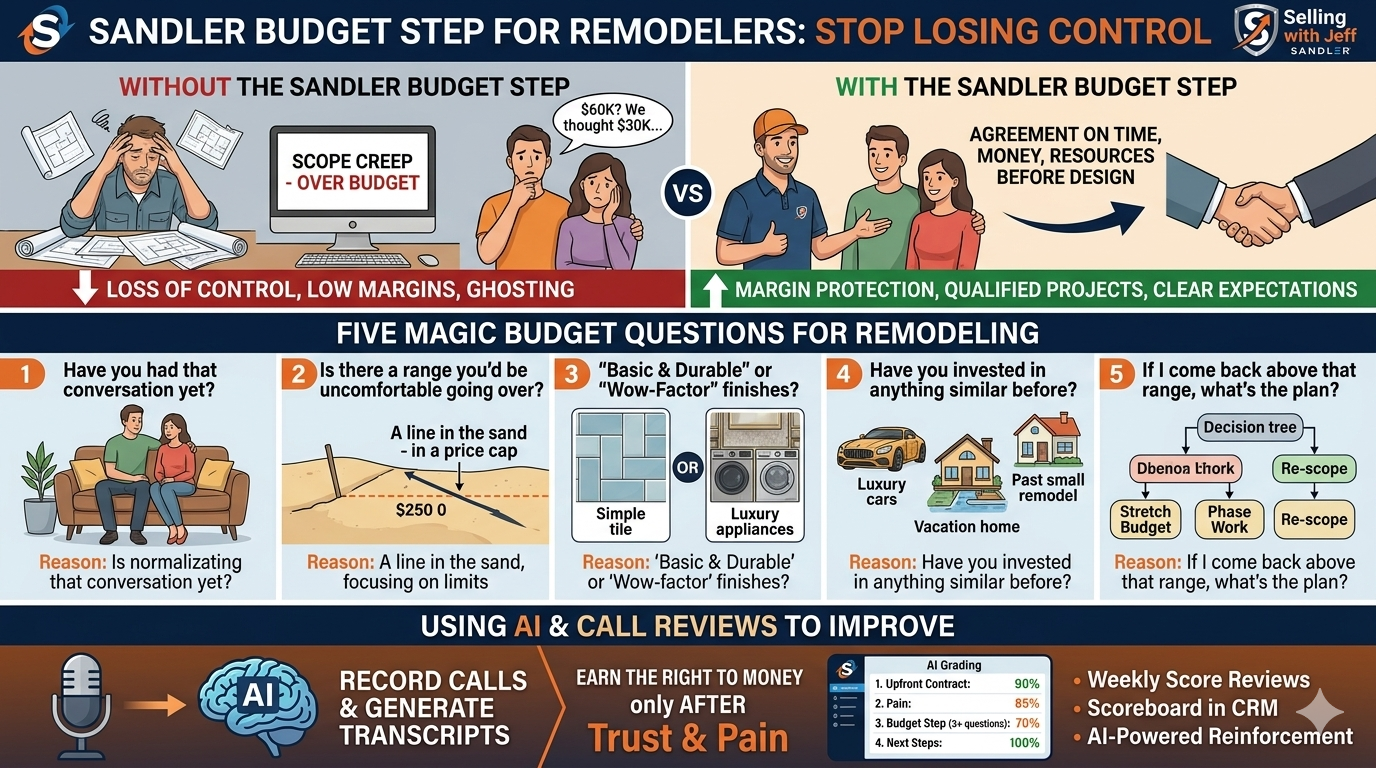
Start by normalizing the conversation: “Before my wife and I ever have anyone out to the house, we always talk about what we think it’s going to cost. We’re usually wrong, but we still have that conversation. Have the two of you talked about what you’d be comfortable investing?” That framing does three things: it humanizes you, signals that guessing is normal, and makes “yes” or “no” the only required answer.
From there, you can move into five focused questions:
- “Have you had that conversation yet?” This is the opener. If they say yes, you follow up. If they say no, you can gently explore why, or ask what’s made it hard to talk about.
- “Is there a number or a range you’d be uncomfortable going over?” People often won’t tell you what they want to spend, but they will tell you their ceiling. One Sandler article on remodeling budgets notes that ceilings are far more reliable than “ideal” numbers because they reflect real fear, not wishful thinking.
- “Are you thinking more ‘basic and durable’ or ‘wow‑factor, Sub‑Zero and coffered ceilings’?” As one builder in the transcript put it, tossing out specific options—appliance brands, finishes, ceiling details—helps prospects realize why you need a baseline and that different choices change price dramatically.
- “Have you invested in anything similar before—like a car, a past remodel, or a vacation home?” Buyers almost always anchor big purchases to something familiar. Getting that out into the open helps you see whether they’re imagining a $60,000 SUV or a $250,000 lake house.
- “If I come back with a plan that solves everything we talked about, but it’s above that comfort range, what would you want to do?” This pre‑handles the “think it over” and gives you a sense of whether they’ll stretch, phase the work, or walk.
When a prospect still says, “We honestly have no idea,” don’t panic or punish them. Take a coaching stance: “Without some sort of range, I don’t know where to begin. Are we talking about replacing everything down to the studs, or keeping the layout and making smart cosmetic upgrades?” Then walk through two or three concrete paths with rough order‑of‑magnitude ranges, so they can react to something real instead of hiding behind “no idea.”
What you want to avoid is turning your website into a price list. In the source discussion, a remodeler who posted sample scopes with ranges like “Kitchens from $110,000” watched close rates slide because prospects fixated on the lowest number and accused him of lying when real bids came in higher. If you publish ranges at all, phrase them as “up to” (for example, “Projects like this can be up to $140,000”) so delivering under the cap makes you a hero instead of a villain.
Finally, protect your design value. AI concept images before a paid design agreement feel exciting, but they quietly teach prospects that serious design is easy and cheap. Several trainers report that firms using free AI renderings saw design‑to‑build conversion drop by roughly 40%, because homeowners felt they’d already “got the big idea” without paying.
Using AI and call reviews to improve your budget conversations
AI will not replace professional sellers in complex remodeling, but salespeople who use AI will easily outperform those who don’t. The most powerful use case isn’t writing emails; it’s diagnosing how you actually handle the budget step in live conversations and tightening your process.
One remodeler in the conversation records every sales call, feeds the transcript into multiple AI engines with a custom rubric, and gets a numerical “probability of closing” based on ten criteria: talk‑time ratio, upfront contract, depth of pain, completeness of the budget step, clarity of next steps, and more. Each week, he and his teammate review their scores and clips, adjust their questions, and aim to move that number up. That is Sandler reinforcement, powered by software.
You can do a lighter‑weight version starting this week:
- Use an AI note‑taker in every discovery or in‑home visit. Explain to homeowners that it lets you focus on them instead of scribbling. Offer to share the summary.
- After the call, paste the transcript into a trusted AI tool and ask it to grade: Did you clearly set an upfront contract? Did you uncover at least three pains and their impacts? Did you use multiple budget questions and get a range? Where did you jump to presentation too soon?
- Keep a simple scoreboard in your CRM: percentage of calls where you reached a real budget range before designing or estimating. Track how that correlates with design agreements signed.
Research from Sandler’s own budget‑step coaching shows that reps who consistently complete at least one full pain funnel and ask three or more budget questions close opportunities at materially higher rates than those who skip straight to solution. In internal analyses, the same teams found that role‑play scores were actually 2–5% higher than real‑world call scores—meaning if you’re sloppy in practice, you’re even sloppier with live prospects.
AI tools can also remind you of the human side. Many models now let you constrain where they pull data from, so you’re not relying on unverified social posts or random Reddit threads about “what a kitchen should cost.” Use those capabilities to build prompts grounded in your own job cost history, market pricing, and Sandler language, then let the model suggest better ways to phrase tough questions like, “How will seeing a detailed price breakdown help you make a better decision?”
Most important, remember that no tool replaces trust. The hinge pin of the whole Sandler system is still the upfront contract: being crystal‑clear about what you’ll talk about, how long it will take, what decisions (including money) are on the table today, and what happens next. When you get that right, the budget step stops feeling like a negotiation and starts feeling like what it really is: two adults planning an investment together.