Paid Design vs. Feasibility: Smarter Remodeling Sales
Clarify your design, feasibility and “three-step” offers
A paid design agreement or feasibility step in remodeling is a structured, low-risk way for homeowners to clarify scope, budget, and fit before full construction. It should trade vague ballparks for one clear concept and a price range, not turn into unlimited free design disguised as a $2,500 teaser.
In the transcript, the team is wrestling with two models:
- A traditional design agreement at roughly 3% of the project’s midpoint budget (e.g., a $400,000 scope leading to a ~$12,000 design fee).
- A “three-step” entry at $2,500 for concepts and a budget check, with a money-back guarantee and the expectation that later phases will get them up to the same 3% total.
On paper, this sounds like a smart on-ramp: lower barrier to entry, concepts for people who are “just not sure yet,” and a chance to prove your process. In practice, two concrete problems show up:
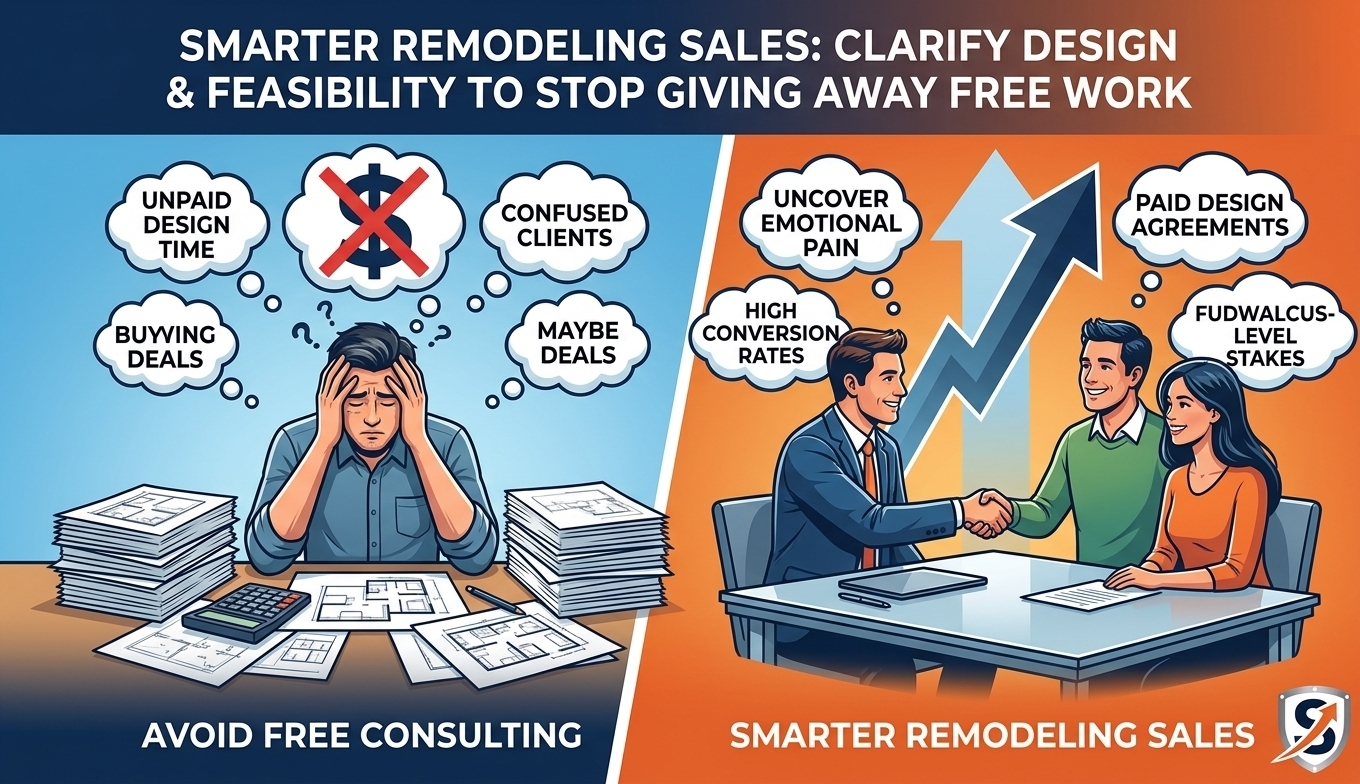
- Scope creep inside the cheap step. Designers are delivering multiple concepts (good / better / best or different area combinations) plus subcontractor estimates. That’s thousands of dollars of unpaid or underpaid labor.
- Refund risk and lost opportunity. Because the $2,500 is refundable, prospects can walk away after consuming real design time. In the transcript, one family literally buys another house, leaving the remodeler with sunk costs and zero revenue.
Industry research backs up the risk of fuzzy “quasi-free” design. One article on honest design agreements for remodelers explains that homeowners assume a design fee buys beautiful drawings and a buildable plan that fits the vague number in their head. When the final design prices much higher, they feel misled, even if you did great work. Similarly, architects who charge for feasibility point out that a free quote is a sales tool, while a paid study is real work that reduces risk for both sides.
The lesson: you need clear, named offers. A feasibility study is one concept and a 60–70% accurate range for complex or uncertain projects. A full design agreement is the in-depth design and selections process that pins down a buildable fixed price. A “three-step” hybrid is only helpful if you define what’s inside each step—and what’s not—so you don’t silently drift into free design.
Use the Sandler pain funnel to uncover real remodeling pain
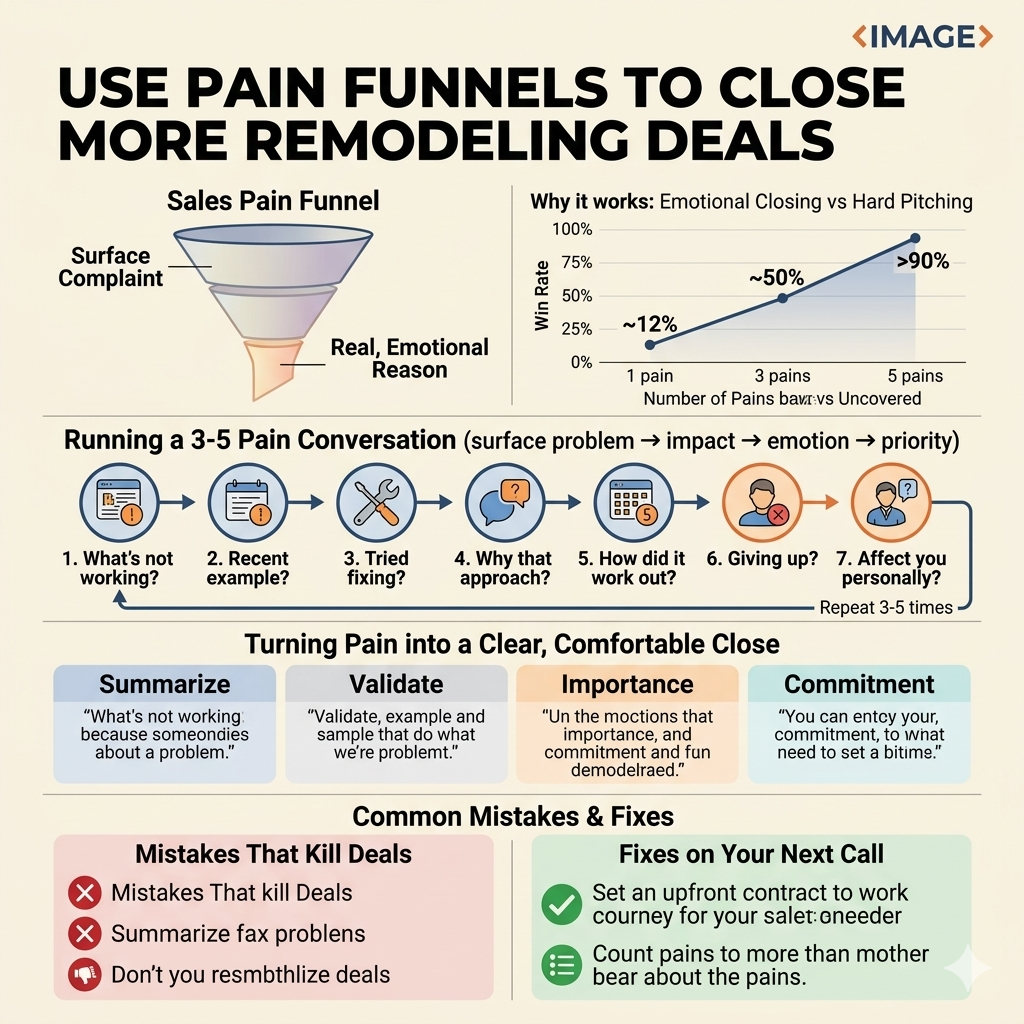
The Sandler pain funnel is a short sequence of follow-up questions that moves from surface complaints ("our kitchen is outdated") to specific, emotional, and financial impacts ("we’re embarrassed to have people over"; "we eat out three nights a week"). Used consistently, it raises close rates and justifies paid design.
In the session, the trainer introduces a remodeling-specific pain funnel:
- Expand: “Can you tell me more about that?” “Can you give me an example?”
- Time: “How long has this been a problem?” followed by “What makes now the right time to fix it?”
- Cost/Impact: “How is this affecting daily life or family time?”
- Fix attempts: “What have you tried to do to solve it?” and “Did that work?”
- Feel: “How does all of that make you feel?”
They even name nine emotional triggers with the acronym FUDWALCUS: frustrated, upset, disappointed, worried, anxious, concerned, annoyed, hate, and struggling with. Internal call reviews cited in another article show that when remodelers uncover at least three distinct pains and real impacts, close rates into paid design can jump to around 84%, versus far lower numbers when they stay at surface level.
In the transcript’s role-play, simply asking “What makes now the right time?” and “What happens if it’s still like this in two years?” pulls out real stakes: kids in school they don’t want to move, constant restaurant bills, and the regret of putting up with a broken kitchen for another decade. That emotional clarity makes a $15,000 design agreement—or a non-refundable feasibility study—far easier to accept.
The key connection: when your team skips the bottom third of the pain funnel (feelings, impact over time, failed fixes), prospects see design as a nice-to-have drawing exercise. When you do the full funnel, they see paid design as the safest way to stop living with a problem they’re truly tired of.
Price feasibility and design so you stop giving away free work
A healthy remodeling sales process uses paid feasibility and paid design to filter in serious homeowners without turning your designers into unpaid consultants. The transcript exposes three traps to avoid:
- Too many options for too little money. Providing three kitchen schemes or multiple whole-house combinations for $2,500 erodes margins. Cognitive science calls this the paradox of options: more choices can slow decisions and increase indecision.
- Refundable work that trains prospects to shop around. Offering to refund the entire $2,500 if they don’t move ahead means some buyers get free drawings and budget conversations they can use elsewhere, even if they never receive full construction documents.
- Using “cheap design” as a convincing tactic. The trainer reminds the team: “It is not your job to convince anyone of anything.” Using a low-fee, refundable step to “talk them into” working with you replaces qualification with persuasion—and often backfires.
Compare this with how many architecture and design-build firms structure their offers:
- Feasibility study (paid, non-refundable): One focused concept, basic code/zoning check, and a roughly 70% accurate cost range—especially useful when scope or constraints are unclear.
- Full design agreement (3–8% of project budget depending on scope): Iterative design, selections, coordination, and detailed pricing that leads to a buildable set and a fixed construction contract.
An architect writing about feasibility studies makes the point that a free quote and a paid study are not the same product. The free quote is a sales tool; the study is real design and risk management work. Your own data should support this distinction. For example, in the transcript, the team has roughly four to six three-step projects started, with only two moved to contract and two lost—a tiny sample, but already a warning sign that the inexpensive step may not be pulling its weight.
A more sustainable structure is:
- Reserve feasibility or a three-step process for complex, uncertain, or borderline-fit projects—not straightforward kitchens or baths where you already know accurate ranges.
- Make the fee non-refundable, but creditable toward full design or construction.
- Limit deliverables to one best recommendation at this stage, not good/better/best.
That way, you protect design time, set clear expectations, and keep the perceived value of your expertise high.
AB test your sales process without confusing qualified buyers
AB testing your sales process is smart—especially in uncertain markets—but only if you track outcomes and avoid muddying your offers. The remodeler in the transcript is doing the right thing by experimenting; the risk is letting the experiment drift into the default.
Four concrete guardrails make AB testing around design fees safer:
-
Define when to use each path. For clean, familiar scopes (e.g., a standard high-end kitchen), aim straight for the full design agreement, grounded in a solid pain conversation and a clear budget. For complex, multi-option or technically uncertain projects (townhouses with sprinklers, additions near creeks, unusual structures), offer the feasibility / three-step path.
-
Name and script your experiments. Everyone should be able to explain, in one sentence, what a “three-step design agreement” is, what it costs, and what the homeowner gets. This prevents ad hoc promises like “we’ll just explore a couple concepts” that quietly balloon into unpaid work.
-
Measure conversion at each stage. Track how many:
- Inquiries turn into feasibility or design agreements.
- Feasibility / three-step deals convert into full design.
- Design agreements convert into signed construction contracts.
Compare cohorts over at least 6–12 months before declaring a winner.
-
Protect your main process from “discount creep.” If reps start leading with the $2,500 three-step for almost everyone, you’ll see design agreement revenue drop and free-design expectations rise. Set a target percentage for how many deals should enter via full design vs. feasibility, and review that in your sales huddles.
Remember the trainer’s core framing: sales is helping qualified homeowners make confident decisions, not convincing the wrong people with cheaper offers. A strong Sandler-style process—PALO to set the meeting, pain to uncover FUDWALCUS-level emotion, budget and decision before heavy design work—lets you charge appropriately for your expertise.
If you tighten your pain conversations, clarify feasibility vs. design, and treat experiments as data-driven tests instead of permanent discounts, you can become the “clearest, safest choice” in your market without giving away your designers’ best work for free.