
Advanced Sandler Pain Funnel for Remodelers
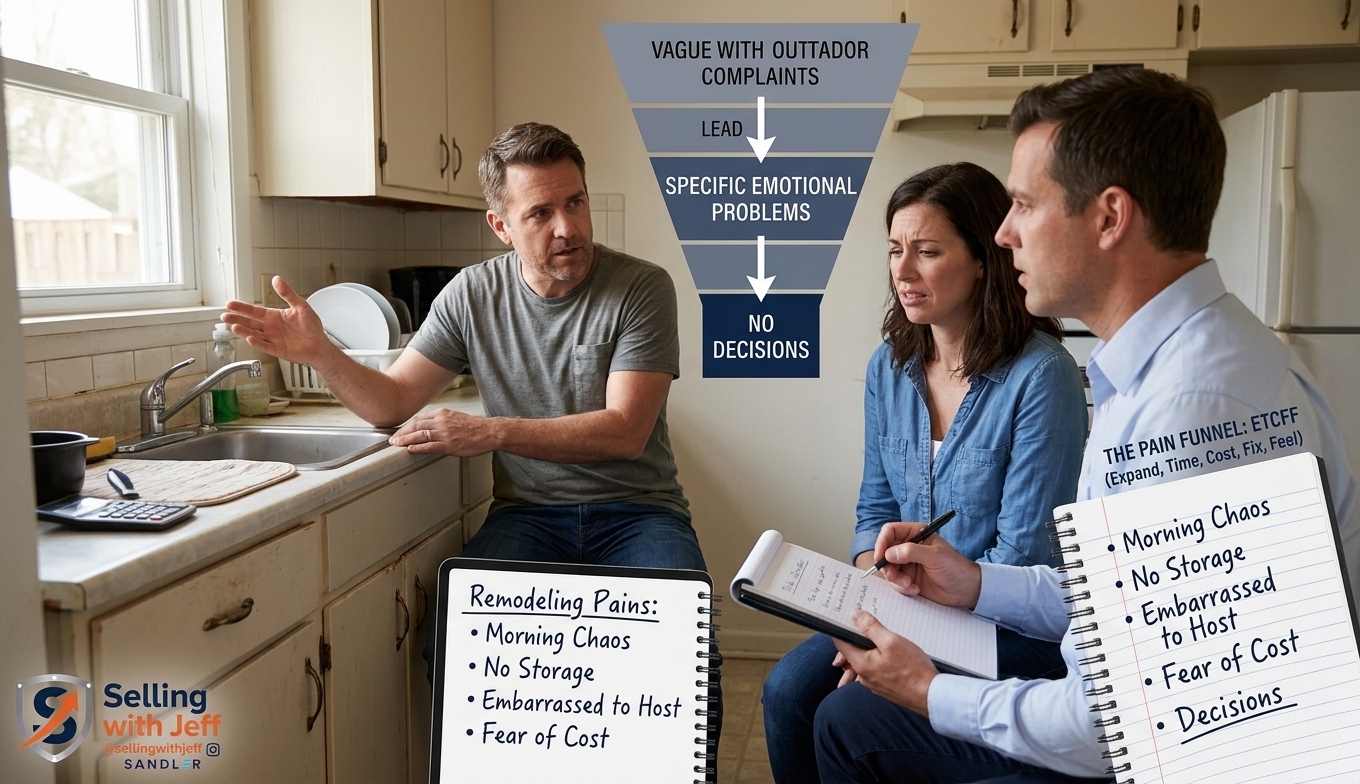
Locking pain into your sales process so it happens every time
The Sandler Pain Funnel is a structured questioning sequence that takes homeowners from vague complaints to specific, emotional reasons to act now, so you qualify hard, protect your time, and win better projects without pressure. When you run it well, you stop doing unpaid design work for people who were never going to move forward.
If you’re like most remodelers, you don’t avoid the pain step because you’re lazy. You avoid it because you’re human.
You’ve been burned by long, meandering calls that ended in a “think it over.” You’ve watched yourself stay too long with a prospect you emotionally needed to close. Or you’ve felt that awkward spike in your throat when it’s time to ask, “How does this affect your family?” and defaulted back to square footage and cabinet lines.
Sandler’s own internal call reviews have shown that most trained reps ask the top-of-funnel questions but fewer than 10% consistently go deep on impact and consequences. The result is predictable: full pipelines, weak urgency, and decisions that drag on for months.
So we stop relying on willpower. Instead, we trap ourselves into doing real pain work.
Here’s the move: you hard‑wire pain into your agenda.
- Open with a tight Upfront Contract.
- Then say, “Before we talk design or budget, I’d like to really understand what isn’t working today. Fair?”
- Ask a broad entry question: “What was going on that made you reach out about the kitchen now instead of just living with it another year?”
- As they answer, write down every pain indicator where they can see it: dysfunctional layout, no storage, embarrassing finishes, chaos with kids, fear of cost overruns.
You’re not winging it anymore. You’re building a visible list that you will run your pain funnel through.
Jeff Borovitz talks about this explicitly in Make the Sandler Pain Funnel Feel Natural. When you commit to capturing at least three pains every call, you stay in discovery long enough for the homeowner to sell themselves on changing now.
The goal in this step isn’t to be clever. It’s to create a non‑negotiable trigger: once pains are on the page, you owe it to both of you to walk through them, not jump to design ideas.
Running the ETCFF pain funnel without sounding like an interrogator
The Sandler ETCFF pain funnel—Expand, Time, Cost, Fix, Feel—is a five‑bucket question framework that keeps you conversational while you go deep on what isn’t working, how long it’s been true, what it costs, what they’ve tried, and how it feels. Instead of bouncing between random questions, you move methodically without sounding scripted.
Most of you know the classic pain questions: “Tell me more,” “Can you give me an example?”, “How long has that been an issue?”, “What have you tried to fix it?”, “Did it work?”, “How does that affect you?” The problem is, when you’re in front of a real family in a cramped, ugly kitchen, those questions can suddenly feel stiff or intrusive.
That’s where ETCFF comes in.
Here’s how you translate the transcript you just read into field‑ready, advanced questioning.
E – Expand
You start by expanding each pain indicator they gave you.
- “You mentioned mornings are chaos. What’s actually happening between 7 and 8 a.m. in here?”
- “You said you’re embarrassed by the kitchen when people come over—what specifically bugs you the most?”
You’re painting a picture so vivid that someone reading your notes could “see” the scene. In Jeff’s ETCFF article, ETCFF Pain Funnel: Talk Less, Close More Remodels, the top remodelers he profiles don’t ask fancier questions; they just hang out longer in this expansion step.
T – Time
Next you bring in the time element.
- “How long has it been like this?”
- “When did it move from ‘annoying’ to ‘we’ve got to fix this’?”
Time does two jobs: it shows how patient they’ve been, and it exposes whether this is a passing annoyance or a real breaking point.
C – Cost
Cost is not just money. In the transcript, you heard real examples: not hosting family, constantly pre‑prepping meals, feeling stressed instead of present with kids.
So you ask:
- “What does living with it this way cost you in time every week?”
- “What are you saying no to because of this space?”
That’s where homeowners start to hear themselves admit the real trade‑offs.
F – Fix
Now you ask what they’ve tried.
- “What have you done so far to make it work better?”
- “Have you talked with other remodelers or designers? How did that go?”
In B2B contexts, Sandler trainers like Frank Gustafson point out that this is where stalled initiatives live—projects that were “fixed” once but slipped back. The same applies in remodeling: unfinished DIY, half‑measures, or quotes that died on the vine.
F – Feel
This is the step most remodelers skip because it feels “too personal.” That’s also why most remodelers carry a bloated pipeline of non‑buyers.
If “How do you feel about that?” sounds like a therapy session to you, reframe it.
- “If I were in your shoes, I’d be pretty frustrated walking into this every night. How is it landing for you at this point?”
- “What’s it like living with this day after day?”
You can also use third‑party stories: “I had another client tell me she stopped inviting people over because she hated her kitchen. Does any of that resonate?” Now you’re giving them language instead of forcing them to manufacture it.
Run ETCFF on each major pain, but don’t run eight questions on every bullet. Go halfway down on function, halfway down on aesthetics, halfway on storage, then consolidate the emotional impact at the end.
Turning emotion and impact into cleaner budget and decision steps
Deep, specific pain is what makes budget and decision steps almost frictionless, because homeowners are already emotionally committed to solving the problem before you ever talk numbers or layouts. When you rush or soften the pain step, you are volunteering for late‑stage “nos” and price pressure.
Think about your own pipeline. The deals that blew up late probably had the same fingerprints you heard in the transcript:
- You really wanted the job (9 or 10 out of 10 emotionally).
- You skipped or softened the harder pain questions.
- You held onto hope instead of criteria.
When you stay emotionally objective—Sandler’s doctor‑in‑surgery mindset—you simply execute your process:
- Summarize the pain out loud.
- “Let me make sure I’ve got this right. For the last five years you’ve been squeezing three kids and two adults into a space that worked for a couple at best. Mornings are chaotic, dinners feel like a relay race, you’re embarrassed to host, and you’ve already tried rearranging, decluttering, and doing more takeout. You’re over it. Did I miss anything?”
- Get explicit agreement.
- When they say, “That’s exactly it,” you just earned the right to talk money.
- Bridge to budget as protection, not a pitch.
- “Because that’s the picture, it probably makes sense to talk about the kind of investment it usually takes to fix it properly, and whether that’s realistic for you, before we get too far into design. Fair?”
Notice what you’re doing. You’re not “overcoming objections.” You’re using their words as the spine of the budget conversation.
When the spouse who’s nervous about cost hesitates, you can legitimately return to agreed‑upon pain:
- “When we started, you told me the stress and chaos in the mornings were wearing you out and you were tired of apologizing for this kitchen. If we leave it as‑is to save the money, what happens to all of that?”
That’s not manipulation. That’s adult‑to‑adult accountability to the picture they drew.
The same logic applies to decision steps.
Once you’ve done real pain work, you’re allowed to say:
- “Given everything we’ve talked through, what needs to be true by the end of today so you can either move forward confidently or tell me it’s a no?”
You qualify hard, so you can close easy. No pressure, no chasing, just clean decisions grounded in real consequences.
Practicing advanced pain work so it shows up under pressure
You will not suddenly “remember” advanced pain questions on the call; you will default to your lowest level of practice. If you only ever run the funnel with actual prospects, you are using live jobs as your practice field—and paying for the mistakes with your time and margin.
That’s why, in the session you just read, we spent so much time on role play.
The reps who get dangerous with the pain step do three things consistently:
-
Memorize the base funnel. Write ETCFF and the core questions in your notebook or tablet. You’ve already memorized song lyrics and sports stats that never made you a dollar. These questions do. No excuses.
-
Customize language for your world. Take 15 minutes and rewrite the questions in your own voice and your own scenarios:
- Expand: “Walk me through a typical weekday in this space.”
- Time: “When did you first start saying, ‘We can’t keep living like this’?”
- Cost: “Where do you feel this the most—time, stress, or missed opportunities with family?”
- Fix: “What have you already tried—DIY or other pros—to change it?”
- Feel: “When you think about five more years like this, what shows up for you?”
-
Role play short, intense reps. Pair up with another rep for 10–15 minutes:
- One plays the prospect with a real recent lead.
- The other runs ETCFF only—no bonding, no presentation, no budget.
- Switch.
In the Borovitz article on making the funnel feel natural, he recommends aiming for 30–40 pain questions in practice rounds so your nervous system gets used to staying in discovery. When you can do that in a conference room, you’re far less likely to bail early in a stranger’s kitchen.
Finally, guard your emotional objectivity.
Before every call, ask yourself: “On a scale of 1–10, how badly do I want this job?” If it’s a 9 or 10, say out loud, “That’s exactly why I’m going to follow my process instead of chasing.” Your job is not to be the hero who saves every project. Your job is to be the surgeon who follows the operating checklist so nobody gets hurt—including you.
Do that, and the pain funnel stops feeling like a script you’re supposed to remember and starts acting like what it really is: the protective structure that keeps you out of fantasyland and inside real, winnable work with clients who are just as committed as you are.