
ETCFF Pain Funnel: Talk Less, Close More Remodels
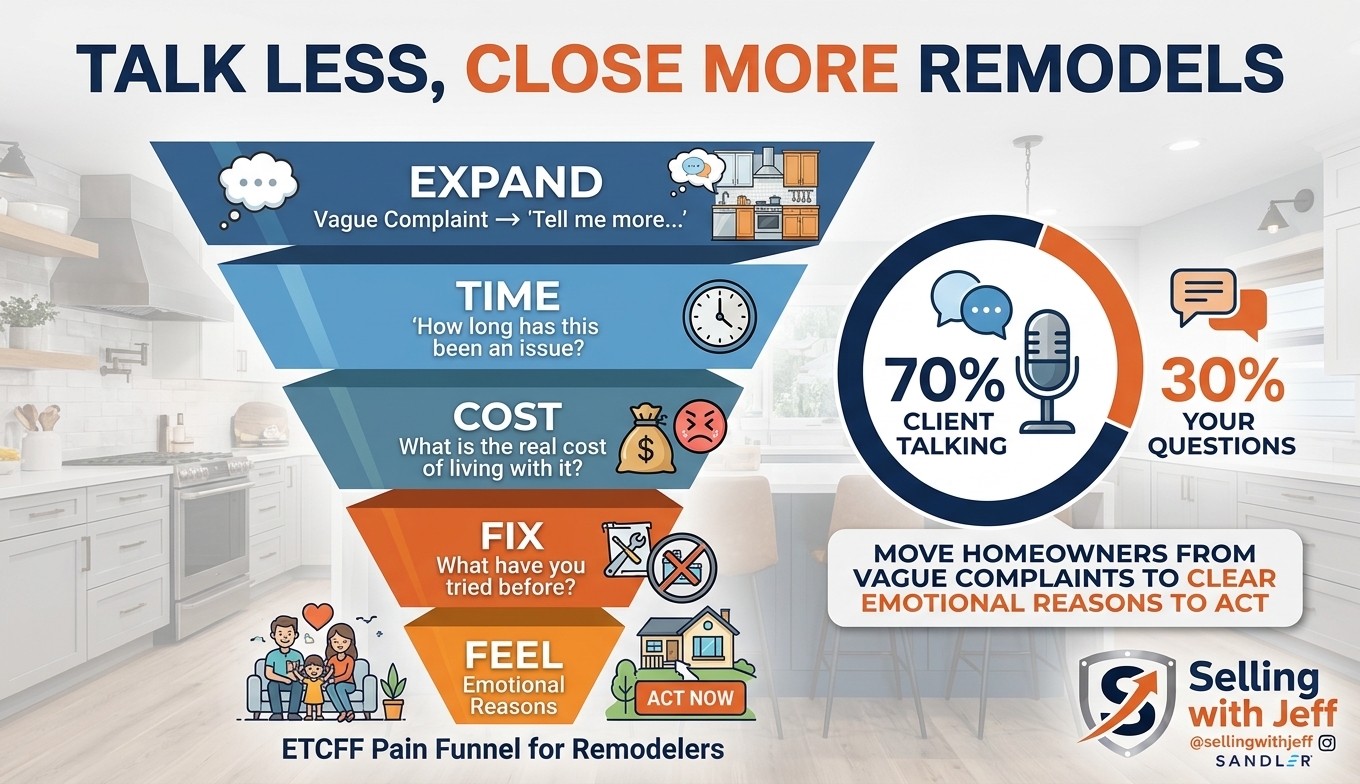
What the ETCFF pain funnel does in remodeling sales
Sandler pain funnel ETCFF is a five-step questioning framework (Expand, Time, Cost, Fix, Feel) remodelers use to move homeowners from vague complaints to clear, emotional reasons to act now, so you qualify quickly, protect your time, and win bigger, better-fit projects without sounding pushy.
In classic Sandler terms, ETCFF is simply a field-ready version of the pain funnel for remodelers. Instead of bouncing between random questions, you walk prospects through five buckets: expand what isn’t working, explore how long it’s been true, clarify the real cost of living with it, uncover what they’ve tried to fix it, and connect everything to how it makes them feel. Training examples from ETCFF for Remodelers show that when reps slow down here, more “we hate our kitchen” leads turn into committed design agreements instead of free estimates that go nowhere.
Turn real homeowner stories into ETCFF questions
The transcript you worked through is full of real proof. Mary Beth walked into a second meeting unsure there was a deal. By consciously running her ETCFF funnel, she kept the homeowner talking about her husband’s pain points, learned they were already at the top of their budget, and discovered who they had called before.
Instead of jumping in with solutions, she asked simple expand and time questions: “Tell me more about that,” “How long has that been an issue?” and “What finally pushed you to reach out now?” Those led naturally into cost and feel: embarrassment about hosting, frustration with timing, and tension between spouses. Shannon’s example did the same with “What have you tried to do to solve it?” and “Did it work?”—revealing they had already brought in three interior designers, but the process felt disjointed. Every answer became usable pain you can revisit later when budget or timing wobble.
Use dummy, reverse, and presumptive questions to stay curious
ETCFF tells you what to cover; questioning techniques determine how you get there. Dummy-up questions (“I’m not sure I follow—can you give me an example?”) let you play curious instead of expert and keep the homeowner talking. In the session, Shannon used this style to uncover exactly why other firms weren’t a fit.
Reverse questions answer a question with a question, softened first: “Great question—that sounds important. Why do you ask?” When a couple asks, “Do you have your own installers?” reversing helps you find out whether they care about schedule, quality control, or past horror stories before you launch into a monologue. Presumptive questions give them credit for conversations they should have had: “When you two sat down to talk about investment range, what did you come up with?” If they haven’t, you have a natural segue into budget instead of dancing around money.
Make 70/30 sales conversations a consistent habit
All of this works only if the client talks more than you do. Sandler recommends aiming for roughly 30% you, 70% them on discovery calls, a pattern echoed by conversation-intelligence studies where reps who talk around 40–45% of the time close more deals than reps who dominate the call, according to Gong-backed research.
You can build that habit with a few simple rules: use ETCFF as a checklist, not a script; never answer your own questions; and cap any explanation at about 60–90 seconds before you flip back to a question. Treat “Is doing nothing an option?” or its softer cousin, “Could you just live with it the way it is?” as a healthy test, not a threat. If they truly can live with the current space, you’ve protected your time. If they push back and say, “No, we can’t keep living like this,” you’ve just deepened the pain that will carry the deal across the finish line.