Wimp Junctions in Remodeling Sales: Choose Winner’s Way
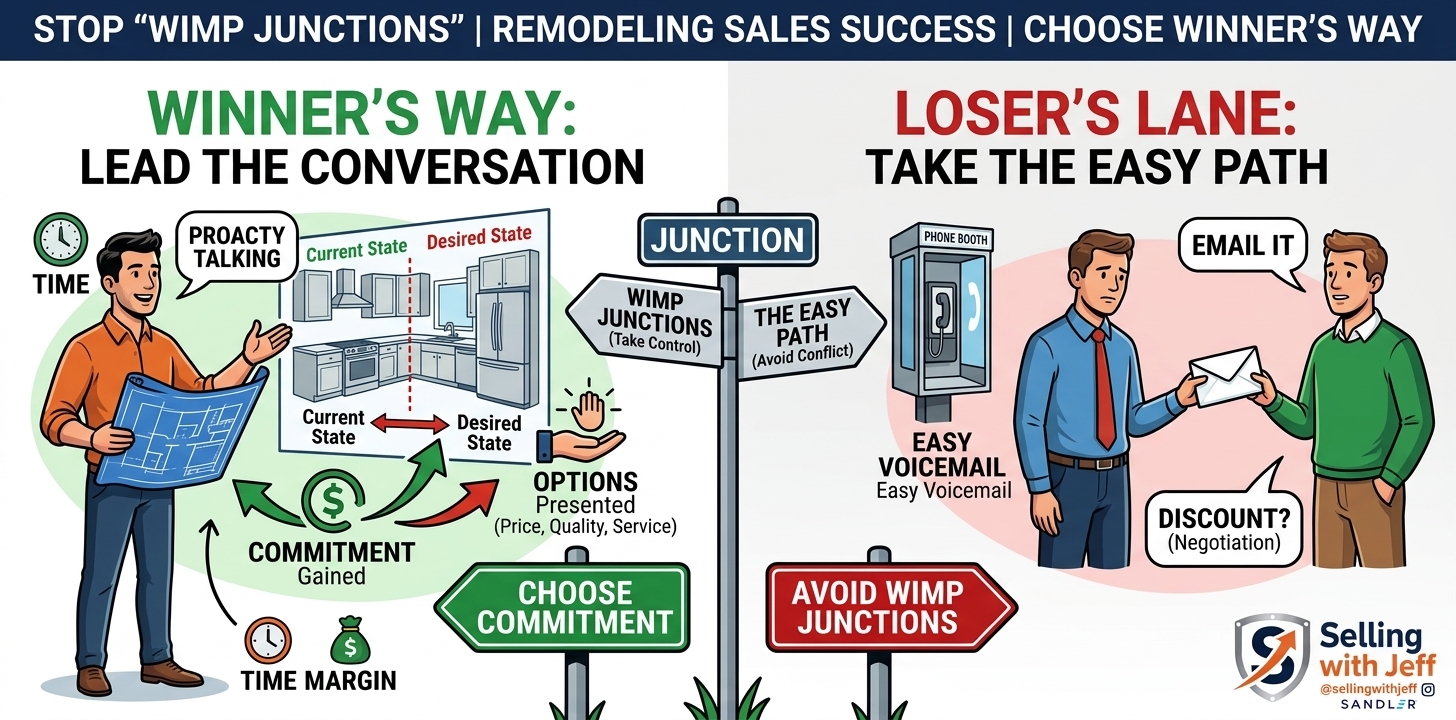
What Wimp Junctions Look Like in Remodeling Sales
Wimp junctions are the small decision points in a sales conversation where it’s tempting to play it safe—emailing the proposal, answering price too early, or accepting a one‑leg meeting. Handling them well means pausing, naming the moment, and confidently asking for a clear next step.
In remodeling sales, common wimp junctions show up everywhere. A homeowner says, “This all sounds great—why don’t you email the proposal and we’ll get back to you.” The easy path is to agree, spend hours estimating, and send it into the void. Winner’s way is, “I’m happy to prepare that. Could we put 30 minutes on the calendar now so we can walk through options together and customize something that really fits you?”
Another wimp junction is the gatekeeper: “She’s not in right now, would you like to leave a voicemail?” Instead of a generic message, you might say, “Could I make a suggestion? Give me 60 seconds to explain who I am and why I’m calling, then we can decide together if it makes sense to connect.” You’re respectful, but you still lead.
Labeling these moments—“That’s a wimp junction”—helps your brain choose the harder but better path. Over time, you’ll see clear patterns: stalled deals almost always trace back to a wimp junction where you took loser’s lane instead of winner’s way.
Use Current vs Desired State to Control the Conversation
When you slow down and map a prospect’s current state versus desired state, you stop winging it and start leading. The current state is the kitchen they wake up to now; the desired state is the space they really want—plus, ideally, ideas they haven’t even imagined yet.
Practically, that sounds like: “Walk me through what living in the kitchen looks like today. What’s frustrating? What are you working around?” Then you shift to desired state: “If you had a magic wand, what would this space look and feel like a year from now?” You’re not just collecting specs; you’re uncovering emotional reasons to change.
This is Sandler pain in action: the meaningful gap between where they are and where they want to be. As Sandler Rule #33 puts it, “No pain, no sale.” If there’s no real discomfort with the current kitchen—or no urgency around the future one—moving ahead to design, budget, or proposal is premature.
One powerful twist from the transcript is offering a bigger dream than they imagined: “Many clients start with this layout, but when we showed them an alternative that opened the room to the backyard, it completely changed how they used the space. Would you like to see something like that?” You’re co‑creating a richer desired state, not just quoting a project.
Never Make a Move Without a Commitment
“Never make a move without a commitment” is more than a slogan; it’s how you protect your time and your margin. Every major action—site visit, design agreement, full estimate, revised proposal—should be traded for a clear decision or next step.
For example, if a prospect says, “Just send the design agreement and we’ll think about it,” winner’s way is: “I’m happy to do that. Could we schedule a Zoom or in‑person meeting where I walk you through the scope and fee, so you can ask questions and we can decide together if it makes sense to move forward?” You’ve just sold the meeting, not given away unpaid consulting.
Micro‑commitments also keep pressure off. In the transcript, Joe suggests framing a second meeting like this: “The good news is, this isn’t a decision‑making meeting. The only decision we’ll need to make is whether it makes sense to schedule a follow‑up.” That’s a small, safe decision, but it’s still a decision.
Before every call, run a two‑minute drill: What’s the purpose of this meeting? What specific outcome do I want (for example, a paid design agreement or a scheduled design review)? What pains do I expect? If you can’t name the commitment you’re aiming for, you’re almost guaranteed to do free work without real movement.
Turn Price Questions into Options, Not Discounts
Price questions are classic wimp junctions. “So what will this cost?” The easy route is to blurt out a number or justify your price. Winner’s way is to reframe price as a set of options that they, not you, ultimately control.
One approach from the transcript is bracketing: “It’s a little early to give you a precise number, but based on similar projects, if you’re watching the budget closely we might be in the $X–$Y range. If you wanted to maximize the space and finishes, we could be more in the $A–$B range. Before we go further, are either of those ranges something you could imagine investing in?” You’re testing reality without locking into an exact quote.
You can also teach the classic trade‑off between price, quality, and service: “Imagine three suitcases labeled price, quality, and service. You can only carry two. If we go cheaper on materials or craftsmanship, we can absolutely lower the number—but something has to give. Which two matter most for you in this project?” Now you’re talking priorities, not defending a bid.
Finally, instead of “negotiating,” offer choices: two design paths, two scopes, two timelines. As a Sandler coach put it, “Never negotiate, only give options.” When homeowners choose between well‑framed options that match their pain and budget, they move forward with far less haggling—and with far more trust in you as a guide.