
Use the Buyer’s Journey to Stop “Think It Over”
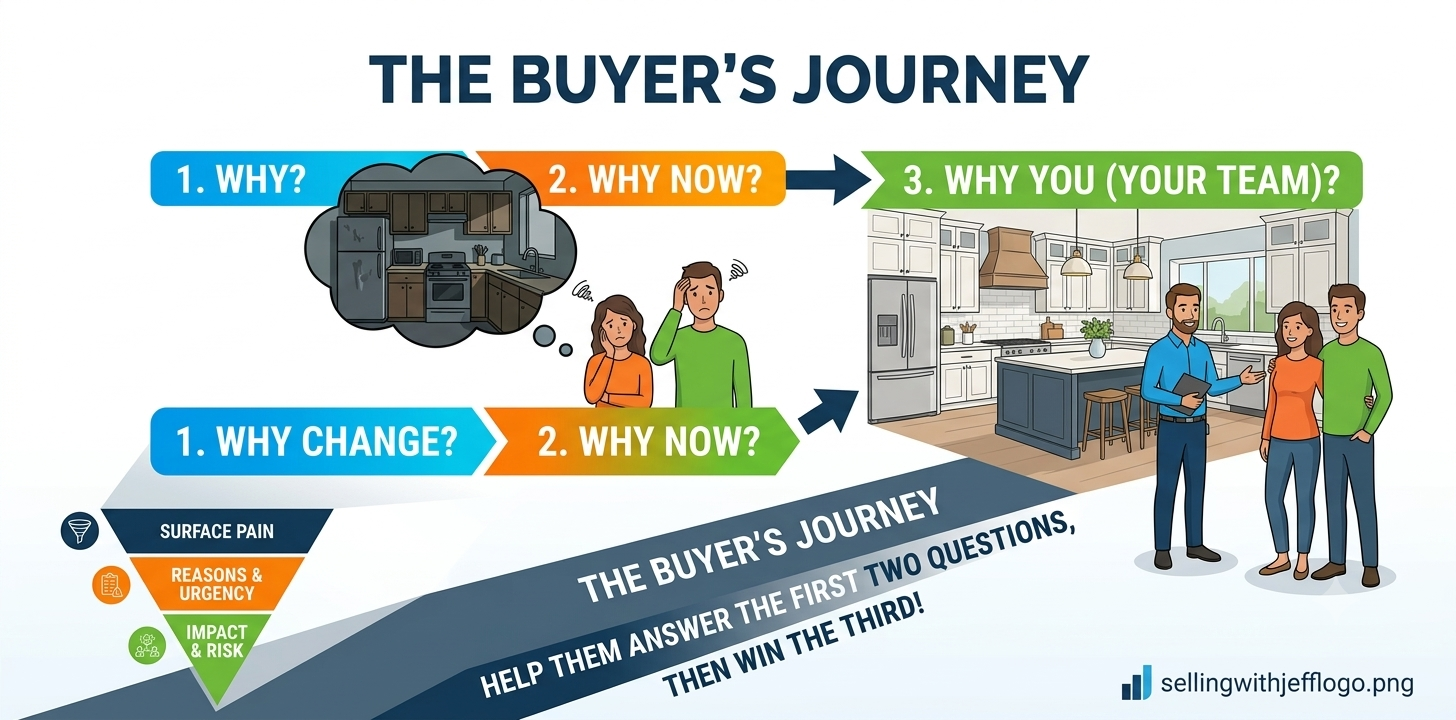
Why “doing nothing” is your real competitor in remodeling sales
The biggest hidden competitor in remodeling sales isn’t another contractor—it’s the buyer’s instinct to do nothing. When homeowners aren’t sure their problem is serious, urgent, or worth the risk of a wrong decision, they default to keeping the old kitchen or bath and telling you they’ll “think it over.”
In the workshop transcript, Joe shares a stat many sales trainers echo: most selling effort ends in some version of “we’re going to wait” instead of a clear yes or no. Sandler materials often cite that 60–70% of deals die as no decision, not as a competitive loss. That matches broader research from firms like Gartner, which find that indecision and status quo bias stall more B2B deals than true competition.
For remodelers, this “do nothing” choice can sound perfectly reasonable: concerns about the economy, fear of going over budget, or anxiety about living through months of dust and disruption. The important insight from Joe’s story is that buyers rarely admit “we’re scared of making the wrong call.” Instead, they cloak it in softer language: wanting to sleep on it, rethink their budget, or get more bids.
This is why obsessing over “Why should they choose us?” is a late-game mistake. If you spend the whole conversation selling your portfolio, process, and warranty, you’re answering the third question in the buyer’s journey—“Why you?”—before you’ve helped them answer the first two: “Why do anything different?” and “Why do it now?” If those aren’t clear, even the best presentation just gives them more to think over.
Joe’s example of the tennis coach reframes this for salespeople: every sales call is either a win or a lesson. When you lose to “do nothing,” it’s just information. Ask what it tells you. Did you really understand the current state of their home, how long they’ve lived with the pain, and what a worst‑case remodeling outcome looks like in their mind? Or did you jump to design ideas and price before their own motivation had a chance to catch up?
A practical exercise is to review a recent stalled opportunity and write out the three whys from the buyer’s point of view. If you can’t clearly state why they should change and why now, you’ve found why they drifted back into the comfort of inaction.
Use the pain puzzle and funnel to answer the buyer’s first two “whys”
The most reliable way to move a remodeling buyer from “maybe later” to “yes” is to use the Sandler pain puzzle and pain funnel to go three layers deep: the problem they see, the reasons behind it, and the impact if nothing changes. This answers “Why change?” and “Why now?” before you ever sell yourself.
Joe’s “pain puzzle” visual breaks the discovery step into three stacked pieces: surface‑level problems, underlying reasons, and emotional and financial impact. That mirrors how Sandler describes the pain funnel in their own materials: start with the obvious complaint, then ask structured questions until you uncover what it’s really costing them in time, money, or peace of mind. A recent article on the pain funnel from Sandler explains that most reps stop at surface pain—“the kitchen is cramped”—and then rush to pitch.
In the transcript, a homeowner’s first comment might be, “Our kitchen feels too cramped; we’d like more light and open space.” That’s your surface indicator. Joe’s “antenna and stop sign” metaphor reminds you to pause there instead of racing to show inspiration photos. Drop that problem into the funnel and ask the first three questions: “Tell me more about that,” “Can you be more specific?” and “Can you give me an example?” Now you might learn they host every holiday, squeeze 15 people into a dark room, and avoid inviting certain family members because of how chaotic it feels.
Next, you explore the reasons and urgency. Questions like “How long have you been thinking about this?” and “What have you tried so far to make the space work?” reveal whether this is a passing wish or a five‑year frustration. If they’ve been talking about a remodel for years and still rearranging furniture to cope, the problem is clearly baked into their daily life. That’s where “doing nothing” starts to look less comfortable than changing.
Finally, you quantify impact and risk. Joe suggests one powerful question: “Hypothetically, if you chose us and we’re six months into the project, what’s the worst‑case scenario in your mind?” Homeowners may share fears about blown budgets, shoddy workmanship, or losing use of the kitchen far longer than promised. When you listen carefully and play those concerns back, you can design your process, communication, and contract terms to address them directly.
This three‑layer conversation does more than qualify a project. It builds a case in the homeowner’s own words for why changing and changing now makes sense. By the time you talk about design and investment, you’re not selling a new kitchen; you’re guiding them out of a situation they’ve already decided they don’t want to live with any longer.
Turn questions and recognition into trust that wins premium projects
Once the buyer is clear on why they should change and why now, the final step is proving you’re the safest guide. You do this less by pitching and more by asking smart questions, using third‑party stories, and recognizing the buyer in ways that build confidence and commitment.
Joe’s tennis‑camp trophy story shows how powerful recognition can be. A small, public award shifted how he showed up the next day—he wanted to live up to the coach’s view of him. The same dynamic plays out in remodeling sales and project leadership. When you call out a homeowner’s thoughtful planning or clear communication in front of their spouse or other stakeholders, you give them a “little trophy” that makes them more invested in the process with you.
Questions are another form of recognition. As a Sandler blog on the buyer’s journey notes, prospects judge your expertise less by what you say and more by what you ask. When you slow down to explore their fears, priorities, and decision criteria instead of jumping into a slide deck, you demonstrate that you see them as partners, not just a bid number. Joe’s example of refusing to answer “What would your program look like and what would it cost?” at a networking event until he understood the owner’s situation is a perfect model for high‑end remodelers.
Third‑party stories tie this together. When a homeowner is weighing three bids and says, “We’ll decide once they’re all in,” you can gently ask about their decision criteria and then offer a story: “Many of our past clients started where you are. One couple had already remodeled once with a low‑bid contractor and regretted it when the project dragged on and change orders piled up. This time, they chose based on three things: clarity of process, track record with similar projects, and how safe they felt about budget control.” This doesn’t trash competitors; it teaches the client how to buy.
Finally, you can reduce decision anxiety with small, clear choices. Joe borrowed a retail example where a shoe salesperson always keeps the shopper to two options, never three, because people decide faster with fewer choices. In design‑build, that might mean showing two flooring packages aligned with their goals instead of five. Each time they successfully choose, their confidence in their own judgment—and in you as a guide—goes up.
Put together, these behaviors move you from “just another contractor” to a trusted advisor. You help homeowners understand their own journey, face the real reasons they’ve delayed, and feel recognized and respected throughout. That’s what earns yes decisions on premium projects even when your price isn’t the lowest—and turns more “think it over” endings into clear, confident commitments.