Sandler Pain Funnel for Energy Efficiency Sales Calls
Why Your Energy Efficiency Calls Stay Surface-Level
In energy programs, stalled deals rarely come from bad pricing; they come from shallow discovery. The Sandler pain funnel is a questioning sequence that takes a prospect from a vague complaint about bills or equipment to the concrete financial and operational pain that actually motivates a facilities leader to act.
Think about your own big purchases. You didn’t buy a car for “lane assist and Bluetooth.” You bought it because the old one kept dying on the freeway. Your prospects are the same. On average, about 30% of commercial building energy is wasted (U.S. Department of Energy). Behind every “our bills are high” comment is real budget bleed and career risk.
Here’s the pain point this article is solving: you ask a few surface questions, hear a problem, then rush to “good news, our program can help.” The call feels positive. Your notes look great. And then the deal dies in “I need to think about it.” That’s what happens when you never reach real, emotional OUCH.
Run the Sandler Pain Funnel on Real Facility Problems
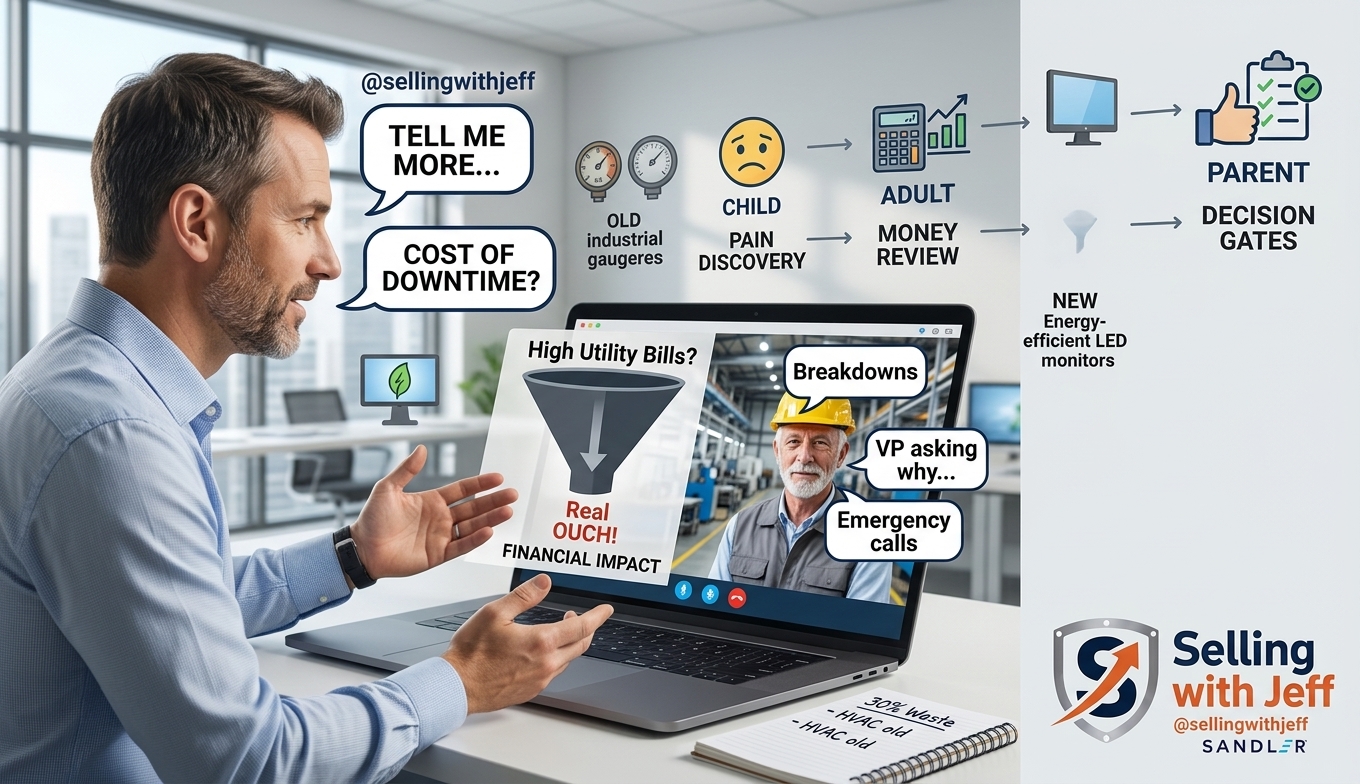
At Sandler, the pain funnel is a disciplined set of questions that takes a problem from intellectual to emotional. Instead of accepting “our HVAC is old” and launching into rebates, you slow down and work down the funnel: “Tell me more about that… Can you give me an example… How long has that been a problem… What have you tried… What has it cost you… How do you feel about it?” (Sandler).
Picture a plant manager who tells you, “Our air handlers are dinosaurs.” Surface-level you nod, empathize, and start talking incentives. Pain-funnel you stay put: you get the story about frequent breakdowns, weekend emergency calls, production downtime, and the VP of Finance asking why the electric bill is up 18% year over year.
That’s the gap you’re really in business to close. Studies show that building energy management and controls can cut energy use in small and medium commercial buildings by 10–20% (ACEEE). But those numbers only matter once the prospect feels the cost of staying where they are. The pain funnel is how you earn the right to connect your solution to that cost.
Use Parent–Adult–Child to Guide Tough Money and Time Talk
Transactional analysis gives you a second lever: ego states. In Sandler language, the child ego state feels the pain, the adult does the math, and the parent gives permission. In the pain step, you are intentionally speaking to the emotional child: the frustration with surprise utility spikes, the anxiety about aging equipment, the embarrassment of tenants or students complaining.
Once that emotional need is on the table, you deliberately shift to the adult ego state for money and time. That sounds like, “If we could cut 10–15% from your annual utility spend without new capital expense, does that make business sense?” or “Walk me through how energy shows up in your budget review.” Adult cares about numbers, tradeoffs, and logic, not hype.
Finally, you engage the parent ego state at the decision step, because that’s where permission lives. “Who ultimately has to say yes to reallocating staff time into this program?” “What criteria do they use to green‑light a project?” You’re not pitching harder. You’re aligning each part of your process—pain, budget, decision—with the ego state that can actually move.
A Simple Call Framework for Your Next Energy Prospect
Let’s put this together into a call structure you can run tomorrow:
- Open and permission. Get a mini-upfront contract: purpose, agenda, time, and decisions. You’re setting the expectation that you’ll talk about problems, impact, and next steps—not just “learning more.”
- Pain discovery (child). Start broad: “What’s your biggest energy headache right now?” Then walk the pain funnel—details, examples, elapsed time, prior fixes, cost, feelings. If a campus is spending $500,000 a year on electricity and wasting even 20%, that’s $100,000 of avoidable burn every year.
- Money and resources (adult). Shift into business terms: “If we could realistically carve $50,000–$100,000 out of that spend, what else could you fund?” “What constraints—capital, staff, time—do we need to respect?” This is where 3–5% or 10–20% savings becomes budget reality, not brochure copy.
- Decision and exit gates (parent). Clarify how decisions get made and set exit gates: “If we can agree there’s enough impact here, are you willing to pull your operations lead into a 45‑minute walk‑through?” If they won’t invest a calendar block or a key stakeholder, that’s your cue to qualify out instead of fantasizing.
Run this framework consistently and you stop being the free consultant with happy ears. You become the disciplined partner who uncovers real pain, speaks to the right ego state at the right time, and protects both your time and the client’s resources with a clear, repeatable process.