Sales Pain Funnel: Qualify Hard and Close Easy

Understand sales pain and the four buying emotions
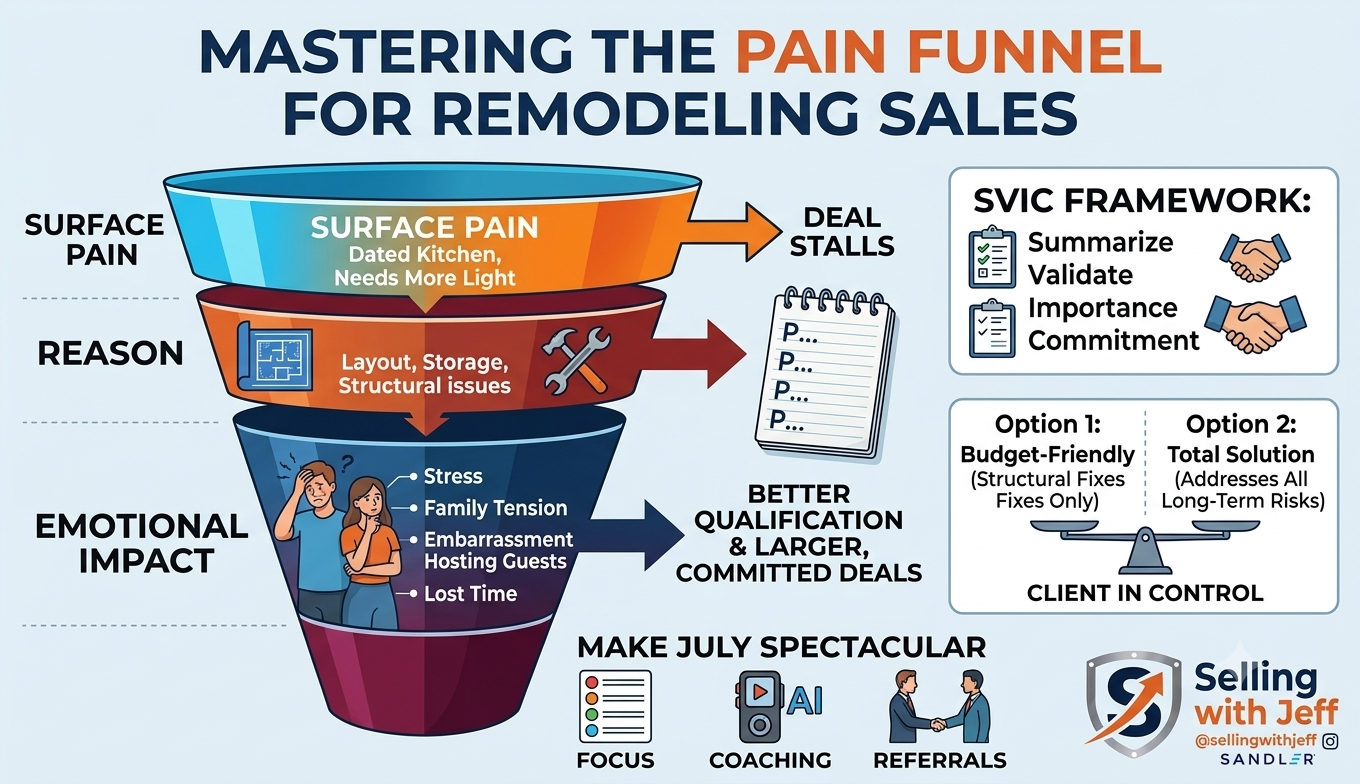
The sales pain funnel is a structured way to move from surface problems to the emotional and financial impact that actually drives decisions. Instead of pitching as soon as a prospect mentions a problem, you keep asking targeted questions until they connect the issue to lost money, time, or personal stress.
In Sandler, “no pain, no sale” isn’t a slogan, it’s a qualification rule. A prospect without meaningful pain may be curious, polite, or even enthusiastic, but they are unlikely to change suppliers or spend real money. Sandler’s own material makes this explicit: no pain, no presentation, no proposal.
A useful lens is the four buying emotions:
- Pain in the present – Something hurts right now. The scheduling system is breaking, jobs are being missed, or the CEO is demanding answers. This is low‑hanging fruit; they often reach out to you.
- Pain in the future – They can see a problem coming. Today “it’s fine,” but the trend is bad. Strong Sandler sellers excel here because they help prospects act before the emergency room moment.
- Pleasure in the present – Immediate enjoyment or gain, like finally getting a boat when you live near a lake and the season is starting.
- Pleasure in the future – Anticipated upside after an investment, like knowing an ad campaign won’t pay off this quarter but will grow the pipeline over 6–12 months.
According to Sandler coaches, people buy to move away from pain or toward pleasure, but pain is usually the stronger and more urgent motivator. That’s why Sandler emphasizes uncovering not just what hurts, but how long it has hurt, what they’ve tried, and what it is costing them in time, money, and emotional energy (Sandler Pain Funnel).
Most reps are good at hearing the what:
- “We’re missing a lot of inbound calls.”
- “Our sales are not where they should be.”
- “We don’t have enough qualified leads.”
That’s only the first layer of the onion. To win consistently, you have to get to:
- Why it’s happening (root causes).
- How it’s personally impacting the person in front of you.
When you reach the center of the onion—where the emotion lives—deals start to move. Buyers become willing to spend more, change faster, and involve more stakeholders because the problem is now real to them, not just a line item on a to‑do list.
Use multiple‑choice questions to move beyond surface problems
Multiple‑choice questions give your prospect a short menu of likely root causes. Instead of “Why is that?”—which can feel vague or confrontational—you respectfully offer two (sometimes three) specific possibilities they can react to.
Here’s the basic pattern:
“Are you struggling more with X, or is it primarily Y?”
You already saw a version of this in the training:
- Pain indicator: “We’re missing a lot of leads/calls.”
- Multiple choice: “Are you missing them because no one is answering the phone, or because you’re answering too slowly and people go with someone else?”
This one question moves you from generic “we miss leads” to operations detail: staffing vs. response time. Each answer points to a different solution, and to different dollars lost.
Another example from the session:
- Pain indicator: “We’re not getting enough sales.”
- Multiple choice: “Is it mostly that your team isn’t doing enough prospecting, or that they’re not getting in front of enough qualified prospects?”
If they say “not enough prospecting,” you’ll explore daily behaviors. If they say “not enough qualified prospects,” you’ll explore marketing alignment and lead quality. Either way, you’ve gone deeper than the first complaint.
Why this works:
- It shows expertise. You’re signaling you’ve seen this pattern before.
- It feels helpful, not interrogating. You’re giving them language for their situation.
- It keeps you out of “fix mode” too early. You’re diagnosing, not prescribing.
A few practical tips when you use multiple‑choice questions:
- Make sure every option is credible. Don’t lead them to the answer you want.
- Limit yourself to two options most of the time; three at most. Too many choices confuse people.
- Be ready for “it’s both.” That’s fine—you can say, “Got it, sounds like a bit of both. If you had to pick the bigger issue, which one is hurting more?”
Sandler coaches often quote internal data that roughly 90% of reps stop after surface pain (Sandler Pain Funnel). Multiple‑choice questions are one of the simplest ways to push yourself past that first answer.
Try scripting three multiple‑choice questions around your most common surface complaints. For example:
- “Is it more that your website isn’t bringing in enough traffic, or that the leads it brings aren’t converting?”
- “Is the delay mostly in getting estimates out, or in following up once they’re out there?”
- “Are you losing deals more on price, or on trust and timing?”
Use these live, then refine based on what prospects actually say.
Leverage presumptive and acknowledgement questions to find root causes
Once multiple‑choice questions narrow the issue, presumptive and acknowledgement questions help you dig into systems, behavior, and ownership—without lecturing your prospect.
Presumptive questions: “When you…”
A presumptive question assumes a best practice is already in place and invites the prospect to confirm or correct you. That gentle assumption often exposes gaps.
From the training, imagine a VP of Sales says, “We’re not getting enough new business.” You have already uncovered that reps aren’t running many meetings. You might ask:
“When you do your weekly one‑on‑ones and review each rep’s KPIs, what are you seeing in terms of new prospect meetings?”
If they answer, “We don’t really do weekly one‑on‑ones, and we’re not tracking that closely,” they just admitted a management gap—without you calling them out. You now know why the problem exists.
Another example related to staff turnover:
- Pain indicator: “I keep losing people after three months.”
- Multiple choice: “Is it that you can’t find enough qualified candidates, or you can’t keep them?” → “Can’t keep them.”
- Presumptive: “When you walk them through your structured 90‑day onboarding plan, where do they usually start to disengage?”
If they respond, “We don’t really have a structured 90‑day plan,” you’ve isolated a specific fixable root cause: weak onboarding.
Acknowledgement questions: “Based on what you’ve shared…”
Acknowledgement questions mirror back what they have told you and ask for permission to focus on a likely leverage point.
For example:
“Based on what you’ve shared—missing a lot of inbound calls and no clear ownership for follow‑up—it sounds like your call‑handling process is a good place to start. Does that seem right?”
Or in a sales performance context:
“You’ve mentioned weak prospecting activity and no visibility into weekly meetings. Based on that, does it make sense to start by tightening your sales management rhythm?”
These questions do three things:
- Show you are listening and not just waiting to pitch.
- Help the buyer see how their scattered issues connect to a central pattern.
- Earn a small yes commitment that you can build on.
From what and why to how it hits them personally
Presumptive and acknowledgement questions help you move from the what and why into the crucial how:
- “How is this impacting you personally?”
- “What does this mean for your bonus, or your team’s jobs, if nothing changes over the next 6–12 months?”
- “How are you sleeping with this hanging over you?”
This is where emotion shows up.
In many Sandler case studies, once a prospect connects the dots between a “clunky system” and, say, 20 lost deals a quarter or the risk of layoffs, the budget they’re willing to consider often doubles or more (Pain vs. Pleasure in Sales). They are no longer buying software or training; they are buying protection from very real consequences.
Turn deep pain into action: qualify hard so closing becomes easy
The end goal of all this questioning is not to be clever. It’s to qualify hard so you can close easy.
Many reps think they have a “closing problem.” In Sandler’s view, most of the time they actually have a qualification problem (Qualify Hard, Close Easy):
- They never reached real pain, so urgency is low.
- They never discussed budget, so the proposal shocks the buyer.
- They never clarified the decision process, so a hidden stakeholder stalls the deal.
When you’ve gone all the way through the onion of pain—what, why, how—it becomes much easier to:
- Ask budget questions without awkwardness: “You’ve said this is costing you two missed projects a month, roughly $40,000. What range were you hoping to invest to fix a $40,000‑a‑month problem?”
- Clarify decisions: “Who else will feel the impact if this doesn’t get fixed?”
- Push back on “just send a quote”: “I’m reluctant to throw numbers over the fence when we haven’t really nailed down what this is costing you. That usually leads to bad decisions for both sides.”
Just as important, deep pain helps you disqualify. Curious and interested people are not the same as qualified prospects.
Red flags that someone is only curious:
- They resist all deeper questions and only want price.
- They won’t share impact, history, or who else cares about the problem.
- They say, “It’s not really a big deal,” when you ask what happens if nothing changes.
In those cases, Sandler sellers are encouraged to move on politely. Your time is better spent with buyers who have real pain in the present or future, or clear pleasure they’re committed to achieving.
To make this stick in your own sales calls:
- Script three surface‑to‑deeper paths for your most common pains: a multiple‑choice question, a presumptive question, and an acknowledgement question for each.
- Practice in role‑plays, not just in your head. As you saw in the training, what sounds good on paper often needs tuning once you speak it aloud.
- Give yourself permission to make prospects uncomfortable—respectfully. Real change usually starts when they admit the status quo is costing more than they realized.
When you consistently peel back the onion of pain this way, you stop pushing square pegs into round holes. You stop feeling like a “used‑car salesperson” trying to close unqualified deals. Instead, you become a calm consultant who helps people put real numbers and real feelings around their problems, then decide whether it’s worth fixing now.
That’s the heart of modern Sandler selling: always be qualifying, not always be closing.