Remodeling Sales: Sell Like a House Doctor
Why remodeling is a “need, don’t want” sale (and why that matters)
Remodeling is a classic “need, don’t want” purchase: homeowners rarely want the disruption, dust, or noise, but they need safety, usability, and dignity in their homes. Great remodeling salespeople act like a house doctor, diagnosing what hurts today instead of pitching luxury upgrades.
Think about a whole‑home remodel. From the homeowner’s side, they’re giving up their kitchen, living in a construction zone, and writing very large checks. People do not choose that experience because they’re bored; they choose it because something in their daily life has become unacceptable. That might be safety (slippery tub), function (no storage), or relationships (fighting over one bathroom).
Research on the Sandler pain funnel shows that when reps slow down to explore pain and urgency, they shorten sales cycles and win more complex deals than when they jump straight to designs and prices (Sandler). Your job is not to persuade them that a new kitchen is “nice.” Your job is to find out what hurts badly enough that they’ll happily live through demo to fix it.
Once you accept that you are in a need/don’t‑want industry, you stop selling like a restaurant server (“Here are today’s specials…”) and start selling like a doctor or attorney. You ask questions, you diagnose, and you recommend treatment only after you fully understand the problem.
Turn every sales call into a question-led PALO
Most remodelers treat the PALO (Purpose, Agenda, Length, Outcome) or upfront contract as a short speech. It should be almost all questions. A question-led PALO engages the homeowner, uncovers constraints early, and prevents awkward surprises at the end of the meeting.
Instead of, “We’ll spend 60 minutes and then schedule next steps,” try:
- “What were you hoping we could accomplish today?” (Purpose)
- “What topics feel most important for us to cover?” (Agenda)
- “How much time do you have set aside for this?” (Length)
- “If it makes sense to talk again, what would you like the next step to be?” (Outcome)
In the source conversation, when the trainer asked, “What if your prospect only has 45 minutes, not 60?” the point was simple: if you don’t ask, you don’t know. Question-led PALOs also surface hidden issues like missing decision‑makers or competing priorities long before you’ve burned hours designing options they can’t or won’t act on.
When you consistently open with questions, you train yourself and your team to be curious instead of assumptive. That habit carries into the rest of the call and makes the later pain conversation feel natural rather than scripted.
Go past surface problems to real pain and personal impact
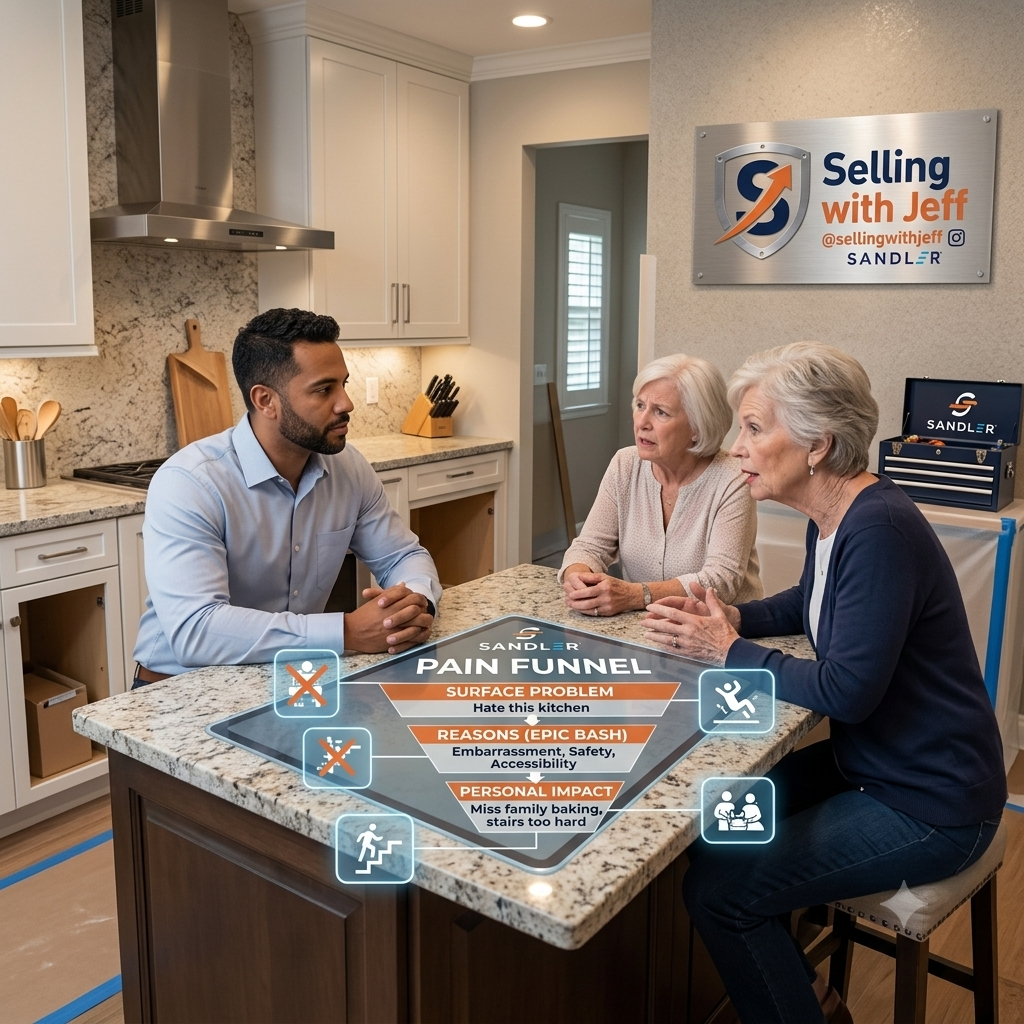
Homeowners almost always start with surface problems: “We hate our kitchen,” “The bath is outdated,” “We need more space.” If you treat that as “pain” and hurry to budget or design, you miss what actually drives decisions: reasons and personal impact.
A helpful way to think about this is the “pain iceberg”:
- Surface problem – what they tell you (“I hate this kitchen”).
- Reasons – why it’s a problem (EPIC BASH issues like Embarrassment, Privacy, Inconvenience, Broken promises, Accessibility, Safety, Health).
- Personal impact – how it affects their daily life and emotions.
Example: a homeowner says, “I don’t cook as much anymore.” With Sandler-style questions, you discover the real story: she keeps baking pans in the basement, hates the stairs, worries about falling, and feels guilty that family traditions are fading. That personal impact is the real motivator.
Good discovery sounds like:
- “What do you hate about the kitchen specifically?”
- “How long has it been like this?”
- “What have you tried in the meantime?”
- “How has this affected you and your family?”
Notice how many of those questions appeared in the training transcript and in examples from Sandler’s pain step guidance. They move you from vague dislike to vivid impact, which is where conviction (and urgency) come from.
Use the pain funnel to qualify, build urgency, and stop price fights
The Sandler pain funnel is a simple, repeatable path from “small talk” to a serious business case. You start broad, then narrow: triggers like “Can you tell me more?”, examples, timing, failed fixes, impact, and finally, “How does this affect you personally?”
Used well, the funnel helps you do three things:
- Qualify. Sometimes, as you go deeper, you discover the issue isn’t that painful. That’s a signal to politely disqualify or look for more meaningful problems instead of forcing a large design on a lukewarm prospect.
- Build urgency. When someone has lived with rubber bands holding drawers shut for six years, or with adult kids fighting over one bath every morning, the cost of staying the same becomes obvious when they talk it through.
- Avoid price-only conversations. If all you know is, “They want a bigger kitchen,” you look like every other bidder. If you understand that the current layout makes them late to work, embarrassed to host friends, and worried about aging in place, your price is anchored to specific pains instead of generic “nice-to-haves.”
Sandler coaches often say, “Selling happens when the prospect is talking.” A practical goal is three real pains per qualified opportunity, each with surface problem, reasons, and personal impact explored. That discipline, combined with tight PALOs, is what moves you out of the commodity pile and into the trusted-advisor seat.