Remodeling Sales In-Home Visit Playbook

Set the stage at the door and the kitchen table
An effective remodeling sales in-home visit process starts with controlled hospitality: a warm greeting at the door, a few minutes of rapport, then moving together to the kitchen table. Sitting at the table shifts you from “quote giver” to equal partner and gives you a calm space to think, look at notes, and ask smarter questions.
You’ve seen how this plays out when you’re the buyer. One HVAC tech shared that a homeowner who simply offered cold water and a chair at the table changed his mindset—and he then fought to get a just-expired $18,000–$20,000 warranty honored. The same psychology works in reverse: when a homeowner offers you a seat and a drink, you’re no longer just another contractor; you’re a guest.
Practically, your opening sequence should sound like this: brief small talk to build human connection, a fast agenda (“I’ll ask some questions, we’ll talk about your project and budget, then decide together on next steps”), and a simple permission question: “Does it work if we sit at the table for a few minutes before we walk the space?” Most homeowners say yes—and now you’re on equal footing.
Run pain and budget discovery before you tour the project
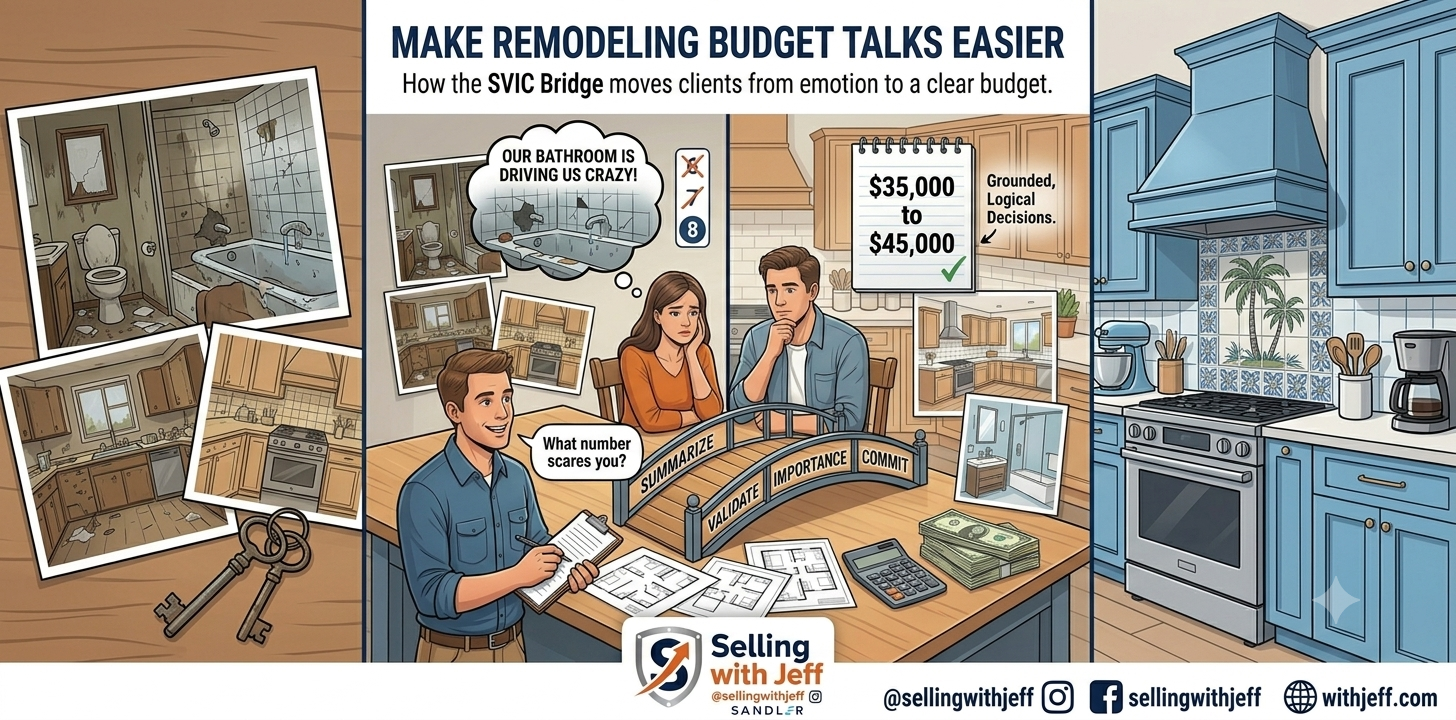
Discovery works best when you’re not juggling tape measures and trim details. At the table, run your version of palo and the pain funnel before you ever step into the kitchen or bath. Ask, “What made you pick up the phone and call us?” then follow with, “What are the top two or three things that are frustrating you about this space?”
From there, use short, open questions to go deeper: “How long has that been an issue?”, “What does that cause day to day?”, “What happens if you don’t fix this for another year?” The goal is to collect specific pains and impacts, not just, “It’s outdated.” Many remodelers who skip this step end up competing only on drawings and price.
Once you have pain, layer in simple budget discovery while you still have your notes in front of you. For example: “Based on what you’ve shared, projects like this often land between X and Y. If we design something that solves these problems in that range, is that realistic for you?” In trainings focused on kitchen and bath sales, teams that move budget into this early table conversation and present in person often see close rates climb from around 15% to closer to 40% on the same lead volume, simply because they stop designing for unqualified budgets.
Explain your process so price isn’t the only decision factor
Homeowners absolutely compare prices—but once bids are in the same ballpark, confidence in your process usually decides who wins. Recent contractor research shows that after price, the remodeler who clearly explains how the project will run is most likely to get the job, because homeowners fear mess, delays, and disappearing crews more than a few thousand dollars difference. Agencies working with remodelers, like Contracting Empire and improveit360, report that trust, clear value, and visible credibility now beat “cheapest bid.”
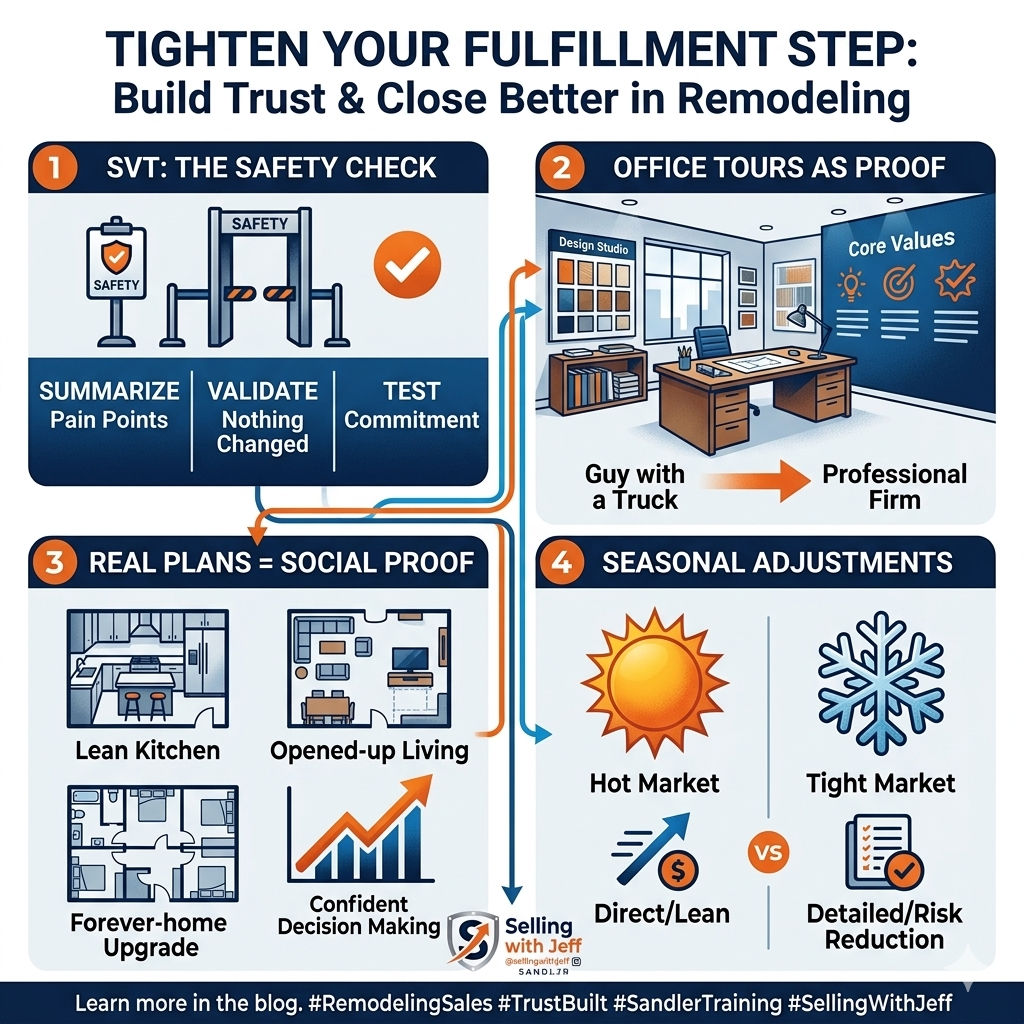
Use that to your advantage. At the table or in the room, walk them through a simple roadmap: design, selections, pre-construction meeting, daily communication, punch list, and warranty. Keep it visual if you can—a one-page process map they can hold. Then tie it back to their pains: “You mentioned you’re worried about dust and disruption. Here’s exactly how we control that during weeks two through five.”
This turns your conversation from abstract promises (“we do quality work”) into concrete proof of how you operate. It also gives the homeowner a way to compare you to “Chuck in a Truck” beyond the number at the bottom of the page.
Ask for clear decisions and protect your proposal time
Most “We need to think about it” responses show up because the homeowner was never ready to decide—and you built a full proposal anyway. Before you invest design and estimating hours, confirm two things at the table: that they’ve decided to do a project, and that they’re willing to choose between you and any other contractor they’re considering.
You might ask, “Let’s pretend I put this together and we review it in detail. What happens then?” If they say, “We’re still not sure we’re doing anything,” you’ve uncovered that they’re not ready. You can reply, “Why don’t we hold off on a full proposal until you’re certain you want to move forward with some contractor? I want to make sure we’re both using our time wisely.”
On qualified opportunities—where they have clear pain, realistic budget, and a commitment to decide—set a specific next step: “If I come back Tuesday at 4:00 with the design and investment options, will you be ready to decide whether we’re the right fit?” In focused trainings on in-home closing, consultants who move from “measure and email a quote” to asking for a decision at the table often see their proposal-to-close rate nearly triple, without increasing lead volume. That discipline protects your calendar and concentrates your best effort on the homeowners most likely to say yes.