
Why Your Sales Presentation Isn’t the Real Problem
A strong sales presentation should feel like a calm confirmation, not a high-pressure movie climax. When deals blow up at the number, it’s usually because earlier steps were weak: you didn’t go deep enough on pain, you glossed over budget, or expectations were never nailed down in writing.
Sandler trainers often say the close actually happens much earlier in the call, during qualification. Research from Sandler explains that top performers qualify hard up front so the presentation becomes routine. In the transcript you shared, Jeff makes the same point: if a remodel falls apart at the proposal, the real problem was three compartments back in the process.
Think about a kitchen addition client whose face goes blank when they see the total. The issue usually isn’t the slide design or the rendering quality. It’s that you never fully understood why they needed the project now, what it was truly costing them to wait, or how much they were honestly prepared to invest.
Fix Pain First: Go Past Surface Problems to Real Impact
Most remodelers stop at surface pain: “The kitchen is too small,” “Our deck is falling apart,” “We’d like a casita.” According to a Sandler article on the pain funnel, as many as 90% of reps are good at this first level and then jump straight to presenting (Sandler).
The pain step only works when you uncover how the problem actually feels and what it’s costing the homeowner. For example, “too small kitchen” might really mean, “I’m embarrassed to host my family,” or, “We fight every night trying to cook together.” That emotional impact is what makes a $150,000 remodel feel necessary instead of optional.
Use simple, direct questions: “How is this affecting day-to-day life?” “What have you already tried?” “If nothing changes for another year, what happens?” In the training conversation, Jeff calls skipping this level “sales malpractice” because it creates objections later. When you don’t have real impact-level pain, every price sounds too high.
Fix Budget Next: Let the Prospect Say the Number
The second weak link is budget. Many salespeople still “quote the budget” instead of getting it from the client. They throw out ranges like, “Something like this probably runs $X–Y,” then wonder why every proposal triggers sticker shock.
A Sandler piece on the budget step notes that sellers often over-qualify on pain and decision makers, but under-qualify on money—so they build scopes that land two to three times higher than what buyers expected (Sandler). That’s exactly what your contractor in the transcript is facing when his prospect keeps “thinking about it.”
Change the pattern by asking, “What have you set aside for this?” or, “Most projects like this land between A and B; where were you hoping to land?” When they say the number, they take ownership. Now, if your conceptual estimate comes in at $220,000 on a stated $200,000 budget, you can have an honest fit conversation instead of a dramatic “no” at the end of the deck.
Use the Ultimate PALO and Lead with Price Up Front
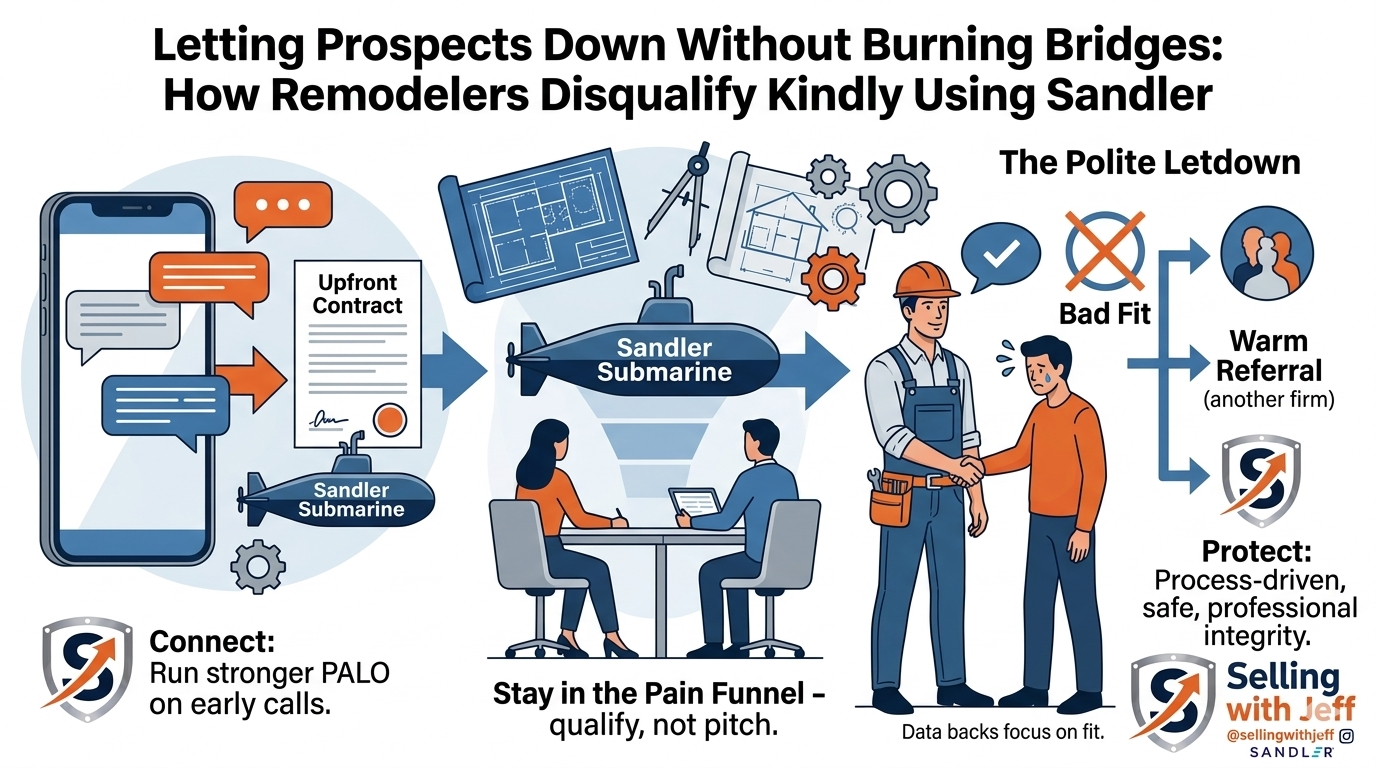
Once pain and budget are solid, you can make the presentation anticlimactic with an “ultimate PALO” (Purpose, Agenda, Logistics, Outcome). Jeff’s version starts the meeting by confirming why you’re there, restating their pains, and asking, “Has anything changed since we last spoke?” That one question protects you from presenting to problems that no longer matter.
He then sets a clear outcome: “At the end, you can tell me yes or no, or we’ll schedule a concrete next step—but no vague ‘think-it-over.’” This upfront contract removes surprise, which Jeff calls “the enemy of yes.” If a spouse needs private time to talk, you plan that into the meeting instead of discovering it at the door.
Finally, don’t bury the price. Put the investment on the front page of your proposal or the first screen of your deck. If there’s going to be tension around money, you want it early while you still have time to adjust scope or have a real adult conversation. When pain, budget, and PALO are done well, leading with the number usually sounds like, “Yes, that’s what we expected”—and the presentation really is the easiest part.