Letting Prospects Down Without Burning Bridges
Why busy remodelers must sometimes say no to new prospects
Politely disqualifying a prospect means using a clear, respectful process to decide you are not the right fit and explaining that decision in a way that protects the relationship. When you connect it to your Sandler sales process, prospects feel taken care of instead of rejected.
If you sell remodeling, there comes a point where you cannot chase every lead. In the coaching call above, Spencer has a referral in a building he dislikes working in, with a loud, demanding prospect who waves clippings around and pushes for fast action. Technically, the project fits caps. Practically, every red flag says, “This will exhaust our team.”
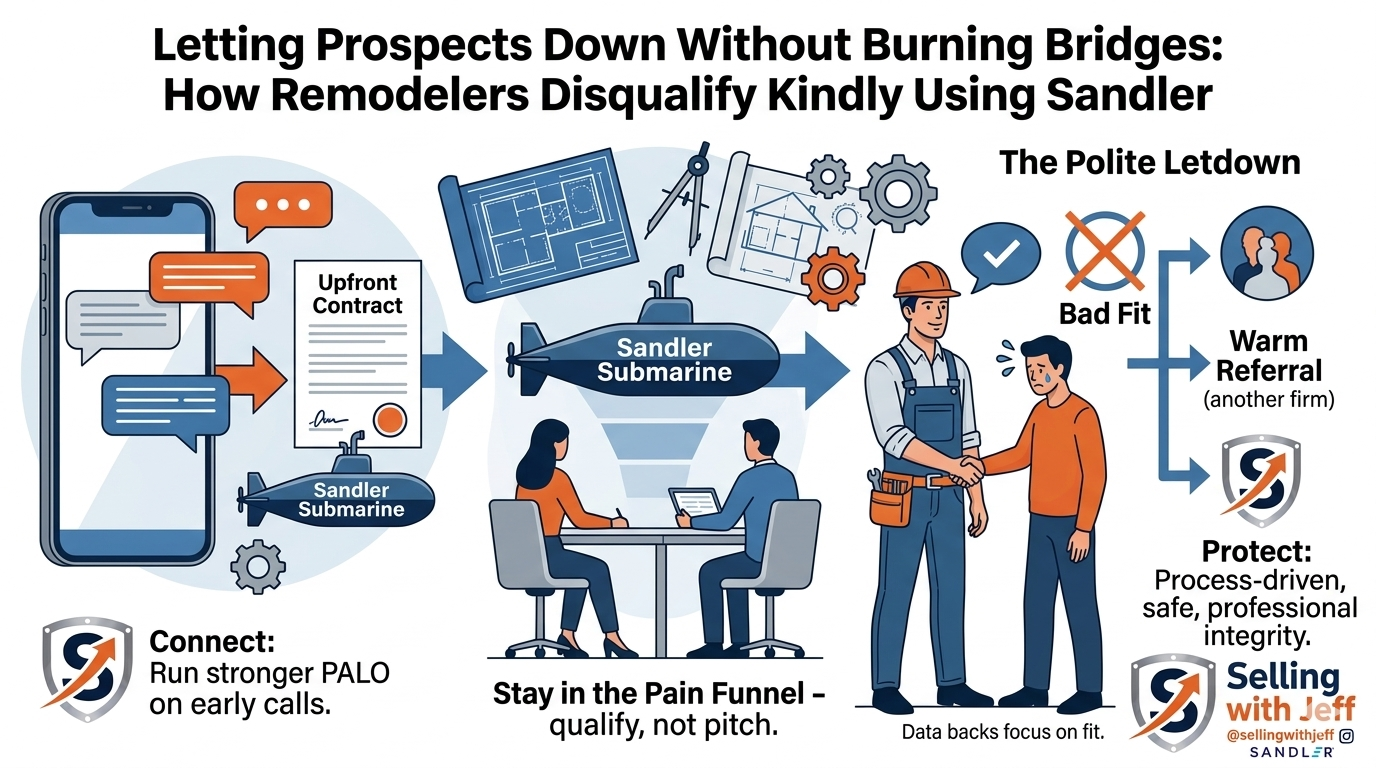
This is where the Sandler Submarine earns its keep. In the early call, you run a strong PALO (Purpose, Agendas, Logistics, Outcome) so you have explicit permission to say no later. During the discovery meeting, you stay in the pain funnel instead of jumping to design ideas. You listen for emotional drivers, pace, expectations, and how they handle money, time, and inconvenience.
By the end, you decide whether this is someone your process will serve well. If not, you lean on the line Jeff coached Spencer to use: your firm is very process-driven, and your process “isn’t perfect for everybody, but it’s perfect for all of our clients.” That framing makes the system – not the person – the reason you do not proceed.
Specific example: Spencer stops the prospect from signing a pre-con agreement on the spot. He keeps the next step as a structured discovery meeting instead of a rushed close. That gives him one more touchpoint to confirm the mismatch, protect his designers from a nightmare client, and prepare his letdown conversation.
Data backs this focus on fit. In Sandler’s own materials on the Submarine, the first three steps – Bonding & Rapport, Upfront Contract, and Pain – exist to qualify, not pitch (see Sandler Training). If the prospect fails those filters, the best close is a graceful no.
A simple Sandler script for letting prospects down kindly
Letting someone down kindly starts with reminding them of the expectations you set at the start of the meeting. Use your upfront contract to restate that you both had the right to say no, then explain, in plain language, why your remodeling process is not the right fit for how they want to work.
Here’s a step-by-step script you can adapt directly from the call:
-
Reconnect to the original PALO. “When we started today, I said that once in a while I come to the conclusion that, because we’re very process-driven, we might not be able to help in the way you want to be helped. Remember that?”
-
Make the process – not the person – the issue. “After walking through your project, I’m concerned our process will drive you a little crazy. We move in structured phases. You like to move much faster and more spontaneously.”
-
Show genuine concern for their experience. “I’d feel horrible if you paid us money and then, halfway through design, you’re frustrated with how methodical we are. I don’t want you to feel trapped in a process that doesn’t fit how you like to work.”
-
Use the core positioning line. “We recognize our process isn’t perfect for everybody – but it is perfect for all of our clients. In your case, I don’t think it’s the right fit.”
-
Offer a warm referral – not a dead end. “What I would like to do is connect you with another firm that can likely move at the pace and style you’re looking for. Here’s a contact I trust who may be a better match for you.”
-
Handle pushback without caving. If they say “I can slow down,” use Jeff’s wording: “I appreciate that, but I’d still be worried. I’d hate for you to slow yourself down now, then feel stuck and unhappy later. I think the fairest thing is to point you to someone whose process truly matches what you want.”
Notice what you do not do: you don’t lie with a padded estimate, ghost the prospect, or blame your backlog. You keep your integrity, echo the emotional pains they’ve shared, and stand by your process. As Sandler’s remodeling-focused guidance on the Submarine emphasizes, you only move to Fulfillment (presentation) once Pain, Budget, and Decision are a clear fit (see this Sandler breakdown).
One concrete variation Spencer can use with his Thailand-and-golf bachelor: “When you’re out of the country for four to six weeks at a time, our process tends to grind to a halt. That’s not good for you or my designers. Rather than frustrate everyone, let’s match you with a contractor who’s built to work around those long trips.”
Protecting your time inventory without hurting future business
Protecting your “time inventory” means qualifying harder up front so you spend in-person time only where you have a real chance to help and win, while still treating every caller like a human being who could refer you in the future. The key is to align your Sandler discovery work with clear rules for which projects earn your time.
On the call, Sergio names the real issue: when everyone gets busy, it’s tempting to see every referral and every small job, even the ones that exhaust your designers. Marlene worries that $25,000 fireplaces can chew as much design time as $100,000 kitchens. Jeff’s answer is to tighten how you use the early Submarine steps, not to abandon small projects altogether.
Here’s how to do that in practice:
-
Run a longer first phone call when you’re slammed. If a lead barely meets caps or feels off, expand your discovery call before booking a home visit. Ask more about past contractor experiences, decision style, and schedule flexibility. You’re looking for emotional red flags as much as dollar amounts.
-
Use Pain, Budget, and Decision to protect designers. When a prospect mentions firing their last designer, ignoring timelines, or expecting 3D walk-throughs for free, log those pains and expectations. If they conflict with how your design team works, that’s a candidate for a polite no.
-
Keep “small but solid” jobs in the mix. Jeff pushes back on dismissing small projects entirely. A modest bathroom for the right family can lead to a six-figure addition later. Krista’s experience with homeowners turned down by competitors proves that saying yes to the right small job can win you a loyal advocate.
-
Farm out tiny, complex work when needed. For ultra-small but design-heavy jobs, Jeff suggests partnering with outside designers. That keeps your in-house team focused on core revenue projects while you still say “yes” to good-fit clients.
-
Never say you have “too many leads” in front of ownership. Internally, that phrase sounds like “hire more salespeople” or “cut marketing,” which may not match reality. Instead, talk about optimizing qualification and time inventory.
Handled this way, saying no does not hurt your brand. You position yourself as the firm that is honest enough to walk away when the fit isn’t right – and generous enough to point the homeowner to a better option. Over time, that combination of clear process and human respect is what keeps your pipeline full of the right kind of work, even when the market turns and everyone else is starving for leads.