Decision Enablement for Remodeler Sales Teams

Why remodeler sales is really decision enablement work
Decision enablement in remodeling sales means your real job is to help homeowners make clear yes‑or‑no choices, not to push them into saying yes. You guide three big decisions: whether to remodel at all, which contractor to trust, and which scope and budget to commit to.
In the source conversation, Jeff reframes everyone’s role: you’re not just designers, estimators, or salespeople—you’re DES: Decision Enablement Specialists. The pain point is obvious: the team keeps losing time and momentum to indecisive clients, scope creep, and “think‑it‑over” delays that stretch out proposals and kill deals.
Notice how he breaks decisions into steps instead of one big yes at the end. First, the homeowner has to decide, “Are we even going to do this project?” Only after that comes, “Are we going to do it with Swank?” That split matters. Without it, reps try to convince people to pick Swank before those people have even committed to doing any project at all.
Trust is the foundation. The training connects bonding and rapport, DISC, and the PALO upfront contract to one core outcome: do they feel safe enough to move forward? Industry groups like NARI and NAHB regularly find that trust and perceived quality outrank price when homeowners choose contractors. Jeff uses the submarine metaphor: bonding and rapport is the paint over the whole boat, not just the nose. It never stops.
The practical takeaway for remodeler sales teams is to shift your identity. Instead of, “My job is to close this $78,000 kitchen,” use, “My job is to help this family decide whether this remodel is right for them right now—and if it is, to make that decision as easy and confident as possible.” That mental shift changes how you run every call, from greeting to post‑sale.
Tools to handle indecisive and over‑budget remodeling clients
Indecisive or over‑budget remodeling clients usually don’t need more information; they need clearer questions that let them own the numbers and the trade‑offs. The transcript is full of specific tools that turn fuzzy conversations into decisive ones.
The first example is Mike’s $78,000 project. Instead of rushing to justify his price, he calmly says they’re roughly 10% over budget and then stays silent. The client does the math and says, “So we’re about 80,000.” Because they said the number first, it becomes their reference point. When Mike finally shares 78,500, it lands as “less than what we were bracing for,” even though he never bragged about being under their expectation.
Jeff highlights two key moves there:
- Let the client do the math. When prospects articulate the number, they own it. You avoid becoming the person who “raised the price.”
- Have them choose what to cut. Instead of Mike suggesting line‑item deletions, he invites them to identify anything they can live without. That way, if they drop a feature, it was their call—not something “Mike at Swank” took away.
Kyle’s story about scope creep shows another decision‑enablement move. The client is three‑quarters of the way through a design, then suddenly adds a deck, garage door, siding, gutters, and more—about $100,000 of extras. They later get frustrated that pricing takes longer.
Jeff’s advice is specific: if the add‑ons are not structurally tied to the current scope (for example, a deck separate from a downstairs remodel), finish the original proposal and contract first. Then write an addendum for the new work. This protects momentum. When teams instead fold everything into one big proposal, time kills the deal—clients get new quotes, second‑guess themselves, or decide to wait for a “better economy.”
On truly indecisive clients, Jeff uses questions to break logjams without manipulation:
- “It sounds like there are two decisions here. One is whether you’re going to do a project at all. The second is whether you’ll do it with us. Have you definitely decided you’re going to do the project?”
- If the homeowner says, “It depends on whether my spouse really wants it,” Jeff hears a gap in the pain step and goes back to do a fresh pain funnel with the spouse. That’s not arm‑twisting; it’s clarifying whether there’s real motivation or not.
This aligns with outside research on stuck remodeling prospects. One recent analysis of more than 350 sales calls in construction and B2B services found reps with a 43:57 talk ratio closed about 1.6× more deals than those who dominated the conversation, because they asked more questions and let buyers talk through their own priorities. People rarely argue with their own data—but they will argue with yours.
For your team, the practical toolkit includes:
- PALO upfront contracts that set expectations and decision steps.
- ETCFF pain funnels (Expand, Time, Consequences, Financial impact, Feelings) to uncover real reasons to act—or not.
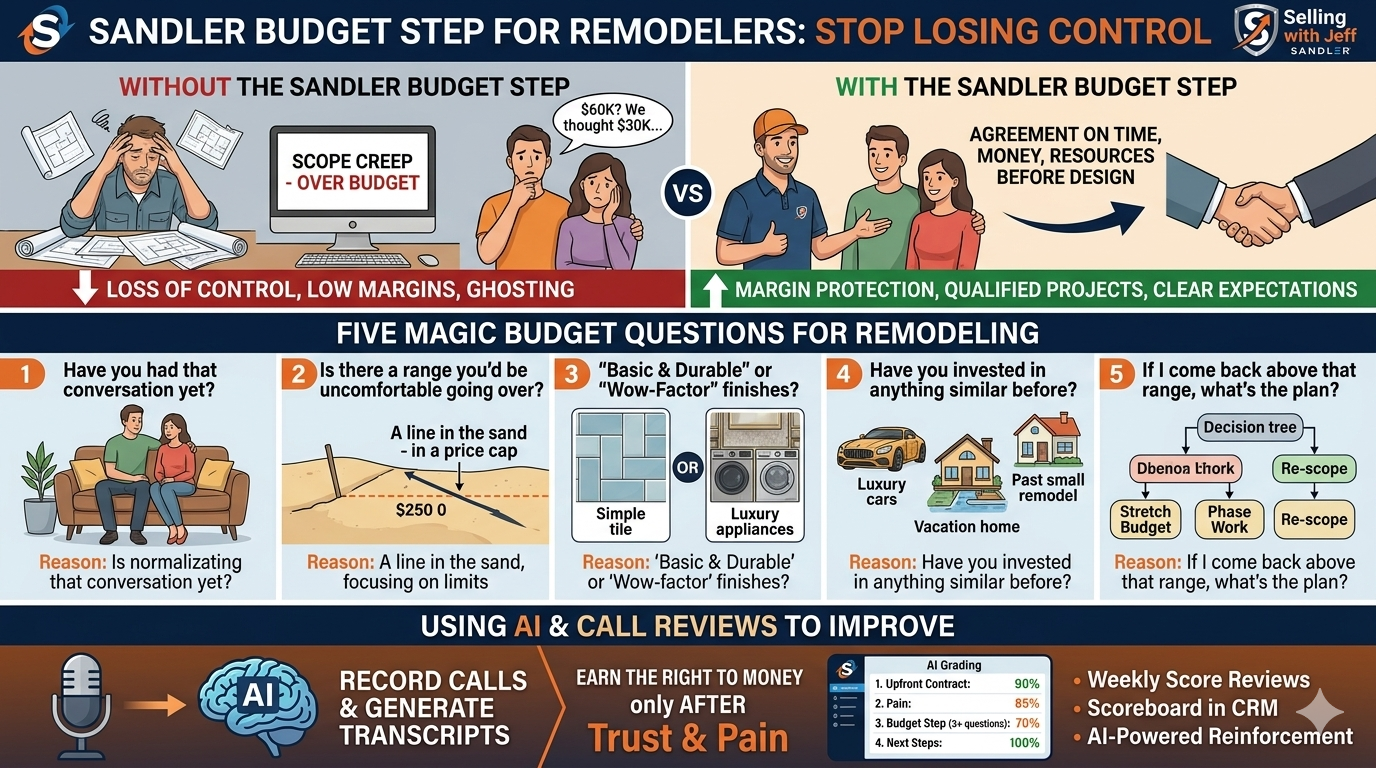
- “Magic budget questions” and silence, so clients state their own investment range.
- Clear separation of scopes and addenda to keep decisions bite‑sized.
These tools don’t pressure clients; they make it easier for serious buyers to say yes and for non‑buyers to say no quickly.
Make Sandler habits stick: practice, recording, and team coaching
Sandler skills like pain funnels and upfront contracts only pay off if remodeler sales teams practice them regularly, review real calls, and coach each other. Knowledge alone—sitting through training on the submarine—is not enough.
In the meeting, Jeff lays out a three‑month curriculum: trust, PALO, pain, budget, decision, presentation, and post‑sale, all backed by psychology. But he’s blunt that they’ve spent too long “information dumping” and not enough time on practical application. Next comes live pain‑funnel clinics, weekly PALO rotations, and AI‑based role‑plays.
He also pushes the team to record actual sales calls. Whether it’s a first qualification call, in‑home visit, or proposal presentation, the goal is to review what really happened instead of relying on memory. An AI note‑taker can transcribe the meeting, highlight question patterns, and produce objective data on how much time the rep spent talking versus the client.
Jeff addresses two common objections head‑on:
- “Clients won’t let me record.” He suggests a simple script: “To stay focused on you and your home instead of my notebook, would it be okay if I use an AI note‑taker and share the notes with you afterward?” Outside of sensitive markets like Washington, DC, almost no homeowners decline. The benefit to them—clear notes and fewer misunderstandings—outweighs the discomfort.
- “I’m different on real calls than in role‑plays.” Data from hundreds of users shows the opposite of what most reps believe: people perform 3–5% worse on live calls than in AI practice, because they don’t have notes laid out and they forget they’re being evaluated. Importing a real recording into the AI tool resolves the argument. The transcript doesn’t lie.
The team also commits to small, concrete behaviors: 20 minutes of AI role‑play per week, scheduling 15‑minute one‑on‑one sessions with Jeff to practice pain funnels, and rotating who runs the PALO at each meeting. Each of these creates a little more repetition and accountability.
For remodeling firms, the lesson is to treat Sandler not as a one‑off workshop but as a practice system. Record calls, review them with the lens of decision enablement, and coach around specific micro‑skills: asking “How will you decide which remodeler to choose?”, letting silence work after budget questions, or splitting the “Do a project?” and “Do it with us?” decisions.
When teams do that consistently, they stop chasing ghosted proposals and start hearing clearer, faster answers—both yes and no. That’s the real win of decision enablement: fewer stalled jobs, less emotional drag, and more time spent with clients who are ready to move forward.