Craft a CAPS-Based 30‑Second Commercial That Wins Trust
Why most 30-second commercials fail (and what prospects really hear)
A 30-second commercial is a short, conversational answer to “What do you do?” that focuses on your ideal client’s world, not your job title. When it’s selfless, specific, and problem-focused, it builds trust quickly and opens the door to a real sales conversation.
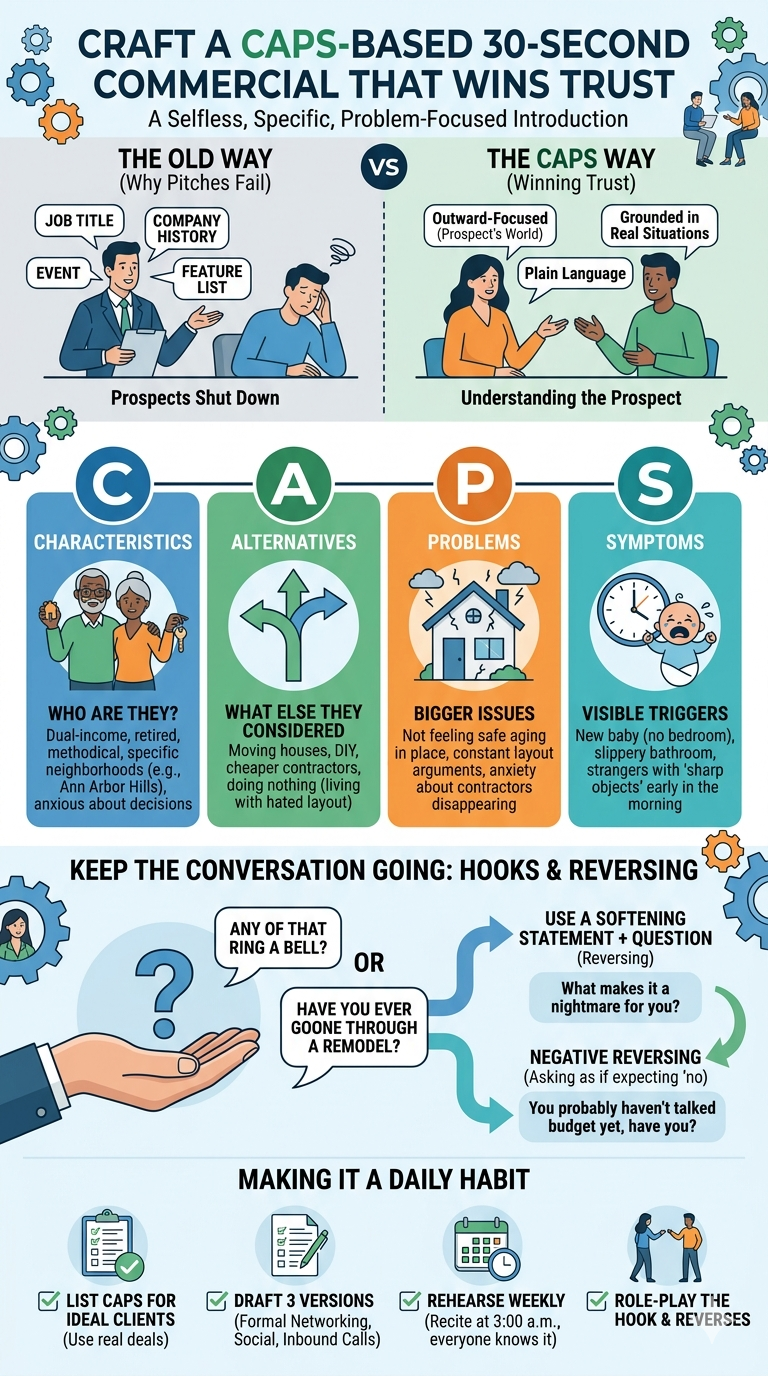
Most sellers blow this moment. They treat the question as permission to pitch: job title, company, years in business, maybe a feature list. At a social event or networking breakfast, that lands as, “Here comes a sales pitch.” Prospects shut down, look over your shoulder, or give you a polite nod and escape.
Sandler’s perspective—and what your source meeting captured beautifully—is that prospects don’t care about you yet. They care about whether you understand people like them. That’s why the most effective short introductions are:
- Outward-focused (about the prospect’s world)
- Grounded in real client situations
- Delivered in plain language, not jargon
Research backs this up. Sandler trainers consistently report that when introductions focus on pains and situations (Sandler), response rates and follow-up conversations go up dramatically, even when nothing else in the process changes.
How to use the CAPS model to build a selfless 30-second commercial
The CAPS model gives you a simple structure for crafting a 30‑second commercial that feels natural and non-salesy. CAPS stands for Characteristics, Alternatives, Problems, Symptoms—four ways to describe the people you help.
Start with Characteristics: Who tends to be a good fit? For the remodelers in your transcript, that sounded like: established homeowners, often dual-income or retired, living in specific neighborhoods, methodical, and anxious about making the wrong decisions. The more concrete you are, the more your listener thinks, “That sounds like us.”
Next, add Alternatives: What did these clients consider before working with you—moving, DIY, cheaper contractors, doing nothing? Mentioning alternatives shows you’re realistic, not pushy. In your session, the team talked about clients who nearly moved, or tried to live with a layout they hated.
Then layer in Problems and Symptoms. Problems are the bigger issues: not feeling safe aging in place, constant arguments over layout, anxiety about contractors disappearing. Symptoms are the visible triggers: baby on the way and no bedroom, slippery bathroom, strangers in the house at 8:00 a.m. with “sharp objects.”
A simple CAPS-based commercial might sound like:
“I work with established couples in neighborhoods like Ann Arbor Hills who love their home but feel stuck. They’ve thought about moving, but hate the idea of leaving their community. Usually there’s a trigger—a baby on the way, a bathroom that doesn’t feel safe anymore—and they’re anxious about choosing the wrong contractor. I don’t suppose any of that sounds familiar?”
Notice what’s missing: job title, company history, features. It’s all about the prospect’s world.
Hooks, questions, and negative reversing that keep conversations going
A strong hook question turns your 30-second commercial from a monologue into a two-way conversation. The only rule: the hook should make it almost impossible to just say “uh-huh” and walk away.
Common hooks include:
- “Any of that ring a bell in your world?”
- “Have you ever gone through a remodel like that?”
- “Who do you know that’s dealing with something similar?”
In your session, the group wisely noticed that hooks should fit the venue. At a charity fundraiser, a softer, more social hook (“Have you ever tackled a remodel?”) is more appropriate than a hard qualification question.
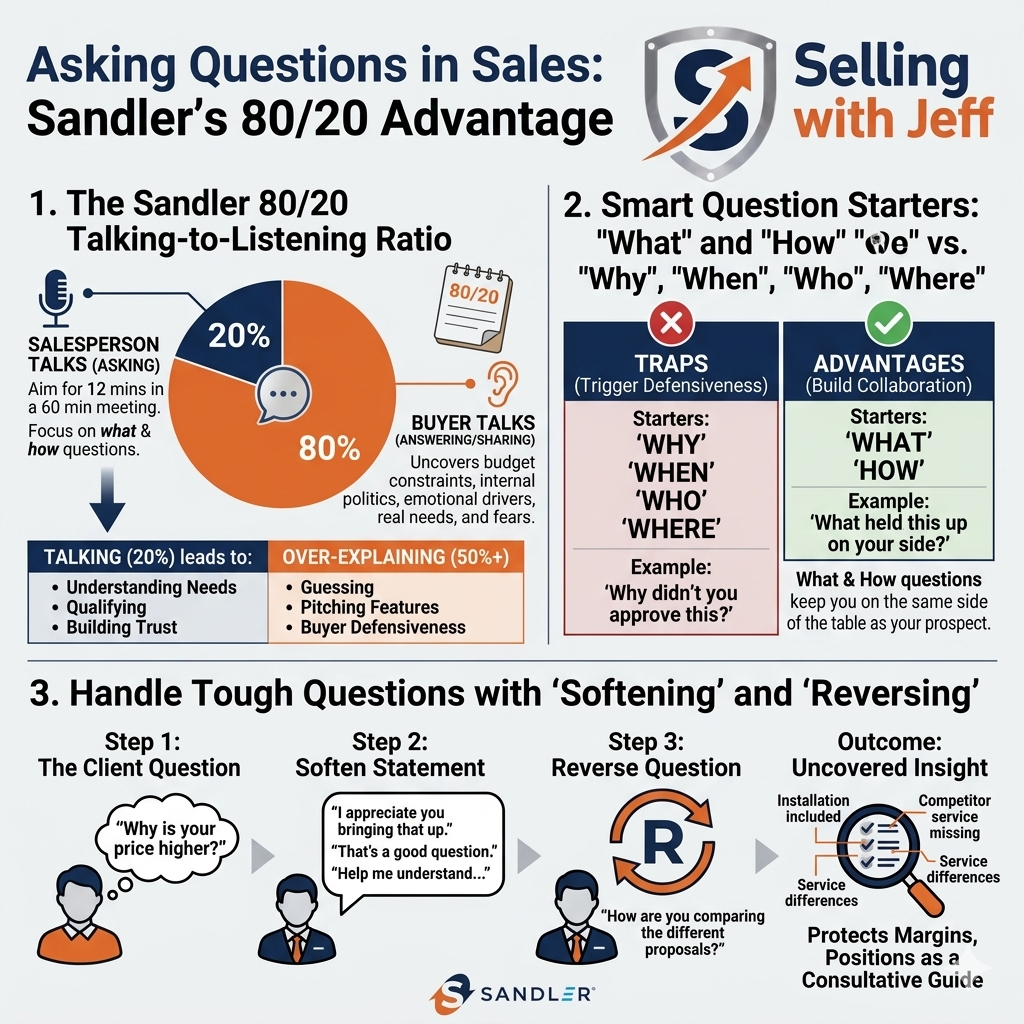
This is where reversing and negative reversing support your commercial. When someone bites on your hook—“Yeah, actually, our kitchen is a nightmare”—resist the urge to educate. Instead, answer their statement with a question that digs deeper.
Use a softening statement plus a question:
- “That’s interesting; I’m glad you shared it. What makes it a nightmare for you?”
- “Good question—I hear it a lot. Is there a specific deadline you’re worried about?”
Negative reversing—asking as if you expect a “no”—is especially useful when rapport is low: “You probably haven’t had a chance to talk budget yet, have you?” If they say, “Actually, we have,” you stay in character: “Really? That’s unusual this early; what did you two discuss?” This keeps you from sounding like a typical salesperson chasing a yes.
Turning your CAPS commercial into a daily habit in networking and sales
Knowing your CAPS intellectually isn’t enough; top performers can recite them at 3:00 a.m. and adapt them in seconds. Your group nailed this: everyone on the team, including people answering the phone, should know your CAPS cold so they can “smell” a good prospect quickly.
Here’s a simple practice plan:
- List your CAPS for your ideal client. Use real deals: age, life stage, neighborhoods, alternatives they weighed, problems they brought up, and the specific triggers that forced a decision.
- Draft three versions of your 30-second commercial: one for formal networking, one for social events, and one for inbound phone calls. Keep each under 80 words.
- Rehearse weekly. Borrow from Sandler’s experience: many trainers recommend running a different version every week in networking groups (Sandler). You’ll quickly learn what language gets people leaning in versus checking out.
- Role-play the hook and first two reverses. Practice how you respond when someone says, “That’s us,” or “No, that’s not really our situation.” The goal is to stay curious, not to start pitching.
When you treat your 30-second commercial as a living tool, grounded in CAPS and supported by reversing, you stop sounding like “just another salesperson.” Instead, you show up as a helpful guide who understands your prospect’s reality—and that’s what gets you invited into real sales conversations.