Use Budget Fear Questions to Protect Remodeling Deals
Why design-build sales stall when budget talks come too late
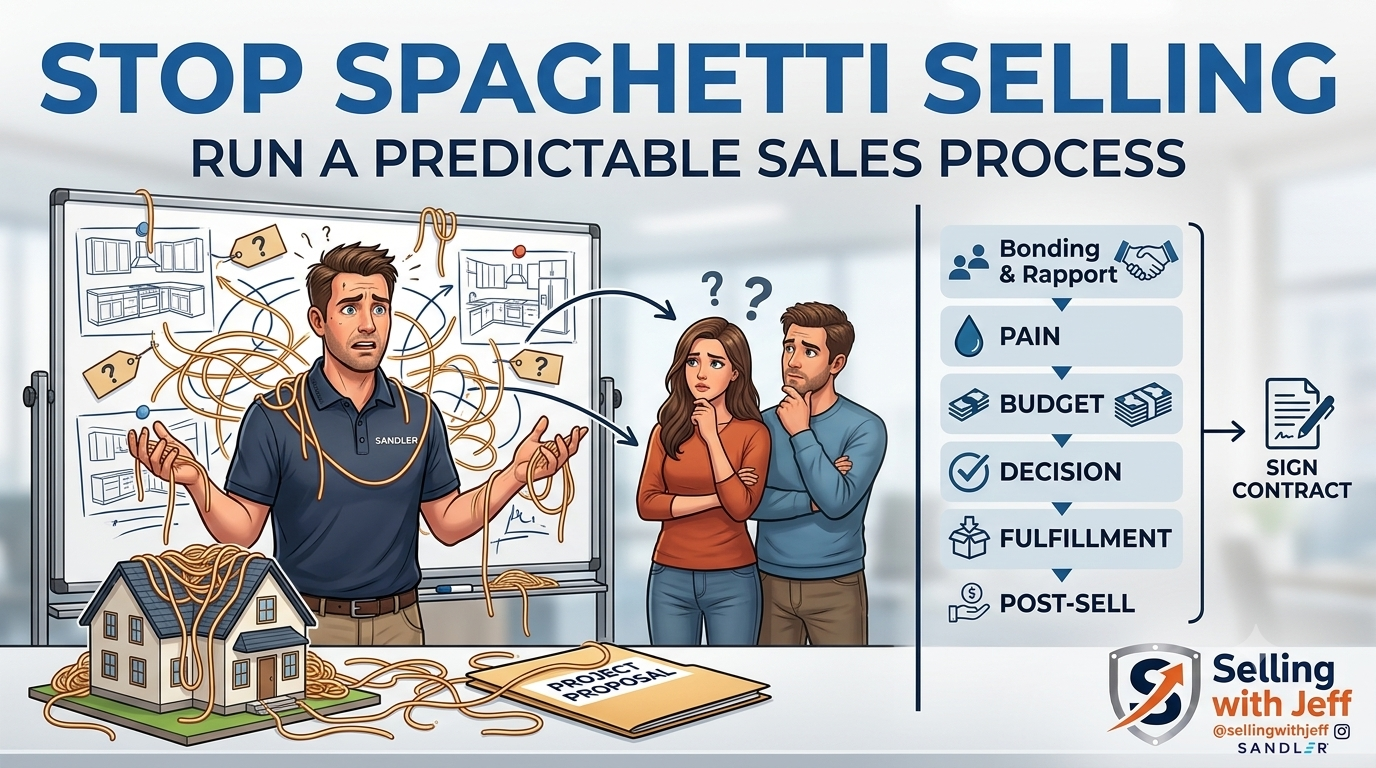
Design-build sales stall when teams avoid early budget talks, letting scope grow without money conversations, which creates surprise, mistrust, and stalled decisions at the end. Using a clear, repeatable budget framework keeps trust high while helping clients decide faster and protect your margins.
In most design-build firms, the pain point is predictable: clients fall in love with drawings long before they understand the real cost. Designers “just draw it,” sales assumes budget was covered earlier, and production inherits a job that’s already over the client’s comfort zone. Everyone did their job, but no one owned the budget conversation.
This is more common than most owners admit. Sandler trainers report that when teams skip structured budget talks between discovery and pricing, they routinely propose projects two to three times higher than what homeowners ever intended to invest. That gap shows up later as ghosting, “we’ll wait a year,” or aggressive scope cutting that kills profit.
Your transcript surfaces the same issue. Erin describes the hardest part of their sales as “the initial meeting and getting in the door with people and talking about numbers,” especially when those numbers are higher than clients hope. Design is not supposed to dictate budget, yet design decisions quietly expand cost when no one revisits money.
The fix is not a magical estimating tool. It’s a communication process. You need a way for sales, design, and production to act as what your trainer called “decision enablement specialists” at every stage. That means:
- Building trust up front so clients will tell you the truth about fears and limits.
- Linking every design wish back to pain, budget, and decision rules.
- Making it normal—not awkward—to talk about what scares clients financially.
When you treat budget as an ongoing conversation instead of a single “estimate moment,” you reduce late-stage stalls and protect the relationship even when the price is higher than expected. Research from Sandler shows that most objections trace back to missing clarity about pain, trust, or budget—not the surface words the client uses. Fix those, and deals move.
How to use “what number scares you?” without losing client trust
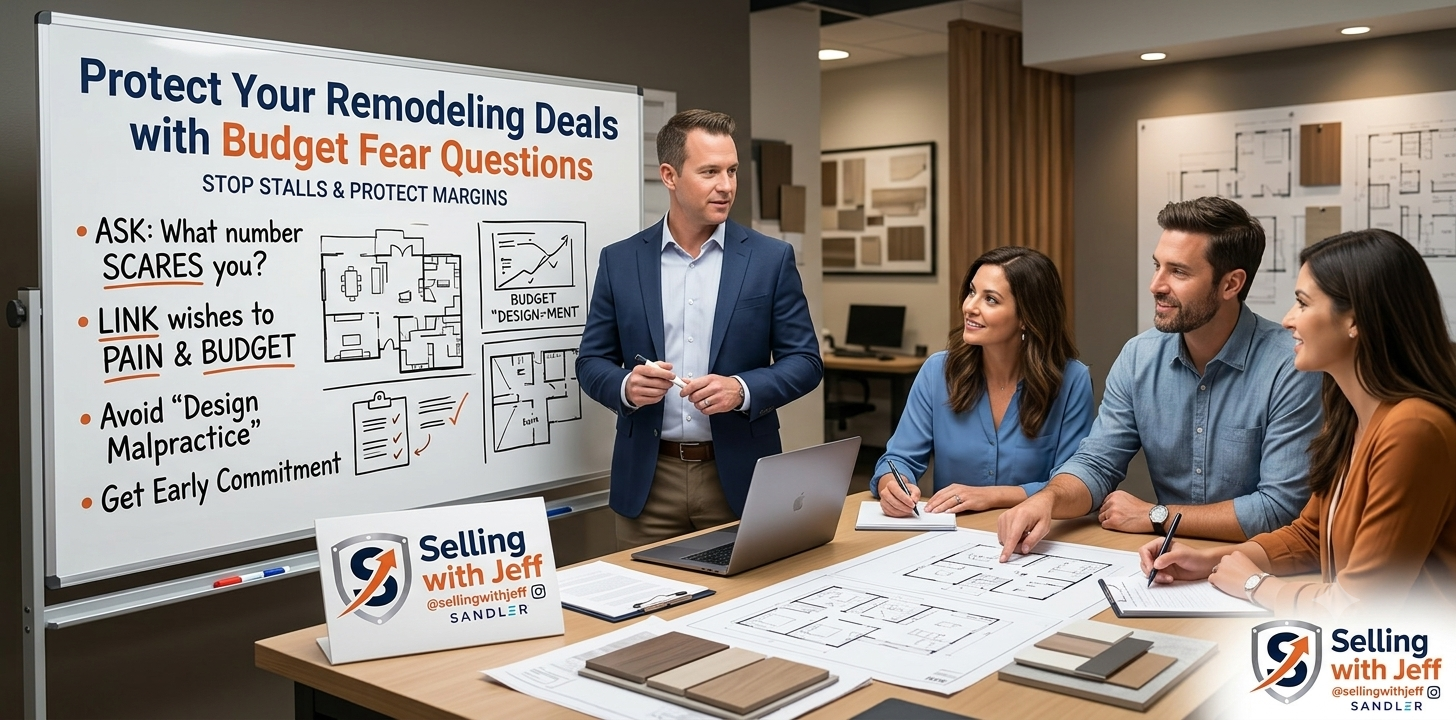
The question “What number scares you?” works because it reveals a client’s emotional ceiling, then lets you design and price inside their comfort range. Used after a solid pain and trust step, it feels protective, not pushy, and leads to clearer decisions about scope and trade-offs.
Your trainer shared a simple but powerful shift: instead of asking, “What’s your budget?”, ask, “When you think about this project, what number scares you?” It sounds small, but it taps into how people actually make money decisions. Fear is often the strongest emotion in a remodel: fear of overspending, fear of regret, fear of making a bad call.
Sandler research and field experience show that as a buyer’s pain and urgency increase, their tolerance for investment also rises. The “chain monkey” story illustrates this: homeowners who refuse to pay $40 for tire chains on a sunny day will happily pay $250 during a freezing night storm. Same people, same chains—more pain, higher acceptable spend.
The “what number scares you?” question surfaces that emotional boundary directly. It:
- Signals that you care about protecting their comfort zone.
- Opens a candid discussion about fears, trade-offs, and priorities.
- Gives you an anchor for options and value engineering.
You can make it part of a short script after you’ve explored pain and goals:
- Acknowledge their goals – “You’ve talked about opening this kitchen, adding storage, and making it easier to host family.”
- Name the elephant – “Most people are a little nervous about what a project like this might cost.”
- Ask the fear question – “When you think about this project, what number scares you?”
- Clarify the comfort zone – “If that’s the ‘no way’ number, where does it start to feel uncomfortable but still possible?”
In your call, Chris worried that clients will push the question back on the designer: “You’re the professional—what do you think it will cost?” The trainer’s response is a practical way to keep control: first, thank them and have them repeat that you’re the professional, then say, “You’re actually in more control of this budget than anyone here. I can design a $100,000 pantry, but I’m sure you don’t want that. I need to know what you’re willing, able, and comfortable to spend so we can see if it fits.”
That line positions you as a guide, not a guesser. Data shared in Sandler workshops shows that when salespeople throw out casual ranges (for example, “$15,000 to $40,000”), they underestimate by around 18% on average. Homeowners only remember the low end, so when the final number lands above it, they feel misled. Shifting to an “up to” number—slightly inflated to stay safe—resets expectations honestly while preserving trust.
Turning design changes into clear, confident budget decisions
Design changes derail projects when they’re treated as harmless drawings instead of budget-impacting decisions. By pairing mini pain questions with a quick budget and decision check, you keep clients informed, avoid surprise costs, and hand sales a clean story instead of chaos.
Your transcript gives a concrete scenario: the client shows up midway through design saying, “We’ve been thinking about it—we want to add a pantry.” The default move has been “We draw it,” which silently tells the client, “Sure, it fits,” even though no one has talked about cost.
That’s where over-budget projects are born. The designer’s job, as your trainer framed it, is to be a good steward of the client’s budget. Over-designing without explicit permission becomes “design malpractice” because it sets clients up for shock later.
A better approach is a short, repeatable play whenever a new wish appears:
-
Mini pain step
- “What makes you want to add the pantry now?”
- “What changed since you first talked with Sam about the project?”
- “How will having the pantry help you day to day?”
These questions uncover whether the idea is a must-have, a nice-to-have, or a passing fantasy. They also honor what Sam and the sales team already covered, instead of starting from zero.
-
Needs, wants, wishes filter
- “If we couldn’t fit a pantry in the project, would that stop you from moving forward?”
Classifying the pantry as a need, want, or wish lets you prioritize. Many design-build firms use this language formally to keep scope creep visible and negotiable.
-
Micro budget step
- “Have you thought about how much more you’d be willing to invest to add the pantry?”
- “If we discover the pantry adds more than you’re comfortable with, what would you be open to trading or cutting?”
Even if the client hasn’t thought about a number, simply asking sends a crucial signal: this change has a cost. In your call, Erin pointed out that even when the number is fuzzy, optioning the pantry on the plan lets estimating price it as an add-alt. That keeps choice with the client instead of springing a lump sum at the end.
-
Decision-making process check
- “Just so we’re on the same page, how are we going to decide whether the pantry ultimately makes it into the project?”
Framing it as “we” instead of “you” keeps it collaborative and reinforces equal business stature. If the client later hesitates, you can revisit the agreed process instead of chasing them.
When designers capture this information and hand it back to sales—“Here’s why they want the pantry, what changed, what they hope to gain, their ‘scary’ number, and how they’ll decide”—sales can have a real budget conversation instead of guessing. That protects margin and speeds decisions.
Finally, all of this sits on a foundation of trust and communication style. Your group noticed how often clients go silent because you’re using the wrong channel. A basic post-sell question like, “How do you prefer we communicate—phone, email, or text?” prevents delays. Research from Sandler and other consultative sales trainers shows that matching the buyer’s communication preference increases response rates and reduces stalled deals.
When you combine clear pain, explicit budget fears, structured decision rules, and the right channel, you stop hoping clients will “figure it out” and start leading them confidently from ideas to signed contracts.