
Transactional Analysis in Sales for Remodelers
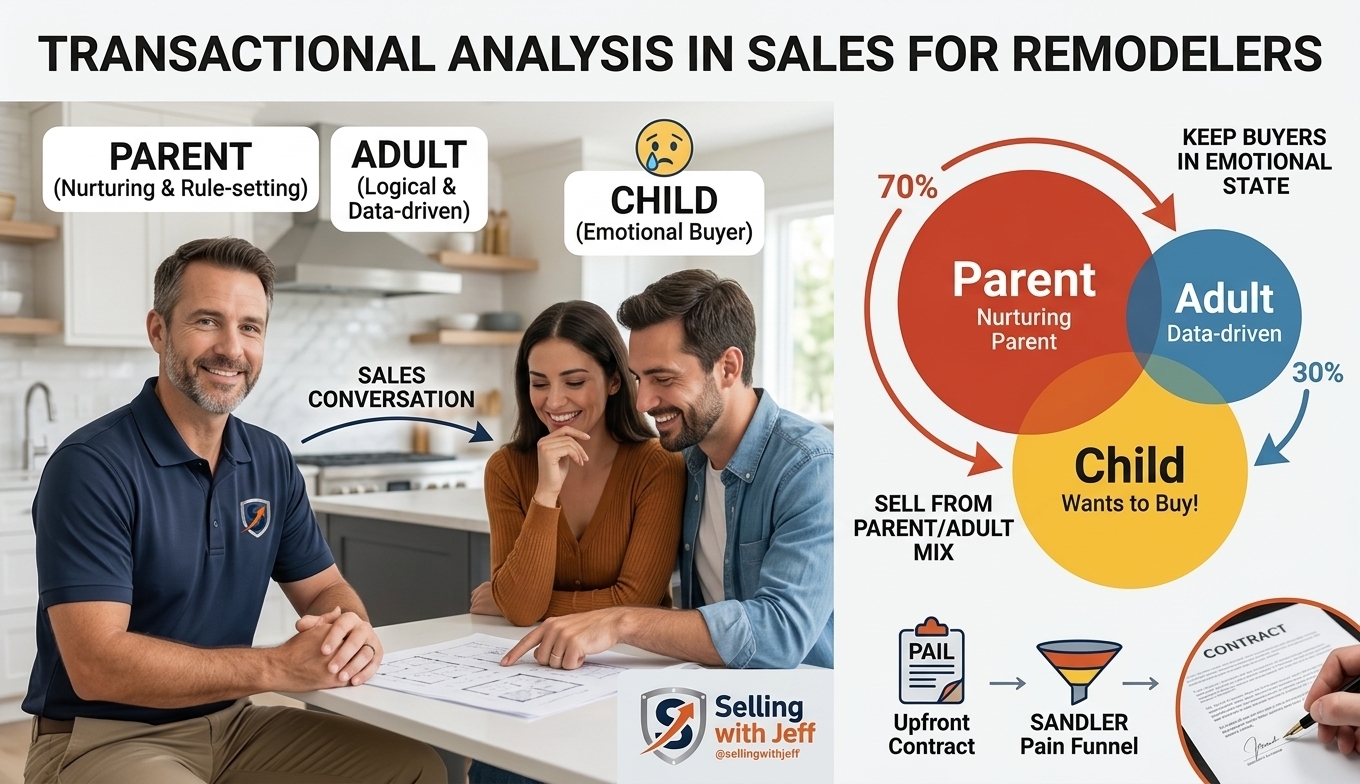
What Transactional Analysis Really Means in a Sales Call
Transactional analysis in sales is a psychology-based way to run conversations using three ego states: Parent, Adult, and Child. In remodeling sales, you sell best from a selfless Parent/Adult mix so homeowners can stay in their emotional Child state, where real buying decisions actually happen.
Transactional Analysis (TA), created by psychiatrist Eric Berne, says every interaction comes from one of three ego states: Parent (rule-setting or nurturing), Adult (logical, data-driven), or Child (emotional, self-focused). Sandler took this clinical model and hard-wired it into the Sandler Selling System as the engine behind bonding, rapport, and qualification. According to Sandler guidance, about 70% of your selling behavior should come from Nurturing Parent and 30% from Adult, with 0% from ChildSandler.
Why that split? Because buyers say yes emotionally in Child, check rules and safety in Parent, and justify in AdultSandler. Your job is to show up as the steady Parent/Adult so the homeowner feels safe enough to stay in Child long enough to admit real pain and decide.
Why Remodelers Lose Control When They Sell from Child State
Most remodelers walk into a home already in their own Child state. You’re excited, you’ve “seen this kitchen a hundred times,” and you’re mentally rearranging walls before you’ve even sat down. That Child state wants approval, fun, and a fast yes—so you pitch, solve, and avoid tough money or process questions.
In TA language, Child is self-absorbed: “Look how smart we are, look at our projects, let me show you six layout options because you asked.” The moment you shift into Child, the homeowner is forced into Parent—cautious, rule-focused, and unwilling to buy. As one summary of TA in sales puts it, in the buying process the Child wants to buy, the Adult decides, and the Parent gives permissionNJBIZ.
You’ve seen the cost of this in your pipeline. Free design work for unqualified custom homes. Six versions of a floor plan for a prospect who “just wants ideas.” Vague “we’ll think about it” endings because you answered every question but never asked, “What happens next?” That’s not bad luck; it’s Child-to-Parent selling.
Run Parent-State Meetings with a PAIL Upfront Contract
A simple way to stay in Parent/Adult is to run every meeting with a PAIL upfront contract. PAIL stands for Purpose, Agendas, Logistics, and Outcomes. It’s Sandler’s structure for getting mutual agreement at the start and end of every meeting so nothing feels like a surprise or a push.
In Parent state, you turn PAIL into questions, not a speech: “What were you hoping we’d figure out today?” (Purpose). “What else should be on the agenda besides layout and budget?” (Agendas). “Who needs to be part of this conversation, and how much time do you have?” (Logistics). “If we land on a design that fits your budget, what would you like to decide by the end?” (Outcomes).
Think about the tile-selection example from your own projects. A solid PAIL sounds like: “You’ll meet Joe at the tile store, choose options that fit your budget, email us your choice, then we’ll meet a week later to review the full design and decide together whether to move forward.” That’s Parent-state clarity that quietly sets the close before the work even starts.
Use Pain, Budget, and Exit Gates to Keep Buyers in Motion
TA is only useful if it changes how you qualify. In Sandler terms, a truly qualified remodeling prospect must have: 1) real pain your firm can fix, 2) adequate money for a project you’d actually take, 3) a clear decision-making process that involves the right people, and 4) a track record of following through on homework and decisions. Miss any of those and you’re in fantasyland.
This is where Exit Gates come in. Gate 1 is the basic qualify: pain, budget range, decision structure, timeline, and willingness to follow your process. If any of those aren’t real, you stop. That’s the opposite of drawing six layouts because “they asked,” or building a detailed estimate for a $700,000 custom home when you don’t even know where the money is coming from.
Parent/Adult sellers treat every meeting like a gate. They use the Sandler Pain Funnel to go deeper than “we want a new kitchen,” insist on a real budget range, and end with a concrete decision or commitment: a selection, a check, or a scheduled next step. That structure protects your time, margin, and sanity while making it easier for homeowners in Child state to say, “Yes, we’re in.”