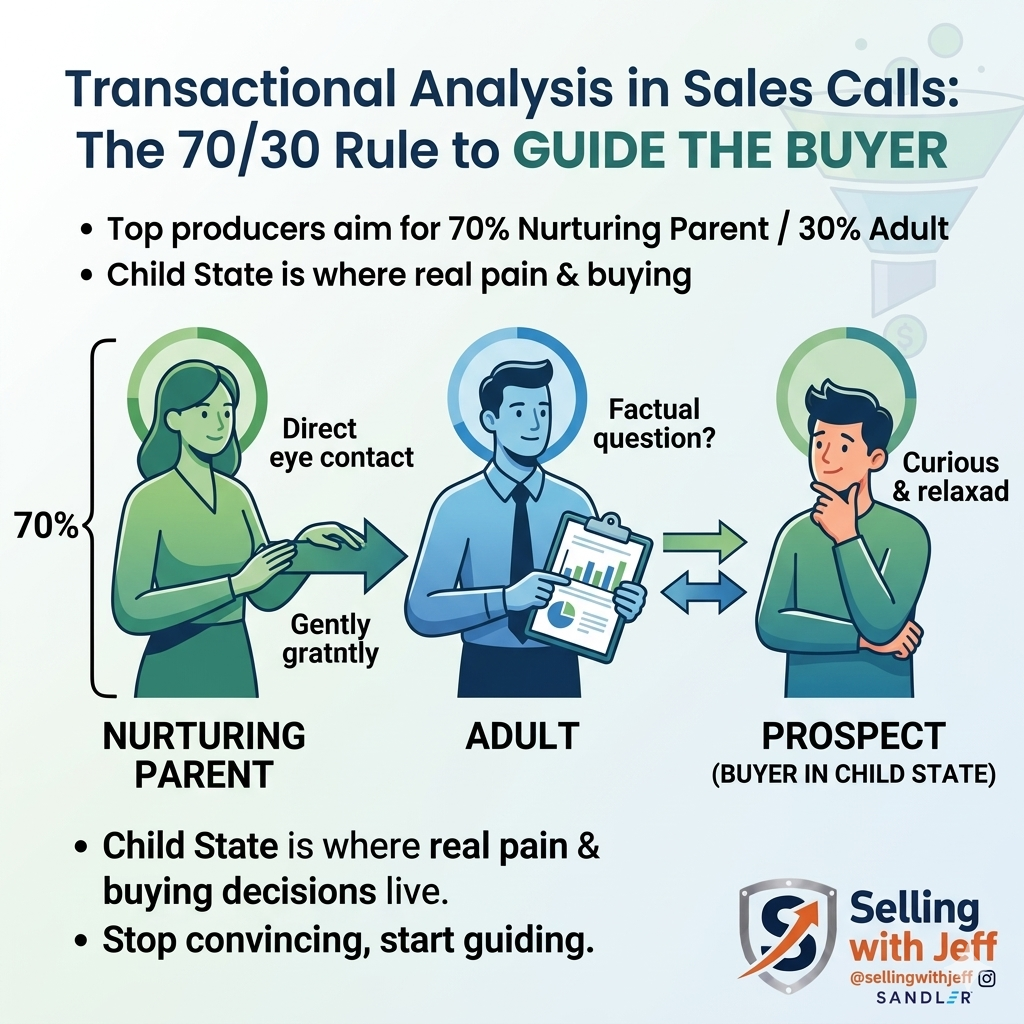
Transactional Analysis in Sales: Stay in Adult, Win More

Why sales calls go sideways: the real psychological problem
Transactional analysis in sales explains why conversations that start fine suddenly feel tense, confusing, or out of control. Most sales calls derail not because your solution is wrong, but because one or both people shift into an emotional state where they can’t listen, think clearly, or make a confident decision.
In the workshop transcript, several reps describe the same pain point: they know the mechanics of selling—up‑front contracts, questions, proposals—but a single comment from a prospect (“Your price is high,” “Just email me something”) can trigger defensiveness, frustration, or withdrawal. Once that happens, logic takes a back seat. Transactions that should move forward stall or end with a vague “We’ll think about it.”
Psychology models like transactional analysis (TA) and the Karpman drama triangle give salespeople language for what’s happening in those moments. TA, originally developed by psychiatrist Eric Berne and still taught in universities, describes three ego states we move through in conversations: Parent, Adult, and Child. The drama triangle, from Stephen Karpman, maps three common conflict roles: Victim, Rescuer, and Persecutor. Both are rooted in decades of psychotherapy practice and have been widely adapted for business, leadership, and sales.
For sales teams, the specific issue is consistency under pressure. You can role‑play great talk tracks in training, but when a live prospect challenges your pricing or compares you to a cheaper competitor, old habits surface. You over‑explain, discount too quickly, or start arguing. Understanding ego states and drama roles helps you notice those patterns in real time and consciously choose a different response that keeps the conversation productive.
That’s why many modern sales organizations and training systems integrate TA into their process: it turns “be more confident” or “don’t take it personally” from vague advice into concrete behaviors you can practice and coach.
How Parent–Adult–Child ego states show up in everyday selling
In TA, every person carries three ego states into a conversation. The Adult is calm, factual, and curious—think of an engineer or Mr. Spock. The Parent repeats patterns from authority figures, either as Critical Parent (“You should have known better”) or Nurturing Parent (“You’ve done a lot right; let’s fix what’s not working”). The Child is emotional: excited, anxious, playful, rebellious, or approval‑seeking.
Sales research and decades of field experience, including materials from Sandler and other consultative sales systems, converge on a key insight: buyers say yes in their emotional Child state, then justify that decision later in Adult with numbers and in Parent with “Is this responsible?” (Sandler TA overview). If you sell only to logic, you end up commoditized and shopped.
You can see all three states in the transcript examples:
- When a prospect says, “Your competition is cheaper,” in a sharp tone, that’s often Critical Parent. If the rep immediately defends the company or lectures the buyer on value, they slip into their own Critical Parent, which pushes the buyer into Rebellious Child (“You can’t tell me what to do”).
- When a rep hears “Just send me an email” after a good discovery and internally thinks, “So I just wasted my time,” they’re moving into Child—specifically a frustrated, hurt version that wants to react, not explore.
- When a trainee describes feeling more relaxed and “equal business stature” after practicing up‑front contracts—“Do you have 5–10 minutes to walk through this, then I’ll follow up in a day or two?”—they’re operating from Adult (clear expectations) and Nurturing Parent (warm, steady tone).
High‑performing sellers aim to spend most of their selling behavior in Nurturing Parent and Adult, and almost never in Critical Parent. A typical guideline is roughly 70% Nurturing Parent (warmth, safety, empathy) and 30% Adult (clarity, facts, next steps). That mix makes it easier for the buyer’s Natural Child to share real fears and desires—“Our last vendor burned us,” “We can’t miss another opening date”—which is where true motivation lives.
A practical example: a buyer says, “You need to sharpen your pencil if you want a shot at this,” which is a Critical Parent move. From Adapted Child, a rep might cave: “Okay, we can drop the price.” From Adult with some Nurturing Parent, the response changes: “Fair enough—when you say ‘sharpen the pencil,’ how far apart do you feel we are, and what are you comparing us to?” That keeps the interaction adult‑to‑adult instead of escalating a tug‑of‑war (TA in sales playbook).
Using the drama triangle to avoid unproductive conflict in deals
The Karpman drama triangle adds another lens for those hard conversations. It describes a repeating conflict pattern with three roles: Victim (“This is happening to me; I have no choice”), Persecutor (“This is your fault; you’re wrong”), and Rescuer (“I’ll fix it for you”). The model, rooted in transactional analysis, has been used in psychotherapy and later adapted for business and leadership coaching (Karpman overview).
In sales, this triangle often appears around pricing, implementation risk, or internal politics:
- A rep slides into Victim: “Procurement always beats us up; there’s nothing I can do.” They give up their ability to ask better questions or walk away from bad business.
- A buyer plays Persecutor: “You salespeople always complicate things. Just send the quote.” If the rep reacts from Critical Parent, the conversation becomes a blame game instead of a joint decision.
- A consultant‑style seller turns into a Rescuer, doing unpaid design work, customizing proposals for every internal stakeholder, and “saving” the project without any real commitment. They take responsibility that belongs with the client and feel burned out when the deal stalls.
The workshop examples hint at this pattern. When a buyer says, “Those weren’t the options we asked for; you never gave me enough information,” they are leaning into Persecutor language. The rep may be tempted to defend (Persecutor back) or over‑apologize and promise to redo everything overnight (Rescuer). Either way, the underlying issues—unclear decision criteria, missing stakeholders, weak pain—remain untouched.
The practical goal isn’t to label prospects but to notice the game and refuse to play it. Instead of rescuing or persecuting, you work to stay in Adult: “Sounds like we’re both frustrated with where this proposal landed. Would it be useful to pause and agree on the two or three things this next version absolutely has to address?” That kind of response acknowledges emotion (Nurturing Parent), avoids blame, and invites the buyer back into an Adult‑to‑Adult planning conversation.
Over time, teams that understand the drama triangle become less reactive. They don’t internalize every tough comment as an attack, and they don’t over‑own the client’s politics. They focus on clarity, mutual responsibility, and whether there is enough pain, budget, and decision structure in place to justify the work of moving forward.
Simple habits to stay in Adult and keep control of the sale
The most useful part of these models is not the theory; it’s a handful of concrete habits you can practice on every call to stay in Adult and Nurturing Parent, even when things get bumpy. Here are four you can start with:
-
Use strong up‑front contracts to prevent surprise. Early in the meeting, calmly set expectations about time, agenda, and possible outcomes: “We’ve got 30 minutes; is it okay if I ask some questions about your current setup, share a quick overview of what we do, and then we decide together whether it makes sense to schedule a deeper dive?” That Adult framing reduces end‑of‑meeting pressure, which is “the enemy of yes” in the transcript.
-
Name emotion without owning blame. When you sense tension, try a soft acknowledgment: “It sounds like my questions are creating some frustration. I don’t want to make this harder than it needs to be.” This is classic Nurturing Parent: it validates the buyer’s experience without collapsing into apology or counter‑attack. From there, pivot back to Adult: “Would it help if we paused and made sure we agree on what the proposal needs to cover?”
-
Slow down your response by one beat. The transcript shows how a single trigger phrase—“Send me an email,” “Your competition is cheaper”—can flip a seller into Critical Parent or hurt Child. Build a rule: when you feel that internal jolt, take one breath and ask a clarifying question instead of reacting. For example, “Happy to send something—so I don’t waste your time, what specifically would you want that email to help you decide?” This keeps you in Adult and often surfaces whether the request is real interest or a polite brush‑off.
-
Avoid unpaid consulting by checking commitment. Rescuer behavior is tempting, especially for technical experts. Before you invest in custom demos, site visits, or detailed design, ask Adult questions about commitment: “If we put the work into building that scenario, what will you be able to decide after you’ve seen it?” If the answer is vague, you’ve just spotted a potential drama triangle; adjust your effort or renegotiate the ask.
Teams that regularly debrief calls using this language—“I went Critical Parent there,” “They were in Victim; I tried to rescue”—build sharper self‑awareness. Over a few months, the cumulative effect is fewer emotional blow‑ups, cleaner qualification, and more deals that move forward without unnecessary drama. You’re still human and emotional, but you’re choosing your responses instead of letting old patterns run your sales process.