Teach Homeowners How to Buy with Better Questions
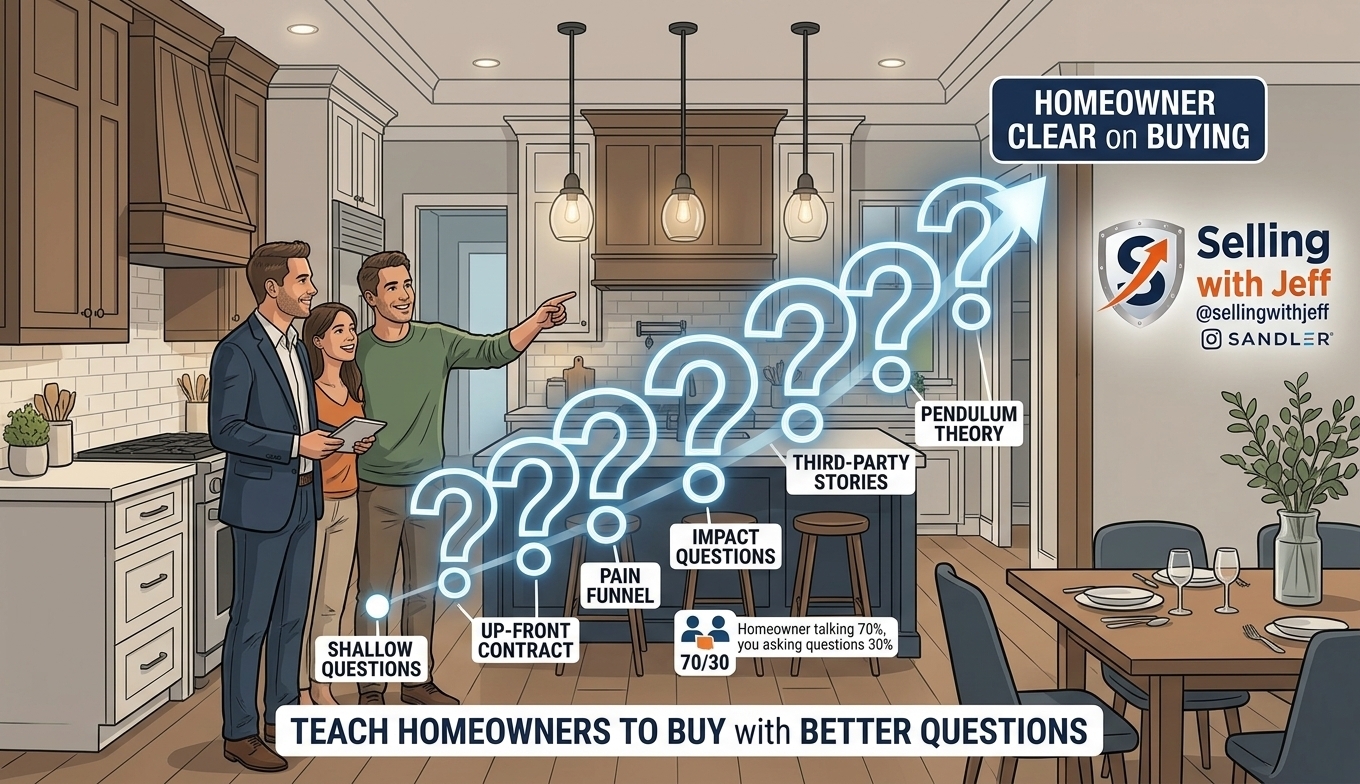
Most remodelers don’t lose deals because their drawings or specs are weak. They lose them because their questions stay shallow, so homeowners never get clear on why they should change, why now, and why with you. Let’s fix that with a few practical Sandler questioning tools.
Use questioning to teach homeowners how to buy
Effective remodeling sales questioning skills help homeowners see the real trade-offs in front of them so they can decide with confidence instead of stalling. That means slowing down, asking structured questions, and letting them talk through impact, budget, and priorities before you ever defend your price or your design.
Think of yourself as running a buying class, not a slide show. Early in the meeting, set an Up-Front Contract: “I’ll ask a lot of detailed questions so we can both see whether this project makes sense. At the end, can we either agree there’s a clear next step or decide it’s not a fit?” That one question teaches them there will be a real decision today.
When they say, “We just hate this dark, cramped kitchen,” don’t jump to layouts. Stay curious, skeptical, and patient. “Can you tell me more about that?” “How long has it been bothering you?” “What’s the effect on mornings or family dinners?” You’re teaching them to evaluate more than cabinets and countertops; you’re teaching them to weigh lifestyle, timing, and trade-offs.
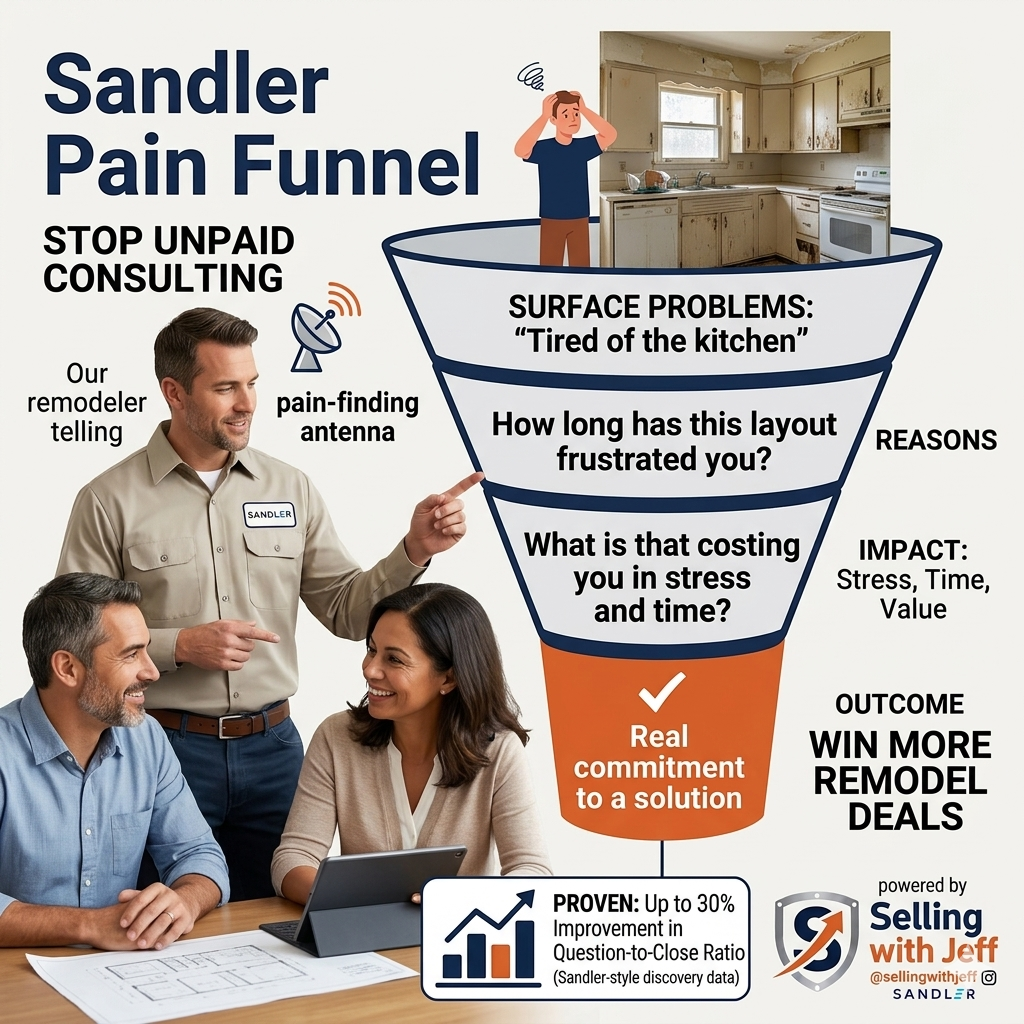
Make the Sandler Pain Funnel usable in real calls
Research on Sandler implementations shows that when reps uncover three pains with real impact, close rates can jump into the mid‑80% range, while deals with only one surface pain and no impact often close in the low teens (Sandler Remodeling Sales). The difference is whether you run the Pain Funnel or bail out early.
Most remodelers master the questions on paper and forget them in a live kitchen. Simplify. At the top of the funnel, stick to three anchors: “Can you tell me more?” “Can you be more specific?” “Can you give me an example?” Those alone move you from vague “We’re tired of it” to concrete “Mornings are chaos; we trip over each other.”
Then, add one impact question: “What’s the effect of that on your day-to-day?” A revenue consultancy tracking Sandler teams reports roughly 30% higher discovery-to-opportunity conversion and about 25% higher win rates when reps consistently reach impact-level pain (It’s Just Revenue). Your goal is not to check off nine questions; it’s to understand those impacts well enough that homeowners start selling themselves on change.
Third-party stories and menu questions that reframe price
Homeowners rarely know how to buy a major remodel. Third-party stories and menu questions let you guide them without lecturing. A third-party story sounds like: “Many of our clients struggled with the price difference between bids. They looked at three things: daily lifestyle, impact on home value, and confidence in communication. How are you planning to compare your options?”
Notice the structure: you normalize their concern, describe how others decided, then end with a question. That keeps you in discovery, not defense. Menu questions narrow focus without boxing them in: “Most clients tell us their top concern is either staying on budget, minimizing disruption, or getting a standout design. Which of those feels most important to you?”
When price comes up, resist the urge to justify. Ask, “When you talked with the lower‑priced contractor about how they handle design changes and site supervision, what did they share?” If they say, “We didn’t ask,” you’ve just opened the door to a deeper, apples-to-apples comparison—again, through a question.
Pendulum theory and the dummy curve in remodeling sales
Pendulum Theory (negative reverse selling) protects you from pushing harder than the homeowner is ready for. If they say, “You’re a bit higher than the others,” the amateur argues value. The pro steps slightly behind: “It sounds like you may already be leaning toward the lower bid. If you’re confident it’s the same scope and experience, you probably should go that way. The only reason to keep talking would be if there are important differences. Would it be worth comparing line by line?”
You’re not playing games; you’re stripping line off the reel so the “fish” feels safe enough to bite. Many remodelers report that when they adopt this stance, more honest objections show up early, instead of ghosting later.
The Dummy Curve is the discipline of acting like the new person on purpose. Even if you’ve done 200 kitchens, you stay in student mode: “Help me understand how you’re thinking about investing in this,” instead of launching into a mini‑seminar. One large Sandler study found that 88% of trained sellers feel their strategy improves and about 50% more hit quota (FirstSales.io). In your world, that improvement starts with one habit: ask the next question, even when you think you know the answer.