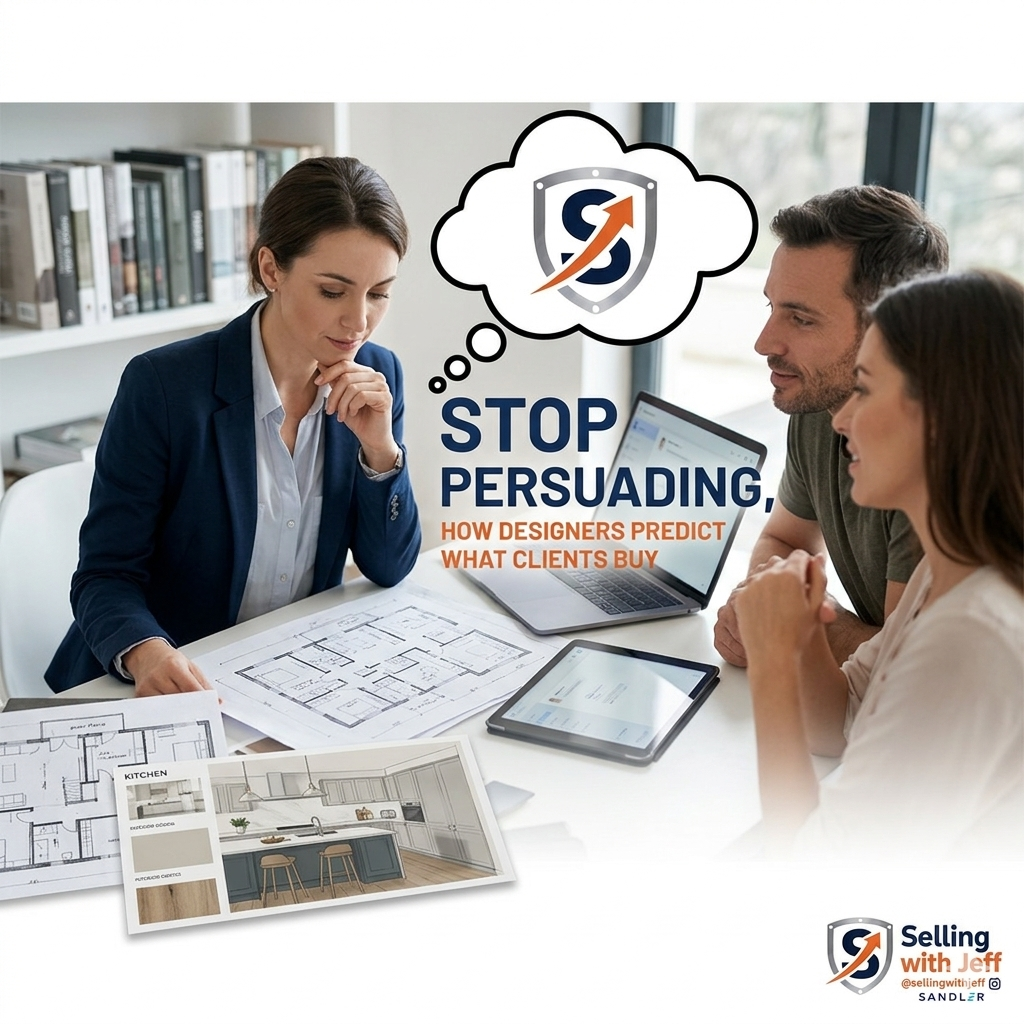
Stop Persuading: How Designers Predict What Clients Buy
Why persuading clients backfires for designers
Consultative designers get better results when they stop trying to convince and start trying to predict what a client will actually buy, based on their motivations, constraints, and decision process, then recommend only what clearly fits those realities. This shift turns sales from pressure into guidance and dramatically improves close rates.
Most designers were never hired to be “salespeople,” yet they sit in living rooms, Zoom calls, and kickoff meetings where real money is on the line. The instinct is to persuade: explain the concept better, show more options, talk faster when there’s silence, or push harder when a client hesitates.
That instinct is understandable—and costly.
Clients who feel pushed either stall, disappear, or push back. Psychological research on reactance shows that when people sense their freedom of choice is threatened, they resist—even if the recommendation is right. Sandler’s perspective aligns with this: when you tell a prospect what they “should” do, you trigger resistance, not trust.
A prediction mindset flips that dynamic. Instead of trying to win an argument, you treat the conversation like a diagnosis. Your job is to learn enough about pull forces (motivation, pain, desired future) and push forces (budget, fear, time, stress) that you can accurately predict what they will and will not move forward with.
Once you know that, “selling” becomes simple. You reflect their own words back and propose what already makes sense to them. As Sandler Rule #4 puts it, people don’t argue with their own data—a principle widely reinforced in Sandler content like Sandler Rule #4: People Don’t Argue With Their Own Data.
How to uncover the real motivations behind every project
Design conversations go off the rails when you accept what the client wants at face value instead of uncovering the deeper motivation driving that request—space, safety, status, family, or identity—and designing to that. Your questions must move from surface wants to underlying reasons.
Clients show up with AI research, Pinterest boards, self-drawn floor plans, and price anchors they found online. None of that is the real story. Those are just their first drafts of a solution.
Your job is to respectfully set that aside and investigate what sits underneath:
- What makes this project important now?
- What happens if they do nothing for 12–24 months?
- Who else is emotionally or financially invested in the outcome?
- Where are they cramped, frustrated, embarrassed, or worried?
A practical way to stay focused is the pull vs. push lens from the workshop:
- Pull forces (motivations): family gatherings they can’t host; fear of falling on stairs; embarrassment about a dated kitchen; needing a space that reflects their success; staying out of assisted living.
- Push forces (barriers): budget shock, schedule disruption, decision fatigue, fear of making a wrong call, disagreements between partners.
For example, a homeowner might insist on a 1,000-square-foot addition to a 1,000-square-foot home. If you stay at the level of the plan, you’ll chase drawings and change orders for months. Instead, ask targeted questions:
- “When you imagine this addition being finished, what are you actually doing in the space?”
- “Who are you picturing being there with you?”
- “If this never got built, what would you be most disappointed about?”
Designers in the session surfaced four recurring motivations for big additions:
- Hosting family and holidays without feeling cramped or embarrassed.
- Aging in place safely and avoiding a move to assisted living.
- Relieving the daily tension of a crowded, hard-to-use layout.
- Fulfilling a “promise” made when they bought the house (“We always knew we’d add on.”).
Once you hear motivations like these, your design and price conversation change. You’re no longer reacting to a sketch; you’re designing a solution around clearly stated forces that will either overcome or lose to the inevitable push of money, time, and disruption.
From ‘order taker’ to trusted advisor: predicting what clients will buy
Designers earn trust and control scope when they act like experts predicting what the client will decide, instead of order takers trying to satisfy every request or convince clients to accept their ideas. This is the difference between reactive quoting and professional selling.
In the workshop, one remodeling firm had given a client six separate floor plans because “the customer asked.” It took days of team time and left the client more confused, not closer to a decision. That’s order taking.
Trusted advisors operate differently. They:
- Do pre-call planning before every meeting: what do we know about pain, budget, decision makers, timing, and desired outcomes?
- Enter the conversation with a clear PALO (purpose, agenda, logistics, outcome), including permission for the client to say no.
- Explicitly give the client the power to say no: “If this doesn’t feel right, or if our process isn’t a fit, it’s completely okay to say no.” That single move lowers pressure and raises trust.
- Treat proposals as a prediction test, not a brochure. If they’re not confident the client will buy what’s presented, they slow down and keep qualifying.
One trainer shared his own turning point as an engineer-turned-salesperson. After burning time on technical demos that impressed but never closed, he changed his rule: “I’m just going to find out what they’re going to buy. If it’s something we sell, great. If not, I’ll leave early.”
The results were immediate: less time, more deals, better fits.
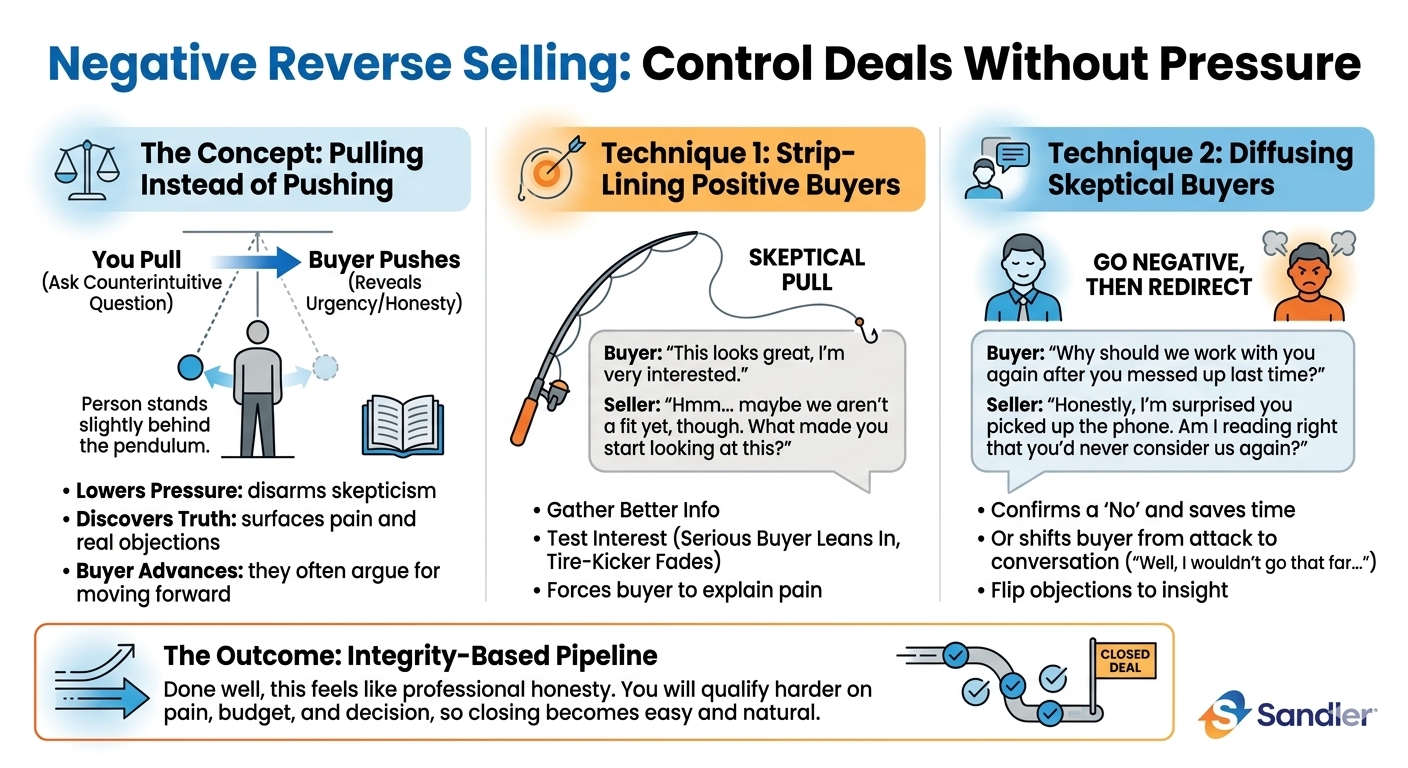
Modern Sandler content on Negative Reverse Selling, like Motivating Buyers with Negative Reverse Selling, reinforces this behavior. Instead of pushing, you:
- Step slightly behind the client’s enthusiasm.
- Use gentle, counterintuitive questions (“Maybe this isn’t urgent?”) that invite them to defend their own motivation.
- Let them convince themselves that action—and working with you—is the right move.
When designers adopt this stance, they:
- Reduce unpaid design iterations.
- Align scope and budget earlier.
- Preserve credibility, because proposals rarely miss by a mile.
- Become the calm, confident guide clients lean on when AI, TV shows, and friends’ opinions create noise.
Practical scripts designers can use in their next client meeting
You don’t need to become a traditional “sales rep” to sell effectively; you need a handful of simple, repeatable phrases that surface motivation, normalize ‘no,’ and help clients verbalize the project they’re truly willing to buy. Here are four script patterns pulled directly from the session.
1. Opening the meeting with control and safety (PALO)
“We’ve got about 45 minutes. My goal is to understand what’s driving this project, how you make decisions, and whether it makes sense to take a next step together.
At the end, you’re totally free to say yes, no, or ‘not now.’ All three are okay. Does that work for you?”
This instantly shifts the energy. You’re not begging for a yes; you’re inviting an honest decision. Many designers are surprised how often clients relax and share more openly after hearing that “no” is truly allowed.
2. Respectfully parking AI research and self-made plans
“You’ve clearly done a lot of homework—AI searches, sketches, even a rough floor plan. That’s rare and really helpful.
Before we lock into any one solution, can I ask a few questions about what’s motivating all this work so we’re sure we’re solving the right problem?”
Then move into motivation-focused questions:
- “When you picture this finished, what’s happening here on a typical week?”
- “Who else needs to love this space besides you?”
- “What would make you look back in five years and say, ‘That project was absolutely worth it’?”
3. Using gentle negative reversing to surface real interest
When a client seems lukewarm or evasive:
“It sounds like this might not be the right time to tackle a full remodel. Am I reading that right?”
Or:
“You’ve mentioned the budget a few times. It may be that staying closer to what you already have is going to feel safer. Would it make more sense to leave things as they are for now?”
If there’s genuine motivation, they’ll correct you: “No, we really do need to fix this,” and then volunteer the real drivers—exactly what you need to predict what they’ll buy.
4. Presenting recommendations as a prediction, not a pitch
When you finally present a concept or design agreement, anchor it in their own data:
“Based on what you told me—that hosting family without feeling cramped is a top priority, that you’re planning to age in place here, and that you want to stay under $X—we’ve narrowed this to one addition concept.
My prediction is that this is the option you’ll feel best about long term. Here’s why it fits what you shared.”
If they push back, don’t argue. Go back to motivation and pull vs. push:
“I might have misread something. Can we revisit what matters most: is it more about budget, timeline, or solving the space and safety issues you described?”
By combining these scripts with a prediction mindset, designers move out of the exhausting role of persuader and into the confident, professional stance of advisor. Clients feel heard and in control, projects are better aligned with reality, and your close rates and profitability improve—without ever feeling “salesy.”