
How to Ask Prospects About Competitors (Without Being Pushy)
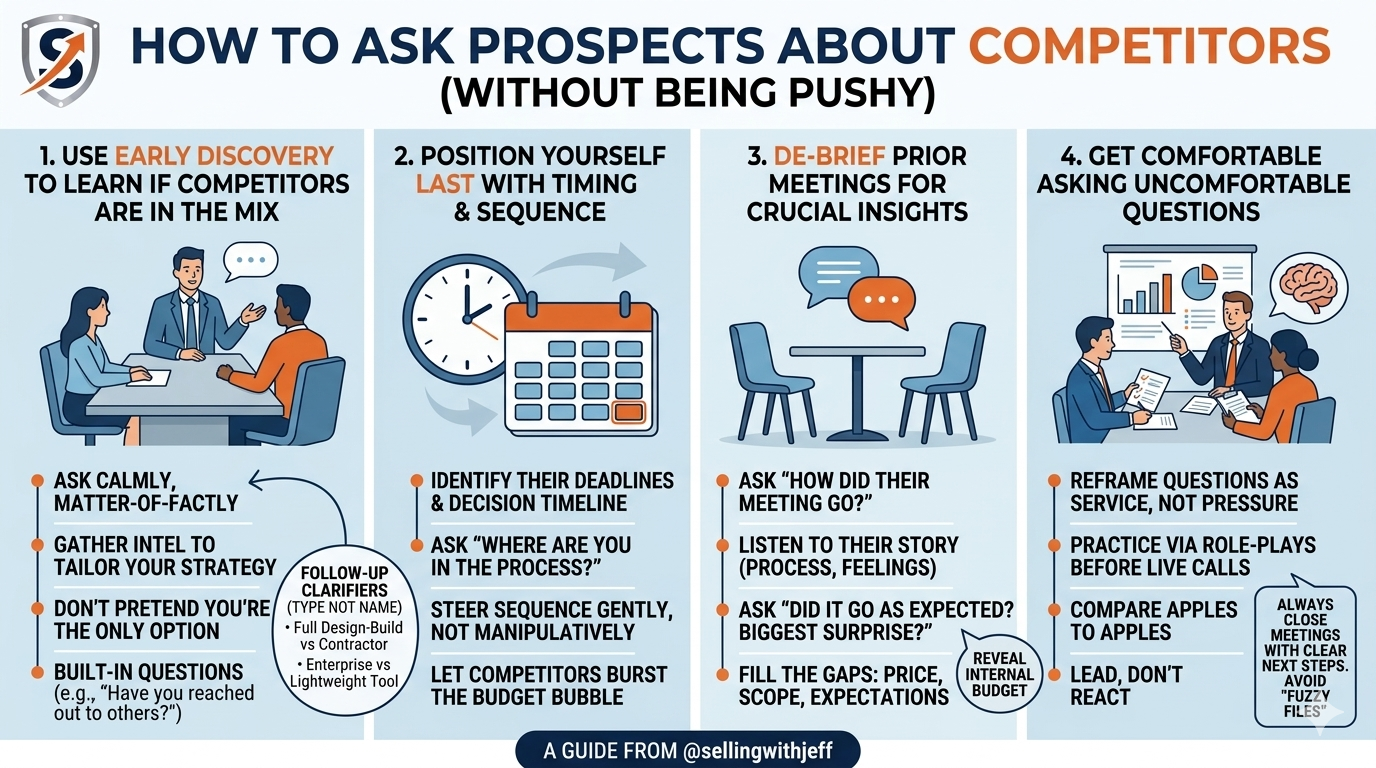
Use early discovery to learn if competitors are in the mix
In a sales call, you should quickly learn whether your prospect is talking to other competitors so you can qualify the opportunity and plan your strategy. Ask in a calm, matter‑of‑fact way, then use that information to tailor your approach, rather than pretending you’re the only option.
Front‑line reps in design‑build, SaaS, or professional services often hear, “We’re getting three bids,” but never learn who those bids are from. The fix is to build competitor questions into your standard lead‑intake or first‑call discovery, right alongside budget and timing. For example: “Out of curiosity, have you reached out to any other firms about this yet?” This open, neutral question surfaces whether you’re in a competitive bake‑off without sounding paranoid or defensive.
When prospects say yes, follow with clarifying questions about type, not name: “Are they full design‑build firms or more traditional contractors?” or “Are they more of an enterprise platform or a lightweight point tool?” Sandler’s own guidance on selling against competition (Sandler UK) stresses differentiation; knowing if you’re up against a low‑price “Chuck in a Truck” versus a polished national player radically changes how you sell value.
Don’t be surprised if some people refuse to share competitor names on the first call. That’s normal. Capture what they do give you—number of competitors, type of solution, how they found them—and pass that forward to the closer. Even a simple note like “They’ve already met one local design‑build firm and are interviewing a second” helps your sales team walk in with context and better questions.
Ask about timing and sequence so you can position yourself last
To gain an edge in competitive deals, you want to be the last serious conversation the prospect has. The easiest way to do this is by asking about their timing and the order of other meetings, then positioning your meeting near the end—without sounding manipulative.
Prospects will often volunteer timing information when you explore deadlines: “We’d like design finished in six months,” or, “We want to select a platform this quarter.” Use that opening to ask, “Where are you in the process with other firms?” and, “Have you already had your first meetings?” These questions sound like project management, not interrogation, yet they reveal whether you’re first, second, or third into the opportunity.
If they’ve already scheduled others but haven’t shared dates, you can still steer sequence using concern‑based language: “I don’t want to overwhelm you with appointments, especially if your spouse/travel schedule is tight. Do you prefer to stack meetings together, or space them out so you can compare notes?” When a prospect replies, “We’d like to move quickly and get everything done this week,” you simply offer the latest slot you reasonably can—Friday afternoon instead of Monday morning.
Research from Sandler and other sales organizations shows that when you enter later in the evaluation, you let competitors be the ones to “burst the budget bubble” on price, while you can frame your solution around value and total experience. Being last also lets you reference earlier meetings in your questions: “Tell me how those first two conversations went,” which naturally leads to insights about price, scope, and gaps that you can address directly in your proposal.
De‑brief prior meetings to learn pricing, process, and gaps
After your bonding and rapport and a clear upfront contract, de‑brief prior conversations by asking the prospect how earlier competitor meetings went, what surprised them, and how those meetings ended. This sequence reveals real decision criteria and often an approximate price range.
Start simply: “I see from our notes you’ve met with at least one other firm—how did that meeting go?” Then stay quiet. Prospects will usually tell a story: who they met, what the process looked like, and whether it felt rushed, confusing, or reassuring. Follow with: “How did that meeting end?” You’re listening for whether they walked away with a bid, another appointment, or a vague promise of an estimate.
Next, ask, “Did the meeting go the way you expected?” and, if they say mostly yes, “What was the biggest surprise?” In many deals, the answer is price: “It was more than we expected.” That opens the door to: “Got it. What had you expected it to be?” Now you’ve learned both their internal budget and that a competitor has already anchored the number higher—without you being the one to shock them.
Sandler UK’s guide to questions when buyers are considering other offers (Sandler UK) reinforces this: thoughtful questions uncover where the other offer falls short. Whether it’s a rushed in‑home estimate or a thin discovery process, you can frame your meeting and proposal to fill those gaps—stronger design, better communication, clearer expectations—rather than simply undercutting price.
Get comfortable asking uncomfortable questions in sales
Sales pros who consistently win competitive deals are simply more willing to ask uncomfortable sales questions—about competitors, budget, and risk—than their peers. The discomfort never fully disappears, but they decide they’d rather feel momentary awkwardness now than long‑term confusion after getting ghosted.
One practical way to build that muscle is to reframe these questions as service, not pressure. When you ask, “Who else are you considering?” or, “What did they quote you?” you’re not being nosy; you’re making sure the prospect is comparing apples to apples. As Jason Lemkin notes in SaaS deal cycles (SaaStr), if you don’t bring up competitors, they will—and you’ll be reacting instead of leading the conversation.
Practice these uncomfortable questions in role‑plays before you try them live. Start with softer versions—“Where are you in the process with other firms?”—and work up to direct ones—“Mind if I ask who those meetings were with?” Track your results: how often do people actually push back? Most teams discover that prospects are far more open than they feared, especially once some rapport and structure are in place.
Finally, close your meetings with clear next steps so you never add to your own “fuzzy files”—those vague, “Follow up in the fall” opportunities with no scheduled date. Either secure a calendar commitment or agree it’s a “no for now.” The more disciplined you are about asking the right hard questions, the less time you’ll spend wondering why you lost, and the more deals you’ll win on purpose, not by accident.