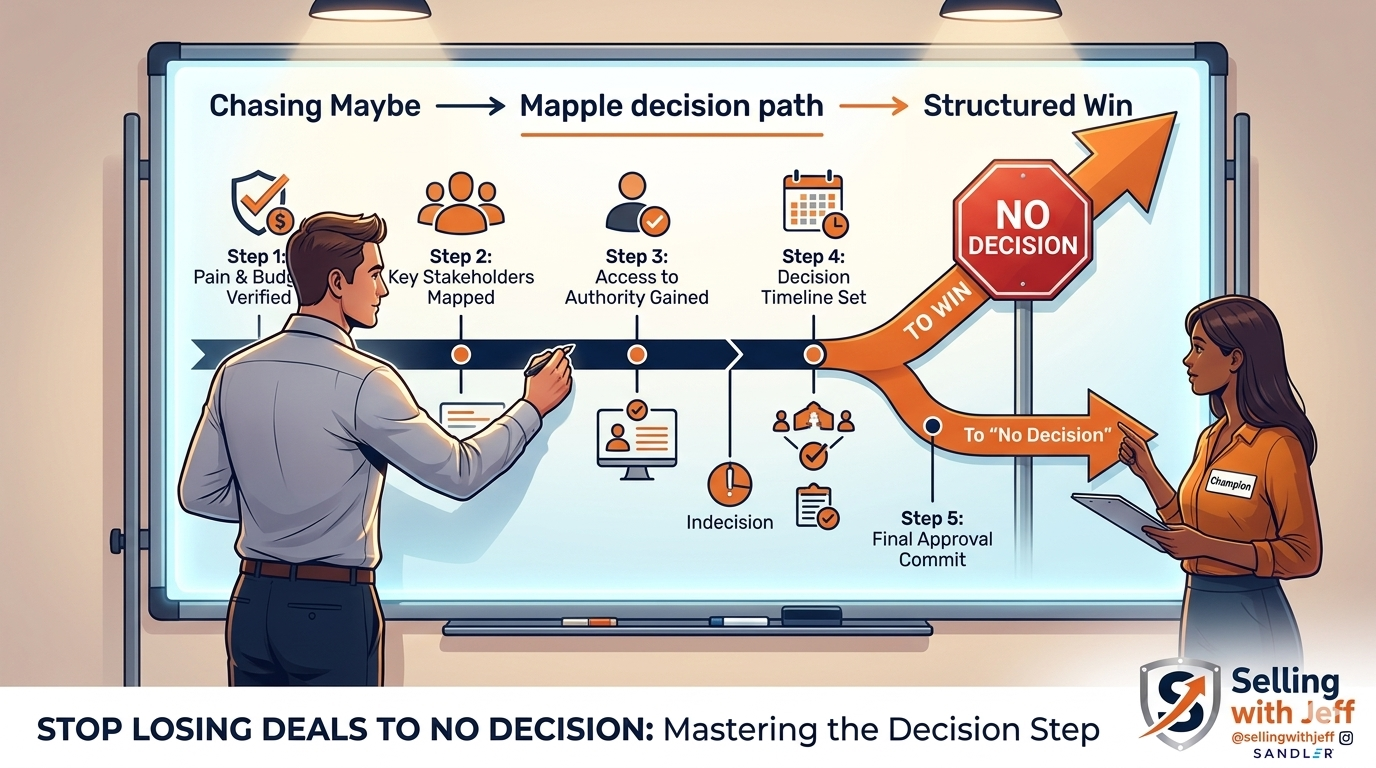
Sandler Decision Step for Remodelers: Stop No-Decision Deals

Why remodelers lose qualified deals at the decision step
The Sandler Decision Step is the moment in your sales process when you get crystal clear on who decides, how they decide, and when the decision will be made. When you treat decision clarity as a hard qualification gate, you dramatically reduce stalled, “think-it-over” projects and inaccurate sales forecasts.
In many remodeling and design-build companies, projects sound great on paper: the homeowner is in pain, they love your ideas, and they say budget is fine. But then everything slows down. Weeks pass. Emails sit unanswered. A “we just need to talk about it” turns into silence. Sandler trainers routinely see teams lose 20–40% of their pipeline to “no decision” because the decision step was never truly qualified. Research on complex buying shows that modern buying groups often include multiple stakeholders, each with different concerns, which is why deals stall without clear decision maps (Sandler Training).
Your own call recording shows this pattern. The team had:
- Real pain (embarrassment about current spaces, safety issues, outdated layouts)
- Clear budget targets and big opportunities ($200k+ kitchens, six‑figure porches)
- A strong pipeline still needing ~$300k in 15 days
Yet there was obvious anxiety about two big jobs (Emerman and Snowden) and whether decisions would actually happen this month. The salespeople felt good about the opportunities but didn’t have a shared, explicit decision roadmap for each one. That’s the core pain point for your ideal reader: they’re doing way too much work on projects that can’t or won’t decide.
For remodelers, qualification is not just about square footage and budget. It’s about whether the household can make a timely, confident decision that leads to a clear "yes" or "no." Without that, design work becomes free therapy, and production capacity becomes impossible to plan.
Six decision questions: practical scripts for remodeling sales
The Decision Step in the Sandler Selling System boils down to six simple buckets: who, what, when, where, how, and why the decision will be made. Your call already surfaced many of these, just not as a consistent checklist. Here’s how to turn them into a repeatable, remodeling‑specific conversation.
1. Who: “Who besides yourself… and who else?”
Avoid the defensive “Who’s the decision maker?” Instead, use softer questions and keep going until there are no more names.
- “When it comes to a project like this, who besides yourself will have a say?”
- “Got it. Who else usually weighs in on big decisions like this?”
- “Anyone whose opinion could slow things down if they’re surprised later?”
In your recording, you named classic surprise stakeholders: adult children vetoing walk‑in tubs to “protect their inheritance,” financial advisors managing a trust, out‑of‑state designer friends, and even disease dynamics like a spouse with Alzheimer’s. Each of these is a potential sniper if not surfaced early.
2. What: "What steps do you typically go through?"
Start with process, then layer people into each step.
- “What are the steps you typically go through when you make a decision this big?”
- “What needs to happen after today for you to feel comfortable saying yes or no?”
As they talk, you can naturally add back the who questions:
“Okay, when you’re comparing options, who’s usually in that conversation with you?”
3. How: "How have you made decisions like this in the past?"
Tapping history helps you avoid wishful thinking.
- “How have you made decisions like this in the past? Did it go smoothly or get stuck?”
- “How would you like this one to go differently?”
If they’ve remodeled before and it dragged for months, this question alone can reveal real risks—and their appetite to fix them.
4. When: Start with the finish line and walk backward
Your call modeling this was strong. You anchored on the date when the kitchen is finished, clean, and ready for Christmas, then backed into design, selections, permits, and demo. The key improvement is to let the client do the math out loud:
- “Imagine it’s December 20th. Your kitchen is done, the dust is gone, you’re cooking for friends, and you’re not embarrassed anymore. What date feels right for that?”
- “If construction will take about six months, where does that put our start date?”
- “Before we swing a hammer, we need permits, selections, and ordered materials. How many weeks do you want to allow for each of those?”
When the homeowner says the dates, they’re writing their own decision timeline. You’re not pushing; you’re translating their dream into a calendar.
5. Where: "Where in your family will this decision be felt?"
The standard business version (“Where in the organization will the impact be felt?”) doesn’t fit residential. Switch to family and day‑to‑day life:
- “Where in your family do you think you’ll feel this remodel the most?”
- “Where will this help you the most—mornings, holidays, hosting, accessibility?”
Answers like “Mom living in the basement,” “adult kids visiting with grandbabies,” or “my husband’s mobility” signal who may quietly influence the decision and how strongly.
6. Why: "Why decide now instead of later?"
This is about urgency and consequence.
- “You could keep living with things as they are. Why change this now instead of waiting a year?”
- “If nothing happens in the next 12 months, what breaks down first—comfort, safety, or family logistics?”
Linking this “why now” back to pain (embarrassment, safety, crowding, a spouse’s declining health) makes decisions feel necessary, not optional.
Put together, these six buckets form a short, conversational checklist that turns vague optimism into concrete qualification—without sounding like an interrogation.
Using timelines and accountability without overwhelming clients
Your team was honest about a tough reality: you often build timelines you don’t keep. You create a sharp “decision timeline” document, review it in the first meeting, and then let the dates slide. That’s demoralizing for you and confusing for clients.
The fix isn’t more pressure on homeowners. It’s a more realistic internal schedule, clearer shared milestones, and light‑touch accountability.
1. Make the first version realistic, not optimistic.
In the call, you recognized that you tend to schedule “for the best case” and then life happens—engineers run late, trades back up, and internal communication slips. Start by assuming the actual cycle time you see today, not the ideal. If an engineer usually takes three weeks, build four into the plan. If selections almost always take a month, plan for six weeks.
2. Co‑create milestones in the meeting.
Use the backward‑from‑finish exercise live with the client, then write it down in simple language:
- “Selections complete by March 15”
- “Permits submitted by April 1”
- “Construction start around September 1”
Have them say these dates out loud and confirm they’re realistic given other life events (school schedules, travel, caregiving).
3. You own the reminders; they own the decisions.
The team instinctively pushed back on asking clients to chase them if they miss a step—and they’re right. It’s your job to manage the workflow. A better phrasing is:
- “I’ll put these milestones on my calendar. You’ll hear from me a week before each one so you’re never surprised. If you ever feel like we’re slipping, please call me out—we want you to feel in control of the process.”
This way, the homeowner feels involved and respected, but you are responsible for the follow‑through.
4. Book the next decision appointment before you leave.
One of your designers already does this well: before leaving, they always schedule the next selection or review session. That keeps Big Decisions anchored on the calendar instead of drifting into email limbo.
For example:
“Since we just mapped out needing all kitchen selections by March 15, let’s get two selection sessions on the calendar now. That way, you’re not scrambling, and we can keep the project on track for Christmas.”
5. Use your project platform as a daily trigger, not a passive record.
Your JobTread schedule already shows what’s upcoming and late. The missing link is a daily ritual: 15 minutes each morning to scan upcoming decision deadlines and send quick nudges:
- “Just a reminder: our appliance selection meeting is next Tuesday at 3.”
- “Permits are filed; we’re still on track for your September start date.”
That small habit shift turns timelines from “nice documents” into living tools that protect your margin and your sanity.
Spotting and disarming hidden “snipers” in family decisions
One of the most valuable parts of your conversation was the real‑world stories of snipers—people who appear late in the game and can derail a nearly‑sold project. In Sandler terms, these are saboteurs who hide in the bushes until your team has invested hours in design and estimating.
You mentioned:
- Adult children overruling a $30,000 walk‑in tub to guard their inheritance
- A financial advisor controlling a trust and demanding contract changes
- A surprise designer friend flying in to mark up your plans at 85% completion
- A spouse whose Alzheimer’s made decision‑making unpredictable and slow
These aren’t edge cases. They’re predictable patterns you can surface with better decision questions and a few proactive moves.
1. Ask “who might be coming over?” early.
A thoughtful accessibility question from your team doubles as a sniper detector:
- “We like to think about accessibility. Who might be coming over regularly—parents, friends, anyone with mobility issues? Will any of them be part of the decision process?”
This feels caring and practical, not political—and it often flushes out adult children or aging parents you need to know about.
2. Normalize third‑party advisors instead of resisting them.
When a financial advisor or designer friend is likely to get involved, invite them into the light:
- “Many of our clients run big projects past a financial advisor or a designer friend. Is there anyone like that we should plan to include early so they’re not surprised later?”
If they say yes, schedule a short joint call. One Sandler‑aligned resource notes that mapping all influencers can shorten cycles and prevent late vetoes (Sandler by Breakthrough Selling).
3. Turn potential saboteurs into collaborators.
You already did this beautifully with the visiting designer: you walked through the development schedule, clarified which tasks she would own and bill for, and which you would handle. When she realized she didn’t want to do that much work for free, she gracefully backed out.
That pattern is powerful:
- Define roles and responsibilities clearly
- Offer a professional path for outside experts (paid or scoped)
- Give them visible credit when their ideas are used
Often, the fastest way to neutralize a sniper is to give them a legitimate way to win.
4. Re‑check decision clarity at every major stage.
Decision qualification is not a one‑time question. Before each big investment of your time—site measure, design presentation, final estimate—pause and reconfirm:
- “Just to double‑check, is anyone new involved in the decision since we last talked?”
- “Is anything in your family, finances, or timeline that might change how you decide?”
A five‑minute re‑check can save five weeks of chasing.
When you consistently ask these questions, map realistic timelines, and stay proactive about hidden influencers, the Decision Step stops being a fuzzy idea. It becomes a practical, day‑to‑day habit that protects your pipeline, your profit, and your clients’ experience.