Sales Role Play Practice: Turn Reps Into Closers
Why most sales reps perform more than they practice
Most teams still treat practice as optional, so reps improvise on live calls instead of rehearsing in advance. AI sales roleplay fixes that by giving them a safe, repeatable way to run discovery, budget, and objection conversations until the right moves are automatic.
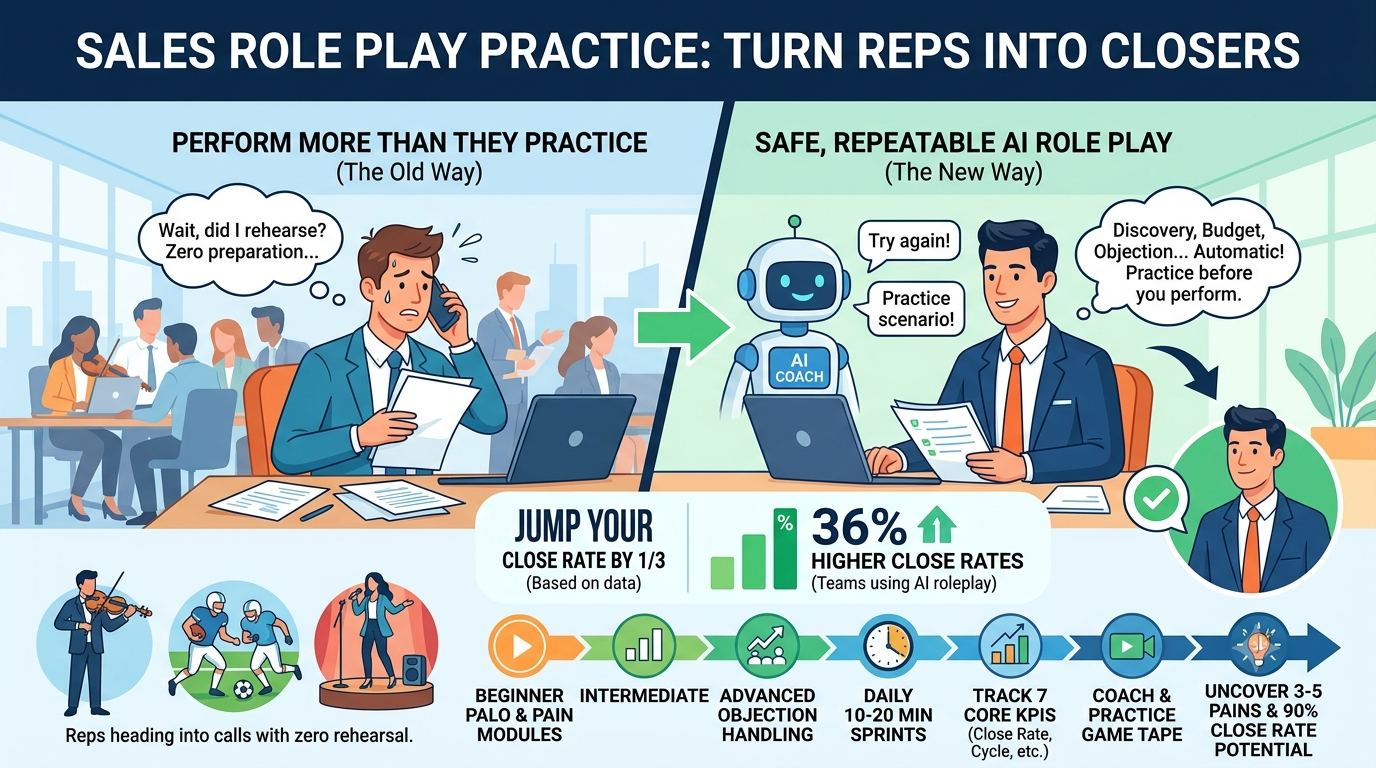
Sales is the only “talent profession” where people perform more than they practice. Musicians like Yo‑Yo Ma, NFL teams like the Lions, and performers like Taylor Swift all practice far more than they are on stage. Yet most reps head into calls having done zero rehearsal beyond a quick skim of their notes.
That gap between knowing and doing is exactly where deals die. One internal Sandler analysis found that reps who practiced before sales calls increased close rates by roughly one‑third. External data backs this up. Aggregated research summarized by Auto Interview AI reports that teams using AI roleplay training see close rates about 36% higher than those relying on traditional training alone. You are not “different in front of the client” in a good way—you are usually 6–8% worse.
The core problem is psychological. Role play feels awkward. So reps avoid it and “practice” on real prospects, where mistakes are expensive. Your job as a leader is to flip that equation so practice happens in a safe environment, and performance time is when the risk shows up.
Make role play a non‑negotiable calendar habit
Managers can solve the “I’ll get around to it” excuse by turning role play into a calendar commitment. Every rep blocks three 20‑minute slots per week and treats them like client meetings: only a true emergency or house fire justifies canceling. That framing alone dramatically increases follow‑through.
This frequency matters. AI roleplay platforms like Sandler’s Role Play Coach, powered by Yoodli, make it realistic to practice in short, intense sprints instead of rare hour‑long marathons. Research summarized by Sandler shows that reps who run simulations before real calls protect every high‑value lead and lift close rates without adding more pipeline. Similarly, a data review by Auto Interview AI found that daily AI roleplay reps hit materially higher win rates than peers who only train in workshops.
Make the habit concrete:
- Block three 20‑minute sessions weekly for each rep.
- Insist they treat those blocks as sacred as prospect meetings.
- Start with beginner PALO and pain modules; move to intermediate, then advanced.
- Encourage them to share real call recordings to compare “practice vs. game tape.”
In one analysis of roughly 1,000 enterprise interactions, AmpUp found a 4.2x win‑rate difference between reps rated strong vs. weak at objection handling. AI roleplay lets your team rehearse exactly those high‑risk objections the day before they face them.
Use PALO and the pain funnel until they feel natural
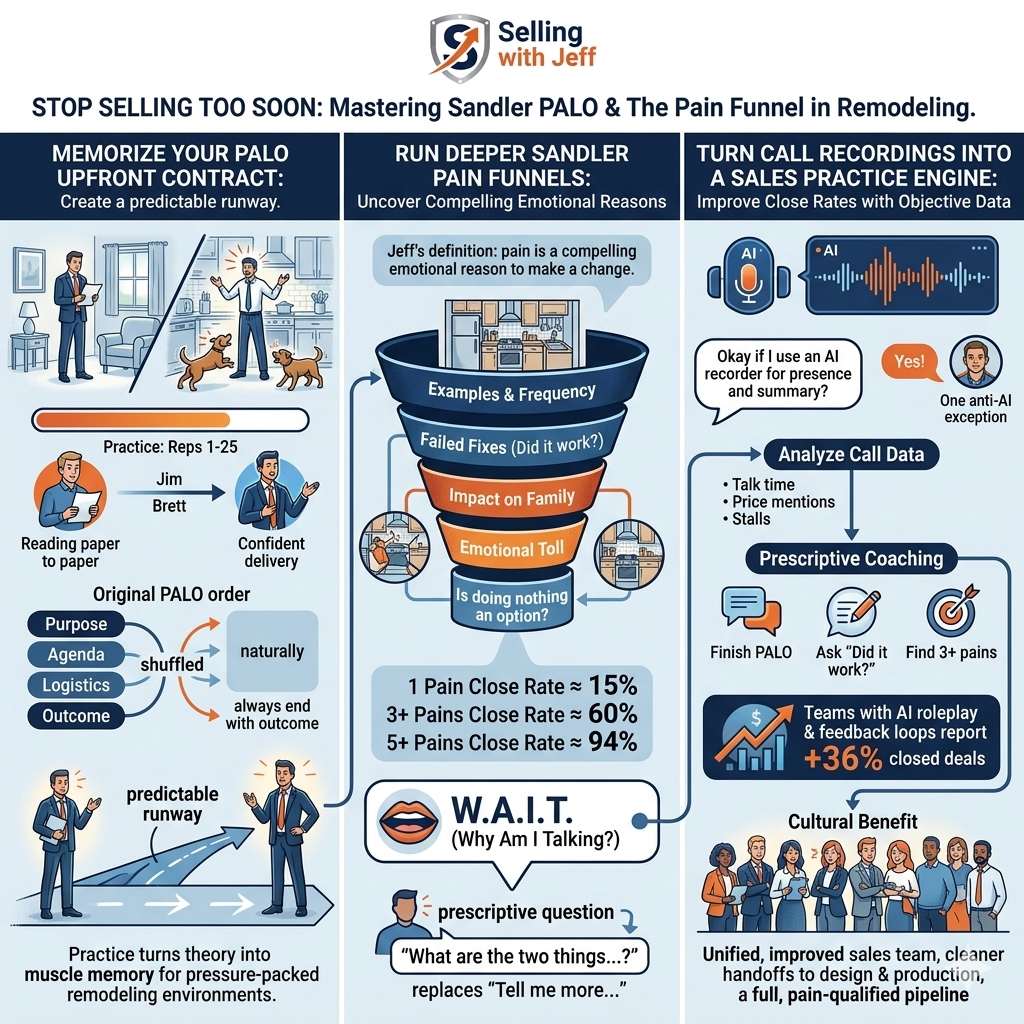
Early on the team’s first attempts at PALO (Purpose, Agenda, Logistics, Outcome) will sound stiff and scripted. By repetition the words changed, the rhythm relaxed, and the openings felt more like real conversations. That is precisely the journey every rep must take—from robotic to natural.
Here is a simple rule: run your PALO 25 times in 24 hours to move from “that was clumsy” to “meh.” Then keep going. By 100–200 reps, your version will sound nothing like the original script—and that is a good sign. The structure is still there; it’s just invisible to the buyer. AI roleplay accelerates this by letting reps burn through dozens of iterations in a week instead of waiting for live opportunities.
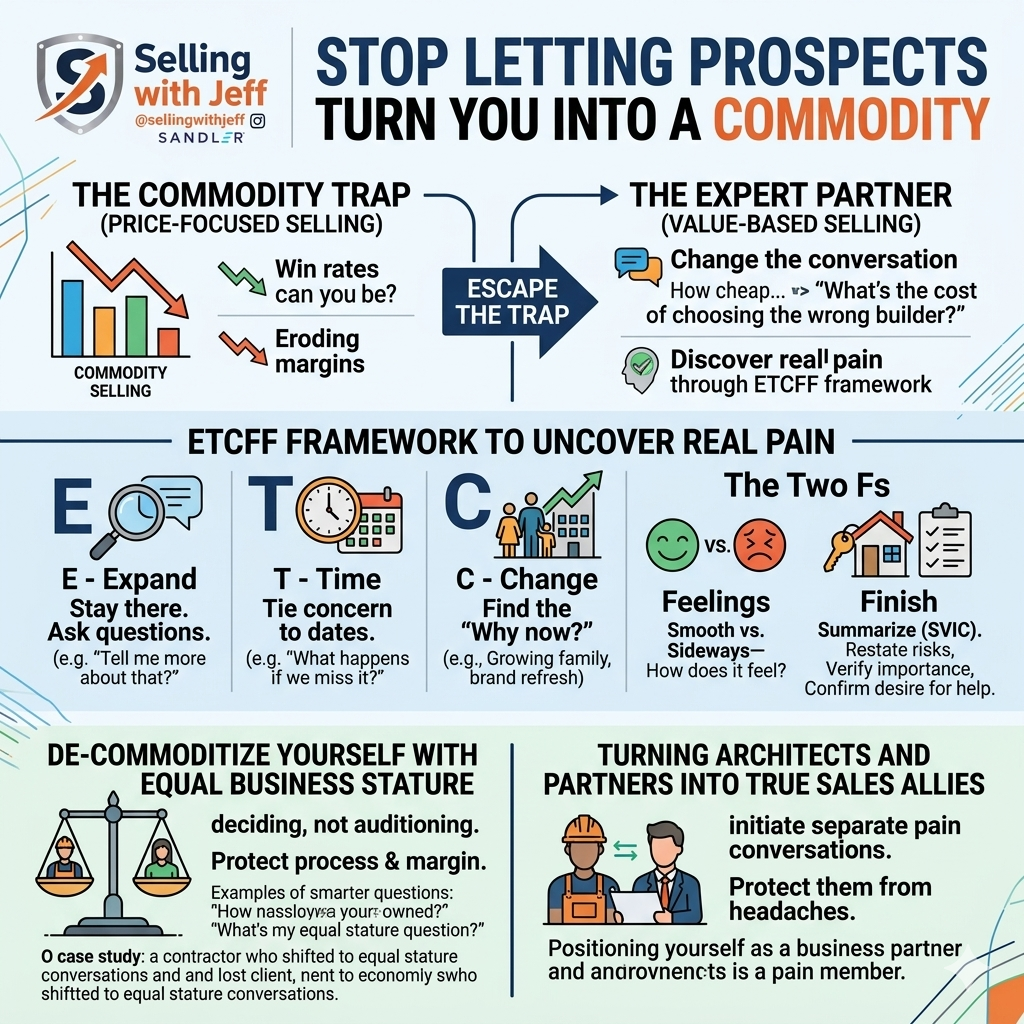
The same applies to the pain funnel using E‑T‑C‑F‑F (Expand, Time, Cost, Fix, Feel). Practicing questions like “Can you give me an example?” “How often is that a problem?” “What have you tried to fix it?” and “How does that make you feel?” builds the muscle to keep digging instead of jumping to a pitch. Jeff knows from thousands of calls that getting to three–five real pains, with emotional impact, pushes close rates toward 90%.
Have reps:
- Practice full PALO openings until they can’t help but sound like themselves.
- Run complete pain funnels in simulations, staying in each letter (E, T, C, F, F) long enough to feel slightly uncomfortable.
Measure progress: from awkward calls to confident 90% closes
None of this matters if you don’t measure behavior change. A simple score thresholds: 70% is a C, 80% is a B, 90% is an A, and 100% earns a prize. The important part is not where reps start; it’s that they reach consistent 90% proficiency on core scenarios.
Modern AI roleplay tools make this measurable. Platforms like Sandler AI Role Play Coach, Tough Tongue AI, or AmpUp’s Skill Lab score reps on structure, questioning, and objection handling, and show trends over time. Auto Interview AI’s review of multiple datasets highlights that teams who commit to 10–20 minutes of daily AI practice and track seven core KPIs (close rate, win rate, cycle length, objection conversion, etc.) see sustained performance lift, not just short‑term bumps. Y
Tie your own measurement to behaviors you can observe:
- Number of AI sessions completed per rep per week
- Time to reach 90% scores on beginner, intermediate, and advanced PALO
- Number of pains uncovered per discovery call (aim for three–five)
- Talk‑time ratio trending toward 20% rep / 80% prospect
Over time, you should see a clear pattern: the people who actually practice in a safe environment—AI coach plus internal role play—are the ones who close more, ask for raises less, and hit their personal income goals faster. Practice more than you perform, and your win rate will finally reflect the potential buried in your current pipeline.