Remodeling Urgency: Turn “In a Month” into Decisions
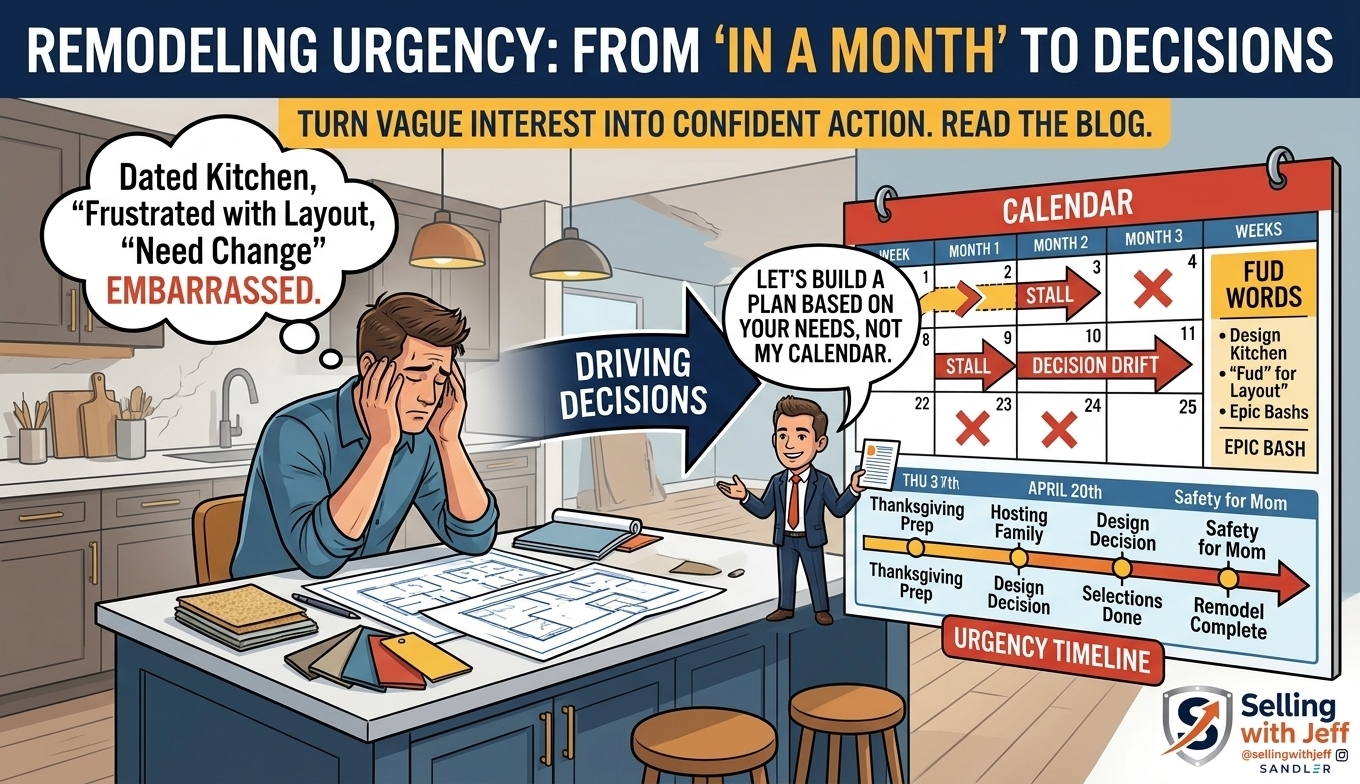
Homeowners rarely say, “We’re avoiding a decision because we don’t feel enough pain yet.” Instead, they say, “Let’s circle back in a month,” then another month, and another. For remodelers, those slow‑drifting opportunities are frustrating and time‑consuming—unless you know how to re‑ignite urgency without becoming pushy.
Why remodeling prospects say “in a month” (and what it really means)
To turn repeat “in a month” responses into real decisions, use the Sandler pain funnel to revisit why the project matters, label the emotions with FUD words, and rebuild a shared timeline. When you connect stalled homeowners back to their own urgency, follow-up becomes coaching instead of pressure.
On the surface, “in a month” sounds like a scheduling issue. Underneath, it usually points to one of a few problems:
- Their pain is vague or no longer feels urgent.
- They’re overwhelmed by decisions and shut down.
- They don’t fully trust the process yet.
- Something else has quietly taken priority.
Sandler trainers often say urgency problems start in the pain step, not at the close. When the emotional impact is fuzzy, decisions drift. One analysis shared in a Sandler article notes that even among trained reps, fewer than 10% consistently go deep on impact and consequences during the pain step—most stop at surface issues and then try to close anyway. You can see that in remodeling when reps accept “the kitchen is dated” and never explore how that affects family life or hosting friends.
When that happens, homeowners are comfortable enough to stall. The space might be annoying, but not annoying enough to write a six‑figure check right now. So “in a month” becomes their way of saying, “We’re not uncomfortable enough yet, and we don’t see why we must decide now.”
Your job is not to argue with that or to lecture them about urgency. Your job is to understand it. That starts by going back to the pain you uncovered earlier and checking whether it’s still valid, still emotional, and still connected to a specific future.
You might say:
- “Last time we talked, you mentioned feeling embarrassed to host friends in this kitchen. Is that still true, or has anything changed since then?”
- “When we first met, you talked about being worried about your mom using that tub safely. Is that still on your mind?”
If they say, “Honestly, it doesn’t bother us as much anymore,” you’ve learned something critical: the pain is weaker, so urgency has fallen. That’s not a failure; it’s an honest signal that you either need to uncover a truer pain—or gracefully step back.
But just as often, they’ll say, “Oh, it still drives me crazy; we’ve just been busy.” That’s your opening to deepen the pain and connect it to a real deadline.
Use FUD words and EPIC BASH to turn vague interest into real pain
Homeowners don’t walk around saying, “We’re experiencing significant emotional distress about our third home.” They say things like, “It’s fine for now,” or “We’ll get to it eventually.” Your job is to translate vague comments into concrete emotional drivers you can work with.
Two Sandler tools make that practical: FUD words and EPIC BASH.
FUD words (sometimes taught as FUDWACAs or FUD Walker) are emotional triggers like frustrated, upset, disappointed, worried, anxious, concerned, annoyed, hate, struggling. When a client uses one of these words, you’ve reached emotional impact, not just surface inconvenience.
The challenge is that clients rarely volunteer those words. You often need to label the emotion and let them confirm or correct it. For example:
- “It sounds like you’re pretty frustrated trying to cook in that layout—am I hearing that right?”
- “Hosting guests when you’re worried about the stairs to the guest suite can’t be relaxing. Is that fair?”
If they agree, they own the word. If they correct you—“It’s not so much frustrating as disappointing we didn’t fix it sooner”—that’s even better. You’ve still got a strong emotional anchor, and they chose it.
EPIC BASH gives you the main emotional buckets for remodeling pain: Embarrassed, Privacy, Isolated, Cramped/Cluttered, Broken promise, Accessibility, Safety, Health. When a homeowner talks about their project, you’re quietly sorting what they say into one or more of these buckets.
A few quick examples:
- “We don’t really have people over” → Embarrassed / Cramped.
- “My dad can’t manage the stairs” → Accessibility / Safety / Health.
- “We bought this as a gathering place, and we never actually gather there” → Broken promise / Isolated.
Once you know the bucket, you can ask sharper questions instead of generic ones. A Sandler article on the pain step for remodelers shows how effective this can be with questions like, “If nothing changes in the next five years, will you be a little frustrated—or really disappointed—you didn’t tackle this sooner?” (Sandler Pain Step for Remodelers).
Now bring both tools back to your “in a month” prospect. You might say:
“Can I check something with you? Last time you told me you were embarrassed to have guests over and really concerned about your mom using that shower. Are those still real worries, or has anything changed?”
If they confirm the pain and emotion, you can gently test urgency:
“If we’re sitting here a year from now and nothing has changed, will you mostly feel okay with that—or will you be frustrated we didn’t get moving sooner?”
You’re not arguing. You’re holding up a mirror so they can see the cost of staying put—emotionally and practically. That’s how you move from polite interest to real motivation.
Build a client-driven decision timeline instead of chasing them
Once the pain is clear and emotional again, your next job is to convert that energy into a specific, shared plan—what Sandler calls a clear, defined future. Without that, even strong pain will leak away into “we’ll get to it when life calms down.”
A powerful way to do this is to build a decision timeline backward from an event the client truly cares about. In one real example, a homeowner’s fifth vacation home near Pebble Beach felt like a low‑urgency project—until the team discovered the client wanted the remodel done in time to host friends during the AT&T Pebble Beach Pro‑Am in February. Working backward from that week made it obvious they were already behind.
You can use the same approach with any client:
-
Anchor to a real-life event.
- “When do you want to be hosting family here without feeling embarrassed about the space?”
- “By what date do you want your mom safely using that bathroom?”
-
Rough in the milestones together. On a shared screen or a simple sheet of paper, outline the major steps: design decisions, selections, permitting, start date, substantial completion, punch list.
- “If we want you hosting Thanksgiving here, selections probably need to be done by this date. Does that feel realistic?”
-
Highlight the decision points, not just construction dates. Tie urgency to their choices, not your production calendar:
- “This week is really about deciding whether you want to move forward at all. If the answer is no, that’s okay; I’d rather know now. If it’s yes, we’ll reserve your spot and schedule design.”
-
Get agreement and ownership. Ask them to confirm, in their own words, that the timeline makes sense and that they’re comfortable with the commitments.
- “If we follow this plan, are you confident we’ll have the house where you want it by next spring?”
One Sandler article on the sales pain funnel emphasizes the four buying emotions—pain or pleasure, now or in the future—and notes that pain in the present is the most compelling motivator (Sales Pain Funnel: Qualify Hard and Close Easy). Building the timeline this way ties today’s decisions to that present pain and to a specific future payoff they actually care about.
Most importantly, frame all of this as being in their best interest, not yours. You’re not pushing them to fit your quota; you’re helping them see whether staying in the current situation truly works—or whether they’d rather endure the short‑term disruption of a remodel to get the life they described.
When you revisit pain with FUD words, sort it with EPIC BASH, and then co‑create a clear decision timeline, “in a month” conversations feel different. Some prospects will honestly decide not to move forward—and you can move on. The right ones will finally have enough clarity and urgency to stop drifting and make a real decision with you.