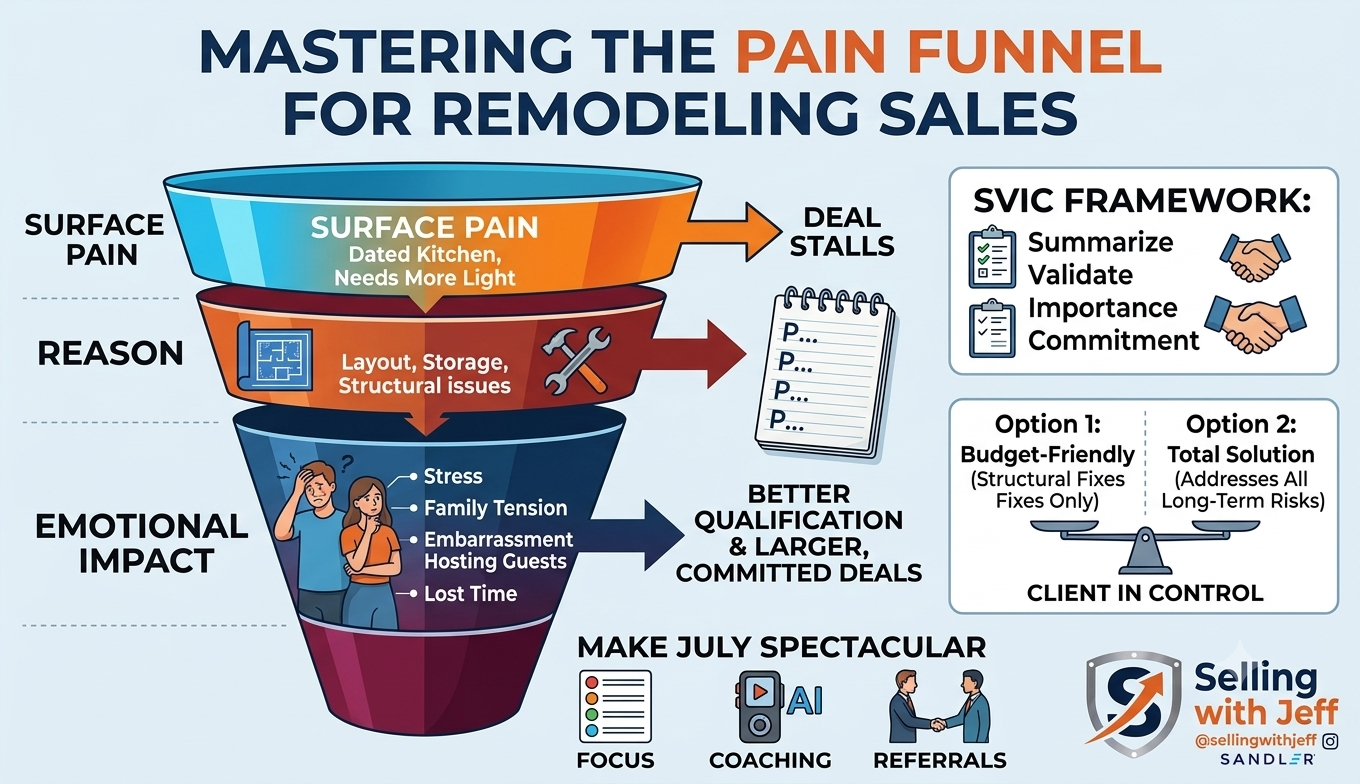

Homeowners rarely say “no” directly. Instead, they get overwhelmed, ask for more time, or disappear after a beautiful design presentation. The real problem usually isn’t your design quality; it’s that surprises around budget, scope, or timing make decisions feel risky. Your job is to remove those surprises long before you ask for a signature.
Why Surprises Kill Remodeling Sales Closings
In remodeling sales closing, eliminate surprises by priming homeowners about budget, timeline, and decisions before every meeting. Use a clear PALO (Purpose, Agenda, Logistics, Outcome), review pain and budget first, and confirm acceptable outcomes, including “no,” so final design presentations feel like confirmations, not shocks.
When homeowners are surprised, their brain hits the brakes, even if the surprise is good news. If you present a design that’s far over (or even under) the number they had in mind, they need new time to think, call friends, or get more bids. One Sandler case study described a “hot” $2 million opportunity that sat in the pipeline for more than 3,700 days because the budget reality was never surfaced early—an extreme example of what surprise does to decisions.
Instead, aim for “anticlimactic” design reviews. Before you open drawings, quickly recap their pains (embarrassing powder room, cramped kitchen), the budget range they approved, and the timing you discussed. If heads are nodding in agreement at each checkpoint, your close is already teed up before they see a single rendering.
Use PALO to Prime Decisions Before the Design Meeting
A strong PALO upfront contract turns vague meetings into decision meetings. Confirm why you’re meeting, what both sides want to cover, how long you have, and what acceptable outcomes look like—including a clear yes, a clear no, or a next step both sides agree on.
For example: “Today’s purpose is to review your kitchen design and confirm whether it fits your budget and timeline. My agenda is to revisit your priorities, walk you through the layout, and review investment options. We have 60 minutes. At the end, can we either say yes, say no, or schedule one focused revision meeting?” This mirrors guidance from Sandler selling system lessons for remodeler sales, where PALO is used to stop “think it over” stalls.
Research shared in a practical walkthrough of the Sandler system notes that home-improvement teams close more when they follow a consistent call structure and let prospects talk roughly 60–70% of the time, not around 50%. That article shows how structure plus listening leads to cleaner yes/no outcomes. PALO gives you that structure while making homeowners feel heard.
Handle Scope Changes with a ‘New Submarine’ Every Time
Every time a homeowner changes scope—“Let’s add the powder room” or “Can we bump the porch too?”—you need a fresh mini selling system, not a casual “sure, we’ll add it.” Treat each change like a new pass through the Sandler submarine: PALO, pain, budget, decision, then fulfillment.
A practical script might sound like: “Happy to talk about the powder room. First, help me understand what’s not working there. Then we’ll talk about how that impacts the budget and timing, and we’ll decide together whether it belongs in this phase.” Only after they share their pain (“We’re embarrassed when guests use it”) do you talk added investment and timing, ideally documented in a simple scope-creep or project-tracker form with an estimated cost range.
Firms that formalize these changes—like the “scope creep” trackers described in Stop free consulting in remodeling—avoid the classic surprise of a final contract that’s mysteriously six figures higher. You protect your estimator’s time and keep clients in the loop on how each choice affects the project.
Check Temperature and Invite No to Get to a Confident Yes
Near the end of a design review, don’t guess where homeowners are. Ask. A simple thermometer check—“On a scale of 1–10, where 10 means you’re ready to move forward and 1 means we missed the mark, where are you?”—turns hidden doubt into a clear coaching moment.
Most polite prospects will pick a 7 or 8. Follow up with, “What would we need to cover or adjust to make this a 10?” If they say 5 or lower, you’ve just saved yourself from a vague “We’ll think about it” by uncovering specific concerns you can address: layout fears, timeline conflicts, or a must-have feature that’s missing.
Equally important, give explicit permission to say no: “If this isn’t the right design or timing, it’s completely okay to say no. You won’t hurt my feelings.” Counterintuitive as it sounds, homeowners who feel safe saying no are more likely to give you a clean yes. Over time, practicing this kind of questioning—even in low-risk conversations with colleagues or family—builds the confidence to use it on real, high-dollar remodeling projects.