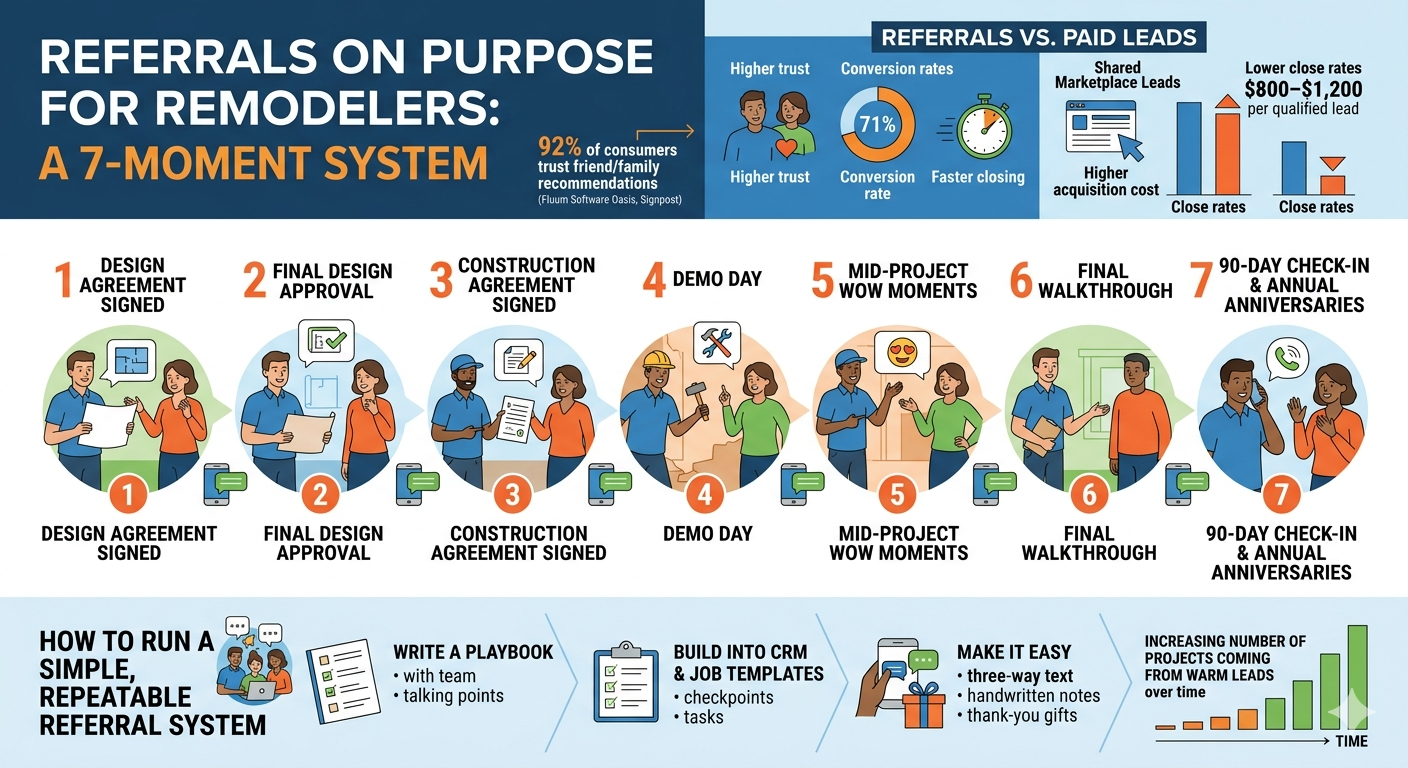

Most design‑build and remodeling teams love referral projects but hate the moment where they have to ask. So they don’t. The client disappears into their new space, life gets busy, and the “we should ask for two names” promise never happens.
That’s not a personality flaw. It’s a process flaw you can fix.
Stop Treating Referrals as Happy Accidents
To get more remodeling referrals, stop waiting until the punch list is done. Ask earlier, when clients are already experiencing comfort and clarity, and use a simple, rehearsed script. Frame the ask as helping their friends avoid contractor headaches, not as doing you a favor.
Referral math is brutal. Referred remodeling leads can close 3–4x higher than cold leads, with close rates around 26% vs. 9% for non‑referrals once you’re in a real sales conversation, according to a Sandler study on referrals in remodeling. When you treat referrals like “happy accidents,” you’re choosing a thinner pipeline and lower margin.
Most contractors also ask the wrong way. A Wharton study (summarized in this referral framing article) found that customers asked to “help the business” referred at less than half the rate of those asked to “help a friend.” The language and timing of your ask are not cosmetic; they’re the whole game.
Set an Upfront Contract for Referrals at Pre‑Con
In Sandler terms, you need an Upfront Contract for referrals. Don’t surprise the client at the end. Normalize it early, when they’re excited and committing to you, not already mentally moving on to tile grout and cabinet hardware.
Here’s a pre‑construction script you can steal:
“Before we dive into logistics, can I run something by you? Most of our best clients come from people like you who had a good experience and didn’t want their friends to roll the dice on the wrong contractor. If, by the time we’re through design and into construction, you feel taken care of, would you be open to us talking about who else in your world might need this level of clarity and communication?”
You’ve now:
- Framed referrals as protecting their friends, not helping your sales quota.
- Tied the ask to specific outcomes: clarity, communication, comfort.
- Created a clear checkpoint in the process where it’s normal to revisit.
That matches what your team is already doing when a hall‑bath couple loves your decisiveness and communication. The only difference is you’re turning that moment into a gate, not a nice feeling.
A 30‑Second Commercial for Sidelines and School Events
Remodelers lose dozens of referral opportunities every month on the soccer sidelines, at school events, and galas with bad coffee. The question “So, what do you do?” shows up, and you respond with a vague title instead of a pain‑based, 30‑second commercial.
You don’t need a monologue. You need one clear story:
“I’m lucky. I lead a design‑build team that fixes homes that just don’t work for real families. You know that back door where you trip over backpacks and sports gear every night? We redesign spaces like that so you stop living in chaos and actually enjoy walking into your own house. When friends complain about their kitchen or mudroom driving them crazy, that’s usually when people call us.”
Notice the structure:
- Start with emotion: chaos, tripping, frustration.
- Describe a specific scene, not a generic “we do remodels.”
- End with when people call you.
That’s your verbal business card. Rehearse it. Own it. Make it feel conversational, so you can use it with parents at back‑to‑school night, neighbors at block parties, and even that widow who’s nervous about strangers in her home.
Team‑Sell with Realtors Without Killing the Deal
Realtor partnerships can be a powerful referral source, but only if you protect both the house price and your value. Walk into the showing without a plan and you’ll watch the realtor’s face fall when you casually say, “That’s probably a $300,000 kitchen,” and the buyer immediately tries to lowball the offer.
Before you ever step into the house, set a joint agenda with the agent:
“Here’s how I see my role today. You’re the expert on comps and pricing. I’m here to help your buyer imagine how the house could work for their life after they own it. I’ll talk in ranges and options, not line‑item bids, so we don’t accidentally turn preferences into price reductions. If I drift over a line, kick me under the table.”
Then, when buyers inevitably ask, “What would a kitchen like this cost?” stay high‑level: “In this neighborhood, full‑gut kitchens we’ve done have ranged from about X to Y, depending on choices and scope. The real question is whether this location and layout are right. If you buy it and still love the house, I can sit down with both of you and map exact numbers later.”
You’ve just honored the realtor, protected the deal, and positioned yourself as the obvious remodeler to call if they move forward.
If you standardize these three pieces—an upfront contract, a 30‑second commercial, and a team‑selling plan—referrals stop being random. They become a disciplined, repeatable part of your remodeling sales process.