ETCFF Questions for Remodeler Sales Teams
What is ETCFF and why pain must come before budget
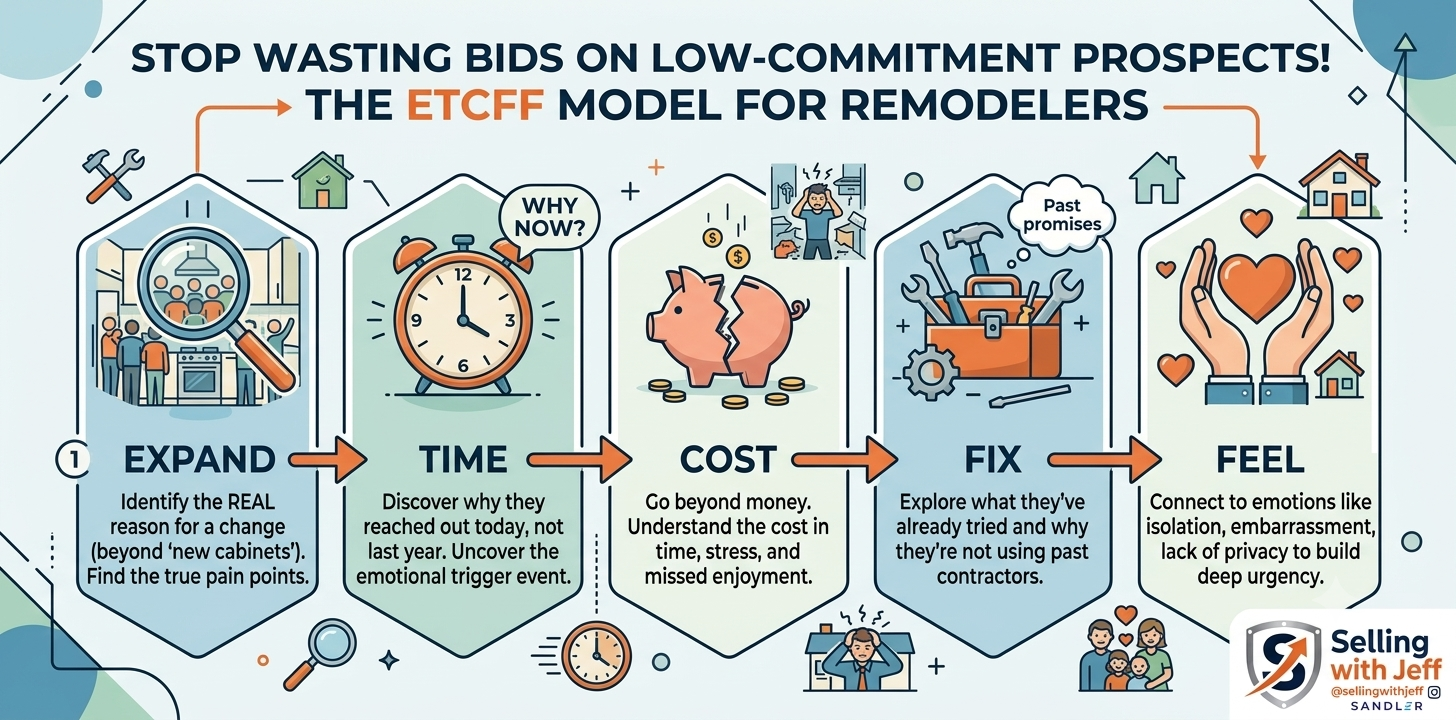
The ETCFF model is a five-step questioning framework (Expand, Time, Cost, Fix, Feel) that helps remodelers move beyond surface project details to the homeowner’s real emotional motivation, so you qualify harder, build urgency, and stop wasting bids on low-commitment prospects. When you slow down and walk through each letter, you uncover why they want to change, why now, and whether they are truly willing to invest.
ETCFF is essentially a clearer, field-ready version of the classic Sandler pain funnel, adapted for residential remodeling. Instead of bouncing between random questions, you follow a simple sequence: Expand the problem, explore how long it has been going on (Time), clarify what it’s costing them (Cost), understand what they’ve already tried (Fix), and finally connect it to emotions (Feel). Research on the Sandler pain funnel shows that when salespeople follow a structured sequence, they win more complex deals and stop getting trapped in price-only comparisons.
Consider a homeowner who says, “We want to redo our kitchen.” Most remodelers immediately jump to layouts and finishes. A better ETCFF conversation might start with, “Can you tell me more about what isn’t working in the kitchen?” (Expand). You might hear, “It’s tight, people bump into each other, and I’m always cooking alone.” Then, “How long has that been an issue?” (Time). If they say, “Honestly, three years,” you can ask, “What finally pushed you to reach out now instead of last year?” That “why now” moment is usually tied to a trigger, like kids getting older or hosting holidays.
Authoritative training for remodelers emphasizes that people shop intellectually but buy emotionally. When you get to Cost and Feel, you make that emotional link explicit. Instead of asking only about dollars, you explore what the current situation costs them in time, stress, and missed enjoyment. For example, a Sandler case story describes a family that lived for six years with kitchen drawers held shut by rubber bands; once the salesperson explored the daily frustration and embarrassment of hosting guests in that space, the project stopped feeling like a “nice-to-have” and became a priority.
Without this depth of pain, even affluent clients hesitate. They may have the money and like your design, but if the problem isn’t emotionally painful enough, the project keeps sliding down the family priority list. ETCFF gives you a repeatable way to test that commitment before you invest hours in design and pricing.
How to use ETCFF questions in real remodeling sales calls
To use ETCFF effectively in live calls, prepare a short checklist of questions under each step—Expand, Time, Cost, Fix, Feel—and keep it in front of you so you don’t jump from surface problems straight into presenting solutions. Your goal is not to interrogate, but to guide a calm conversation that helps homeowners hear their own reasons for changing.
Start with Expand: “What prompted you to reach out about the kitchen?” “Can you give me an example of what happens on a busy weeknight?” In the training transcript above, the instructor describes a homeowner who begins with, “I don’t like my kitchen,” but, after follow-up questions, realizes she actually wants “a space where I can cook and entertain friends without feeling cramped.” That shift from “new cabinets” to “host friends comfortably” changes everything about design, budget, and urgency.
Next, dig into Time: “How long has this been a problem?” “What finally pushed you to call now?” If they’ve lived with a cramped kitchen for three years, that either means they’ve found workarounds and can keep living with it—or they’ve finally hit the point where they “can’t stand it anymore.” Asking, “Where does this project fall in your family priorities over the next 12 months—top one or two, or more like top five?” helps you decide whether to invest design resources now or treat it as an early-stage future opportunity.
For Cost, avoid jumping immediately to dollars. Instead, ask, “What does the current layout cost you in time or enjoyment?” One remodeler on the call described constantly running to the garage to grab appliances and put them back after cooking. A follow-up like, “How many times a week does that happen, and what does it do to your dinners?” gets them to picture the frustration in detail. This mirrors real-world examples shared in Sandler content, where exploring the everyday cost of living with the problem helped remodelers stop competing purely on price.
Then explore Fix: “What have you tried so far to work around this?” “Have you remodeled before or talked with other contractors?” A sales rep in the session shared a powerful move: when a prospect mentions talking to multiple bidders, he calmly asks, “Is there a reason you’re not just going back to the last contractor? What are you hoping will be different this time?” That question surfaces past broken promises and sets you up as a better-fit guide, not just a third price.
Finally, lean into Feel: this is where many reps bail out. Use emotional language on purpose: “It sounds like you feel isolated from your family while you’re cooking—is that fair?” “Are you more frustrated, embarrassed, or worried about safety?” In Sandler’s ETCFF guidance for remodelers, trainers recommend “FUD” words (frustrated, uncertain, disappointed) and the EPIC BS checklist (Embarrassed, Privacy, Isolated, Cramped/Cluttered, Broken promises, Safety/Security). When a homeowner says, “I’m embarrassed to have people over,” you know the project is about more than square footage; it’s about identity and hospitality. That’s the kind of motivation that survives sticker shock.
Applying ETCFF across intake, sales, and design teams
The ETCFF framework works best when everyone—intake, sales, and design—uses the same language and passes emotional insight forward, so each step of your process builds on the last instead of restarting the conversation. Intake doesn’t need to run the full pain funnel, but they should capture enough ET (Expand, Time) to set sales up for deeper discovery.
For intake, one marketing manager in the transcript updated their lead form after Sandler training to include questions like, “What are you struggling with most in the kitchen?” and “How long has that been going on?” They learned that even a couple of emotional words (frustrated, cramped, isolated) in the notes helped sales avoid generic “what do you want done?” calls. You can formalize this with a one-page script: two Expand questions, one Time question, and one priority check such as, “Over the next 12 months, where does this project fit on your priority list?” That keeps intake calls to a reasonable length without turning them into full consultations.
Sales then picks up the thread by reviewing those notes before the first phone or Zoom meeting. One rep shared that he tells prospects, “Based on your conversation with our intake coordinator, I’ve written down a few questions so I can really understand your perspective. I may pause to ask follow-ups; is that okay?” He keeps a small ETCFF card beside his notepad so, even when the homeowner goes off on tangents, he remembers to cover each step before talking design or budget. Another owner suggested that all reps use the same printed question sheet or binder to avoid “squirrel moments” in front of clients.
Designers can also apply ETCFF, especially around Fix and Feel. A design leader in the session described a client overwhelmed by exterior options until she asked, “What bothers you most when you pull into your driveway?” That one Feel-focused question cut through the noise and let them invest budget where it mattered most. Designers should know the top pains and priorities before they ever start picking materials—must-haves, nice-to-haves, and wish-list items tied back to specific frustrations or aspirations.
Finally, leaders can use ETCFF to coach and qualify pipeline. During deal reviews, instead of asking, “Do they love the design?” ask, “What’s the Time story? What’s the Cost in their words? What exact emotional words did they use in Feel?” If a salesperson can’t answer, you know they’re still at surface level and are likely to face “think it over” or budget stalls. By insisting on complete ETCFF notes before producing detailed bids, you protect design time, improve close rates, and create a consistent, client-centered experience from first call to final contract.