Upfront Contracts for Remodelers: Fix Broken Sales Calls
Why Remodeling Sales Calls Go Sideways Without an Upfront Contract
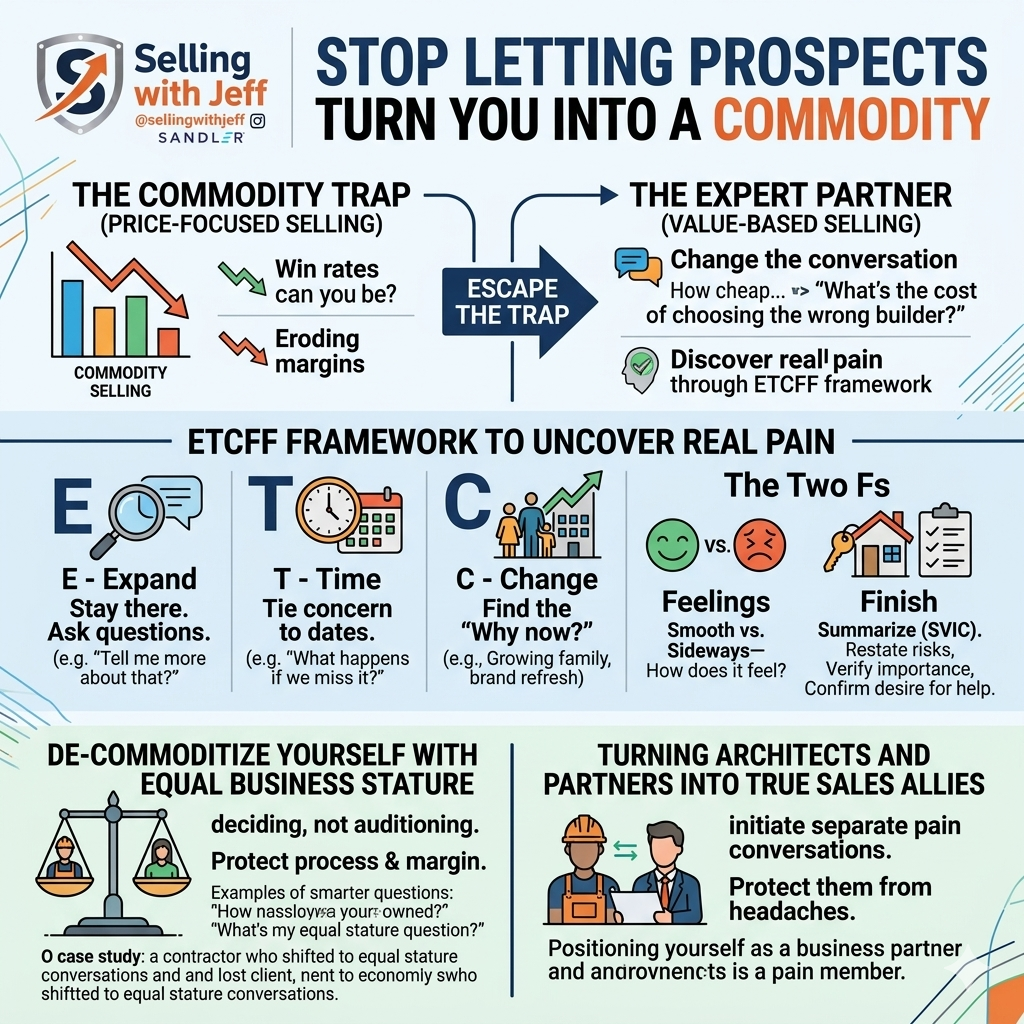
A strong upfront contract is a short, mutual agreement about purpose, agenda, logistics, and outcomes of a meeting. In 40–60 words, it defines why you’re there, what everyone will cover, how long you’ll talk, who needs to be involved, and what decision you’ll make together so the call ends with clarity instead of confusion.
If you sell design‑build or remodeling projects, you’ve lived this: you walk into a home thinking it’s a qualified design meeting, and it devolves into a tour, free consulting, and “we’ll think about it.” Or, like the example in your transcript, a third party (often a parent) hijacks the conversation while the real decision maker checks out and literally walks out of the room.
When you don’t control the expectations upfront, prospects control them for you. They assume the meeting is about “getting ideas” or “seeing numbers,” while you need to qualify budget, decision process, and fit. That gap creates frustration, drama, and stalled deals.
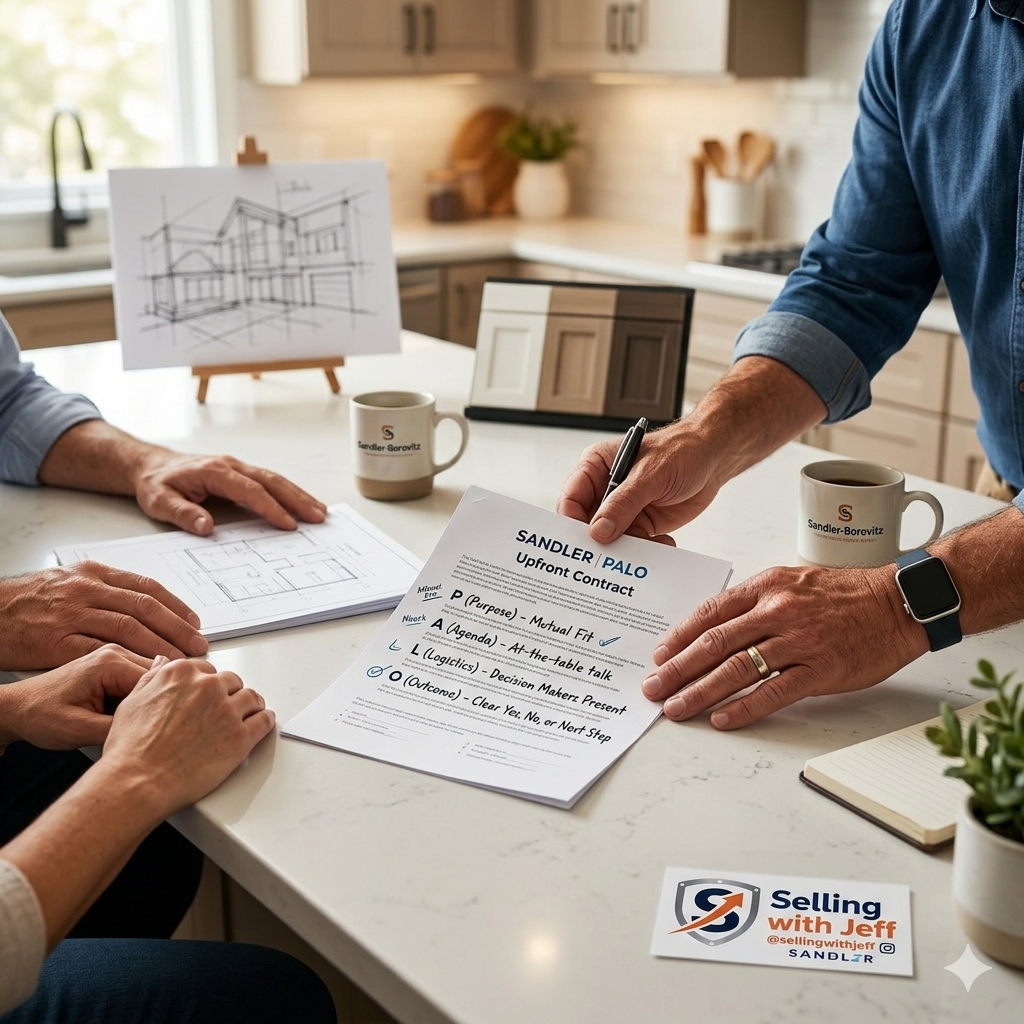
Sandler’s concept of the upfront contract is designed to solve exactly this problem. It’s not a legal document; it’s a conversational agreement. As Jeff Borovitz explains, the P-A-L-O structure—Purpose, Agenda, Logistics, Outcome—gives both sides a clear roadmap for the meeting (Sandler Borovitz).
For remodelers, that roadmap must also deal with emotional dynamics. Homeowners are nervous about money, disruption, and making the wrong choice. According to remodeling guides for homeowners, the first consultation often sets the tone for the entire project—and misalignment here leads to scope creep, budget shocks, and delays later on (Your Next Door Experts).
The good news: a disciplined upfront contract actually lowers anxiety on both sides. It respects the client’s time, makes “no” a safe option, and stops you from over‑investing in the wrong opportunities. In the rest of this article, we’ll walk through a practical PALO you can use in remodeling consultations, how to handle disruptive third parties, and how to end every meeting with a clean yes, no, or tightly defined next step.
Building a PALO Upfront Contract for Remodeling Consultations
A practical upfront contract for remodelers should be short, conversational, and easy to repeat on every call. The PALO framework—Purpose, Agenda, Logistics, Outcome—gives you that repeatable structure (Sandler Borovitz).
Purpose – why are we here?
Most homeowners think the purpose is “get ideas and a price.” You need to reframe it:
“Thanks again for having me over. From my side, the purpose of today is to understand what’s not working in your space, what you want to accomplish, and to see if we’re a good fit to help. From your side, what were you hoping we’d accomplish today?”
Notice the last sentence. You explicitly invite their purpose so you don’t discover at minute 55 that they only wanted a free design.
Agenda – what will we cover (and in what order)?
A simple, remodeling‑specific agenda might be:
“If it’s okay, I’d like to spend a few minutes here at the table talking about how you use the space, your priorities, timeline, and investment range. Then we’ll walk the project together, and if it still makes sense, I’ll outline how our design and build process works. What would you add to that?”
Many remodelers skip the “at the table” part and go straight to the tour. That’s how you end up in a 45‑minute design brainstorm before you’ve discussed money, decision makers, or fit. Setting the agenda upfront lets you hold the line later: “Let’s start here at the table so I don’t miss anything important when we tour.”
Logistics – time, people, and constraints.
This is where you prevent surprises like the constantly‑interrupting mother.
“We set aside about 60–75 minutes today. Does that still work, or do you have a hard stop?”
“Aside from the two of you, is there anyone else—family or friends—who’ll be closely involved in decisions or attending design meetings?”
If they say, “My mom may join us,” you can define that before you ever walk in: how involved she’ll be, what decisions she can speak to, and what you’ll need from the actual homeowner.
Outcome – what decisions are we making at the end?
Without this, meetings drift into “we’ll think it over.” Mike Crandall describes outcome as agreeing on what should happen at the end of the meeting—often a clear yes, no, or defined next step (Custom Growth Sandler).
For a remodeling consultation, you might say:
“Typically, by the end of this meeting, one of three things happens:
• We both agree it’s not a fit—that’s completely okay.
• You’re comfortable moving ahead with a paid design agreement.
• Or we set a specific follow‑up by phone with a date and time to finalize that decision.
Are you comfortable with those options?”
You’ve just made “no” safe and removed the option of disappearing into voicemail.
Managing Third Parties, Drama Triangles, and Hijacked Sales Meetings
One of the hardest situations in remodeling sales is the third‑party influencer who dominates the meeting—especially when they’re emotionally charged, like a parent “helping” an adult child. Left unchecked, that dynamic can wreck an otherwise great fit.
The key is to anticipate and contract for third parties before they show up in the living room.
Pre‑meeting questions that prevent hijacking
Add these to your phone qualification or confirmation call:
- “Besides you, who will be involved in the decisions about design and budget?”
- “Sometimes a parent, designer friend, or contractor has a strong voice in the process. Is there anyone like that we should plan for?”
- “If they’re a big part of the discussion, it works best when they’re on this first meeting. Will they be joining us?”
If they confirm a third party, you build that into PALO:
“So today, the purpose is for the three of us to understand your goals, and for me to see whether we’re a fit. I’ll ask questions mostly of you as the homeowner, and I’ll also get your mom’s input on style and function. Is everyone okay with that?”
You’ve just defined roles: homeowner = decision maker; mom = advisor.
See it, say it—without being mean
Even with a good contract, a strong personality may still interrupt or answer for the real decision maker. That’s where “see it, say it” comes in: respectfully naming the pattern in the moment.
For example:
“Mary, I really appreciate how involved you are and how much you’re trying to help. I’m noticing that when I ask John a question, you understandably jump in with ideas. My concern is that I’m not hearing how John thinks about this, and he’s the one who’ll live with the project and write the checks. Would it be okay if I direct a few questions to him first, and then we get your thoughts?”
You’re not attacking; you’re aligning everyone back to the purpose.
If the son starts leaving the room, you can calmly reframe:
“John, when you step away, I worry we’re designing a project around someone else’s preferences instead of yours. That usually leads to frustration later. How involved do you want your mom to be, and what’s the best way for us to work together?”
This is also where the trust equation from The Trusted Advisor is useful: credibility + reliability + intimacy, divided by self‑orientation. Calling out the dynamic in a calm, empathetic way builds intimacy and shows your focus is on their success, not forcing a sale.
Knowing when it’s not a fit
Sometimes, the conclusion is what your team already sensed: “This isn’t the right client for us.” In that case, you can use your upfront contract to bow out professionally:
“Based on how decisions are being made and how involved everyone needs to be, I’m not confident we’d be the best fit. I’m concerned we’d frustrate each other. It’s probably better if you work with someone whose process matches what you’re looking for.”
That kind of clear “no” saves hours of unpaid design time and protects your brand.
Driving Clear Yes/No Decisions and Protecting Your Pipeline
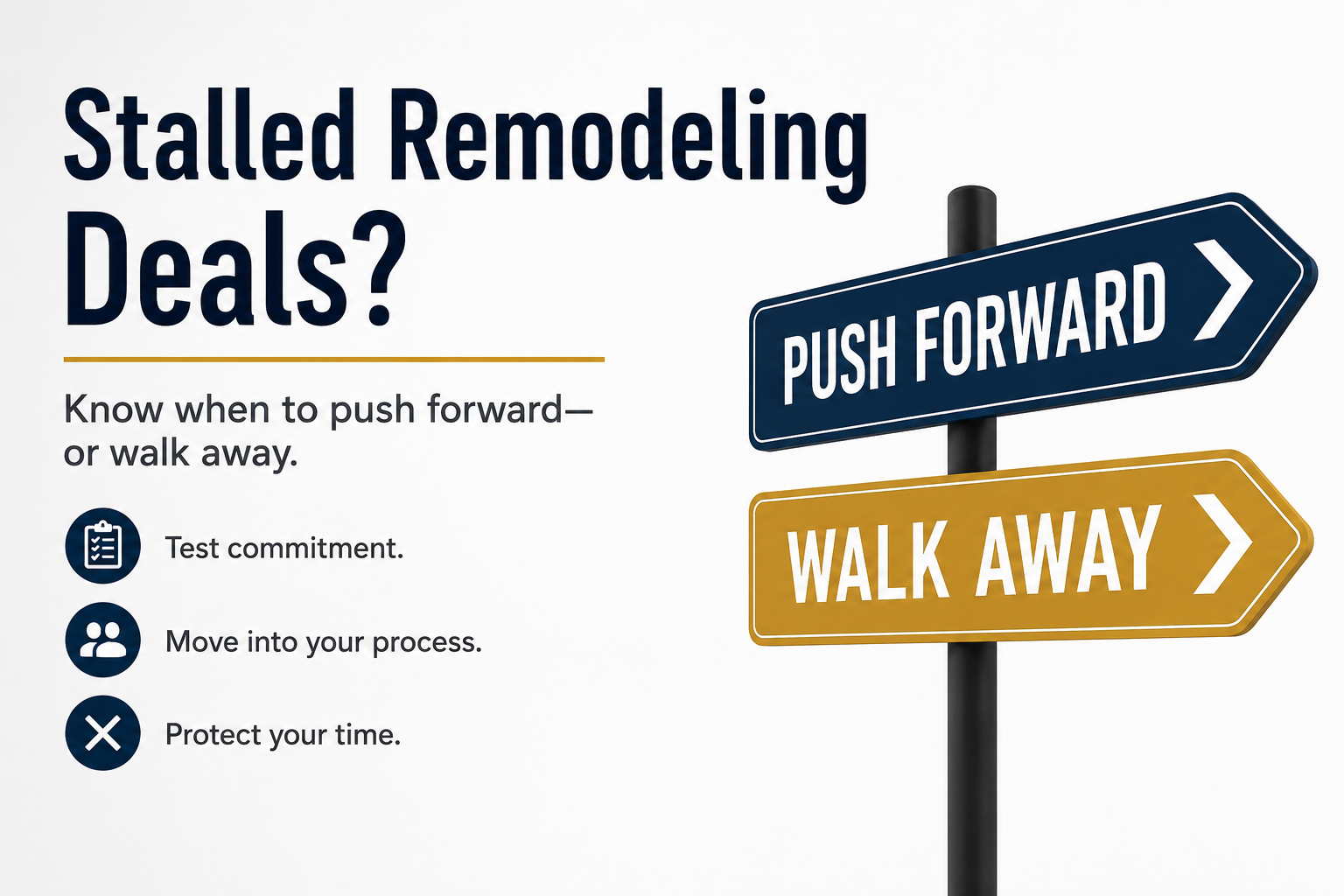
The last job of an upfront contract is to make sure every meeting ends with a deliberate decision—not “we’ll see.” For a remodeling firm with a limited design bandwidth, vague outcomes are expensive. They tie up your pipeline, your calendar, and your mental energy.
Make ‘no’ easy so ‘yes’ is meaningful
Anxiety around pushy salespeople drives many homeowners to dodge calls instead of deciding. When you explicitly normalize no, you lower their guard and increase the odds of a real answer.
You might say early:
“At any point, if you feel this isn’t a fit—maybe scope, budget, or personalities—that’s completely okay. I’d rather you tell me ‘no’ than feel any pressure. Fair?”
Later, when you review your design agreement, you can lean on the same contract:
“We talked about three options: move forward with design, decide it’s not a fit, or set a specific follow‑up. Which of those feels right today?”
If they hesitate, don’t rescue them with a discount or more free consulting. Instead, ask one more clarifying question:
“It sounds like you’re not ready to move ahead today. Is that because of investment, timing, or something about us that doesn’t feel right?”
That question often surfaces the real objection—or confirms that “no” is the right outcome.
Use specific next steps, not vague follow‑ups
When a homeowner truly does need time to process, keep the outcome concrete:
“Okay, so you’re not ready to sign the design agreement today. The usual next step that works well is this: you two think it through over the weekend, and we schedule a 15‑minute call Tuesday at 4:30 to get to a yes or a no. Does that work?”
Compare that to “I’ll check back next week.” One keeps control of your calendar; the other feeds your ghosted‑proposal pile.
Measure and refine your PALO by meeting type
Different stages of your process—phone qualification, in‑home consult, design review, pre‑construction—may each deserve their own version of PALO. Some remodelers even map their standard meetings across a project to reduce stress and build trust (Forward Design Build Remodel).
A simple improvement plan:
- Pick one meeting type (e.g., first in‑home visit) and script a 60–90 second PALO that fits your voice.
- Practice it until you can say it conversationally in the car before every appointment.
- Debrief after each call: Did we hit Purpose, Agenda, Logistics, Outcome? Did we get a clear yes/no/next step?
- Tweak one element at a time—for example, tightening how you talk about outcomes or adding a question about third‑party influencers.
As you do, you’ll notice fewer “mystery meetings” that go sideways, less drama with extra voices at the table, and a healthier pipeline where each opportunity has a defined next step—or is cleanly closed out as a no.
Ultimately, upfront contracts are not about being rigid or scripted. They’re about being clear, respectful, and honest in how you and your clients work together. When every meeting starts and ends with that kind of clarity, you protect your time, your margins, and your sanity—while giving homeowners the confidence to move forward on the right projects, for the right reasons.