Use the Pain Funnel to Close More Remodeling Deals

Why emotion, not estimates, drives serious remodeling decisions
Most remodeling and custom-home deals move when homeowners feel a clear problem, not when they collect one more quote. Research on consumer behavior suggests up to 95% of buying decisions are emotional, then justified with logic later (Mindforce Research). Your job is to uncover that emotion, not just email another estimate.
Think about the clients who actually sign. They’re rarely the ones casually “shopping numbers.” They’re the families embarrassed to host Thanksgiving because of a dated kitchen, or the couple losing sleep over a $1.4M project going off the rails. When you slow them down and talk through what happens if nothing changes—missed holidays, budget blowups, another bad contractor experience—you create urgency that a lowball price can’t match.
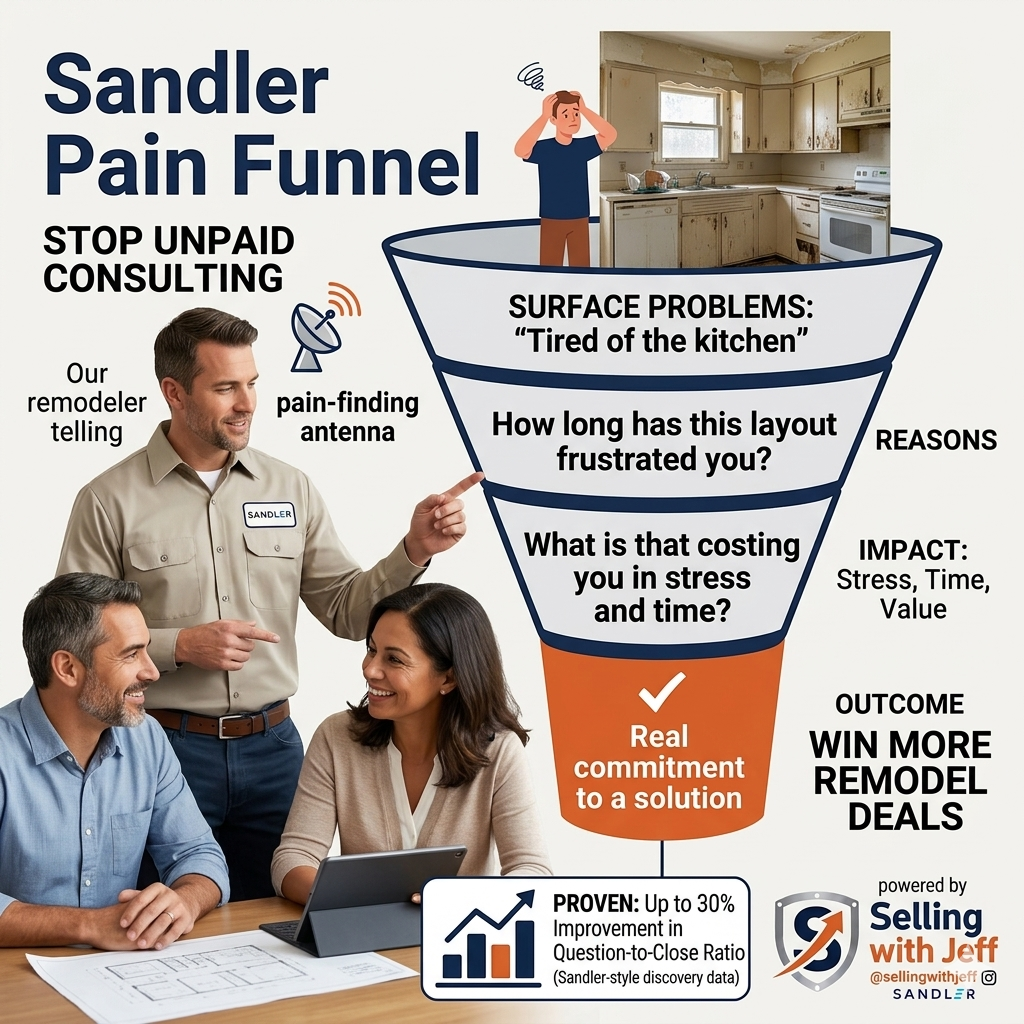
Tools like the Sandler pain funnel help you stay in question mode long enough to get there. Instead of jumping from, “We hate our layout,” straight to square footage and finishes, you ask layered questions: what bothers them day-to-day, how long it’s been an issue, what they’ve tried, and what it’s costing them. Studies on sales psychology show emotional triggers influence roughly 70% of the decision weight (Research & Metric). If you skip that, you’re just guessing at a number and hoping.
How to use PALO to set up decisive, no-surprise sales meetings
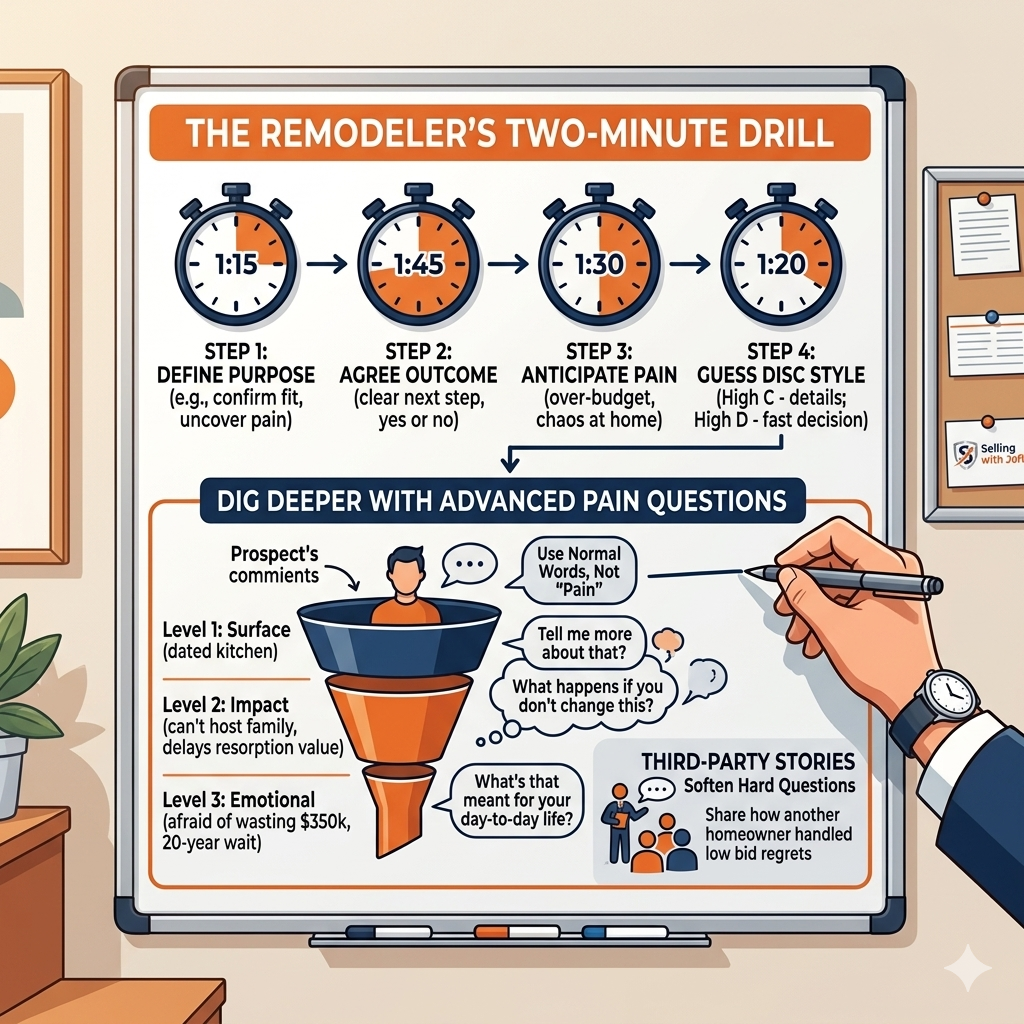
The fastest way to hear “We need to think about it” is to surprise people with a decision at the end. A strong PALO upfront contract—Purpose, Agenda, Logistics, Outcome—prevents that. In a few sentences, you align expectations and earn the right to ask for a clear yes or no at the end of the meeting.
Before a design or pre‑construction proposal review, open with something like: “We’re here to review your pains, walk through our design agreement, and make sure the budget still works. This usually takes 45 minutes. At the end, if we’ve addressed your concerns and the investment is comfortable, are you okay deciding whether we move forward today?” That one question removes the “surprise” close and gets them thinking about a decision from minute one.
Next, remove budget mystery up front. Confirm their target (“We talked about up to $180,000—still accurate?”), then anchor the reality: “To get everything you need, want, and wish for, we’re at about $210,000. There is a version at $180,000, it just doesn’t include everything. As we review, tell me what you’d remove to get there.” Now they can listen to your solution instead of silently waiting for the number.
Finally, protect your time. If they say they’ll “think about it,” trade that for a scheduled follow-up: “Totally fair. Let’s put 20 minutes on Monday so you can tell me yes or no.” If they won’t schedule, you can honestly say, “My concern is that usually means it’s already a no. Is that what’s happening here?” You’d rather surface that now than chase for weeks.
Working with agents and gatekeepers without giving away free bids
When realtors or other third parties insist on a price before you can meet the homeowner, you’re dealing with a gatekeeper, not a buyer. If you play along and throw out ballparks, you train them to see you as a commodity. Serious projects are won in a pain conversation with the decision maker, not in the agent’s inbox.
Treat the agent like any other gatekeeper: respectful, but firm about your process. You might say, “We do a lot of work in this community and can certainly help. Our experience is that pricing without a conversation with the homeowner leads to missed expectations and change orders. Our process is to have a 30–45 minute meeting with the owners first. You’re welcome to join.” You’re qualifying them as much as they’re qualifying you.
You can still do light qualification: scope, timing, any red‑flag history with builders. Use mini‑pain questions with the agent: “When past projects have gone badly, what usually caused it?” and “What does a great builder look like to you?” Their answers tell you if they value quality and process, or just the cheapest number. Agents who only talk price are usually the same ones who slash their own commissions—good clues that you’re headed for margin erosion and endless concessions.
Using Epic BASH pains to qualify hard and avoid nightmare jobs
A homeowner with one vague complaint is a 25–30% close. A homeowner with three to five clear pains you can fix is an 80% close—and usually a better client. That’s why a structured pain checklist like Epic BASH is so useful in construction and remodeling sales.
Epic BASH stands for Embarrassed, Privacy, Isolated, Cramped/Cluttered, Broken promise, Accessibility, Safety/Security, and Health. Each is a “bucket” you can fill with specific examples. A client might be embarrassed to host friends, feel isolated from kids while cooking, and burned by a broken promise from their last contractor. That’s three buckets; now you have real leverage when you say, “If we don’t move forward, what changes?”
Aim for three to five pains spread across those buckets before you talk detailed design or money. Ask, “How long has that been going on?” “What have you tried?” and “What happens if you do nothing for another year?” One builder who ignored obvious red flags on a $1.4M job kept going “for the revenue” and ended up losing a top project manager and many nights of sleep. The lesson: time spent chasing misfit deals is more expensive than walking away early.