Use Biggest Fear to Strengthen Your Up-Front Contract
What “biggest fear” really is in Sandler—and why it isn’t manipulation
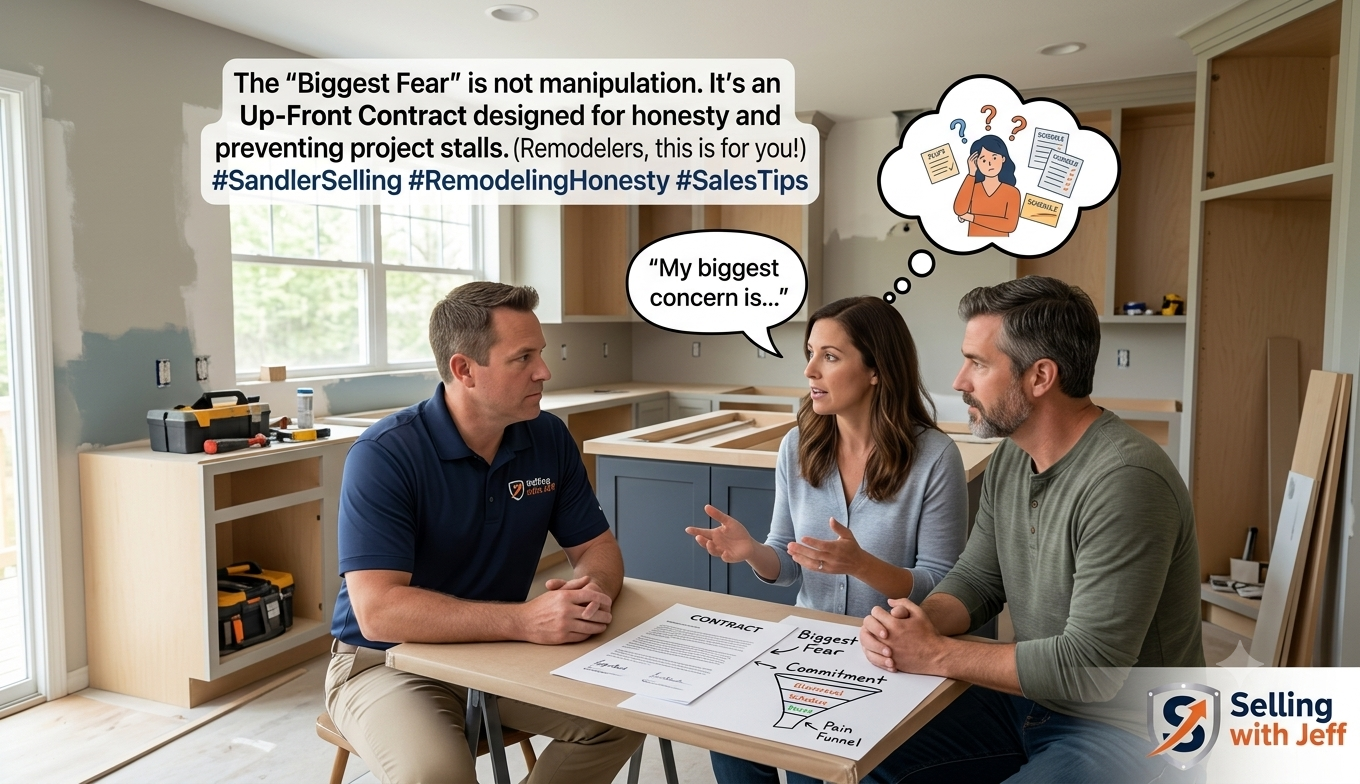
Biggest fear in the Sandler system is a short, disarming statement you add to your up-front contract to name the specific problem you’re worried will derail the project, and then ask the buyer to help you prevent it. Used well, it protects their schedule, your time, and the truth in the conversation.
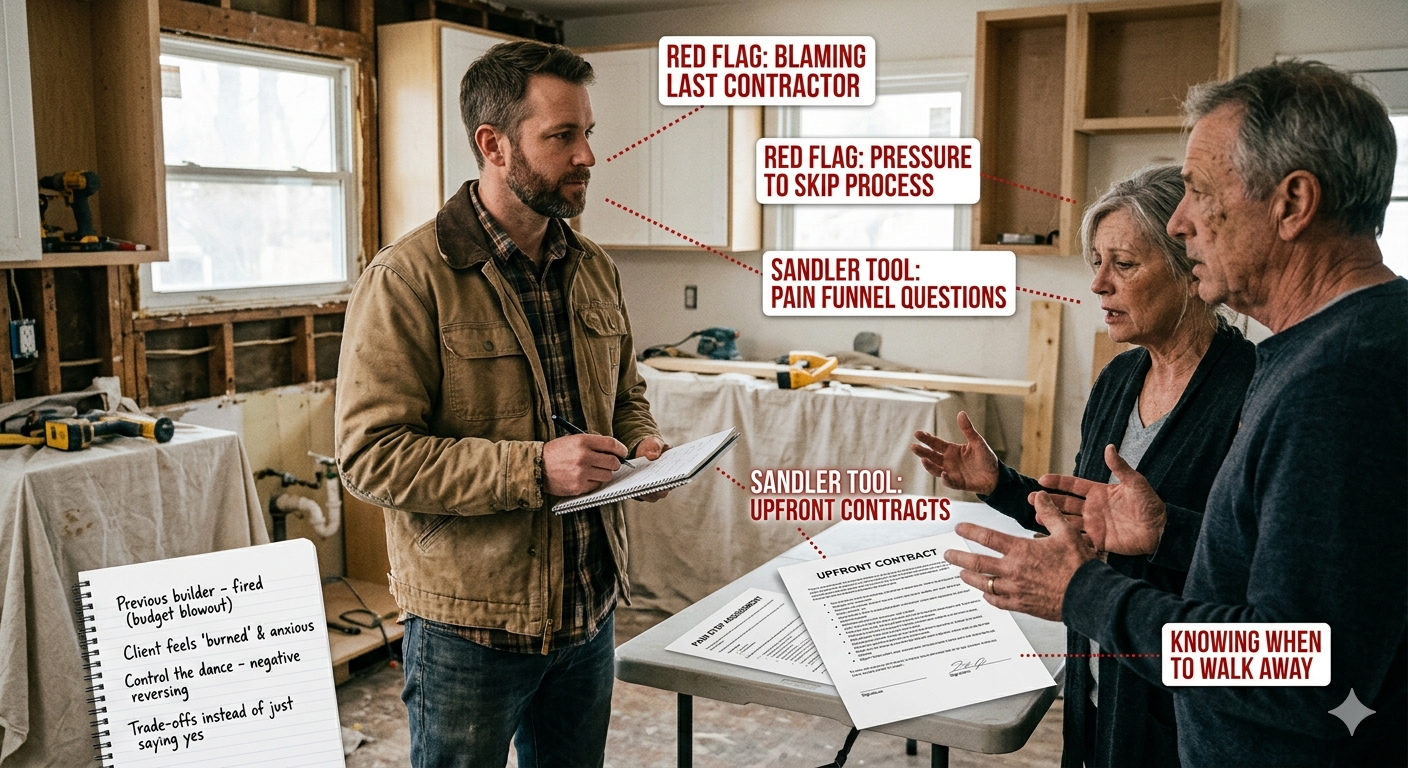
In the coaching session above, the team at Swank is wrestling with a familiar tension: they want to sell more kitchens and large remodels, but they refuse to pressure people. Kyle in particular worries that digging into pain or using tools like the pain funnel could become emotional manipulation. That concern is healthy; it’s also exactly why “biggest fear” exists.
Here’s the practical distinction.
Manipulation is when you hide your agenda, push people into a decision that’s not right for them, or use fear to get compliance. Sandler’s disarmingly honest approach does the opposite: you make your concerns explicit, invite the client to react, and give them full permission to say no.
For example, with the “uber wealthy” client who ignores schedules, the trainer suggests a biggest-fear line like:
“My biggest concern is that we overload you with information and it becomes hard to make decisions. If that happens, could you tell me so we can slow down and simplify?”
Notice three things:
- You’re naming what could go wrong before it does.
- You’re taking responsibility for your part (“if we overload you”).
- You’re asking for their help designing the fix.
That’s not trickery; it’s proactive risk management. It heads off schedule slips, ghosting, and endless re-selections by getting the client to co-own the process. For remodelers juggling complex projects, that honesty is often what separates profitable jobs from exhausting ones.
How to use ETCFF, pain funnels, and SVIC to qualify honestly
The Sandler pain funnel and the ETCFF acronym give you a structure for understanding the client’s real problem deeply enough to recommend the right project—or to agree it shouldn’t happen yet. When you add SVIC on top, you can move from pain to budget and commitment without pressure.
In the transcript, the team realizes they’ve learned the acronym ETCFF but haven’t seen the visual pain funnel. The trainer walks them through it:
- E – Expand: “Can you tell me more about that?” and “Can you give me an example?” These sit at the top of the funnel and keep the client talking.
- T – Time: “How long has this been going on?” Moves the issue out of the abstract and into their history.
- C – Cost (impact): In remodeling, that’s not dollars yet. It’s: “How has this impacted you and your family?” Maybe they can’t entertain, cook together, or host grandkids.
- F – Fix: “What have you tried to do to fix it?” and “How did that work?” You learn about past contractors, DIY attempts, and disappointments.
- F – Feel: “How do you feel about that?” and “Who else knows this is a problem?” That’s where embarrassment, frustration, or stress surface.
For high-end homeowners, the emotional cost is often bigger than the financial one. A cluttered, cramped kitchen might be stopping them from hosting holidays, which matters more than square footage. Research from Harvard Business Review on complex B2C purchases shows that emotional drivers like identity and social status influence decisions as much as functional needs; Sandler’s funnel simply gives you language to uncover those drivers.
The discomfort Kyle feels—“I don’t want to dig into pain just to sell more”—usually comes from confusing intent with tool. The same questions can be asked from two very different places:
- If your intent is “I need this sale,” the funnel becomes a pry bar.
- If your intent is “I need the truth so we don’t design the wrong thing,” it becomes a diagnostic.
The trainer makes that explicit when she compares the process to therapy: good counselors don’t put answers in your mouth; they ask questions so you self-discover the real issue. Likewise, elite remodelers act as house doctors, not order-takers. The pain funnel keeps you from quoting “I hate my kitchen” the same way a random “Chuck in a truck” would.
Once the pain is clear, you can use SVIC to shift from emotion to investment:
- S – Summarize the pain in the client’s own words.
- V – Validate by asking, “Did I get that right? Did I miss anything?”
- I – Importance: “Where does this fall on your priority list, given everything else going on?”
- C – Commitment: “Are you willing to commit the time, inconvenience, and budget to see this through?”
This transition keeps you from talking numbers with a client who secretly isn’t ready. Sandler’s own material emphasizes that not every prospect is qualified; accurate pipelines and fewer stalls come from uncovering that truth early, not pushing everyone to a yes. An article on modern Sandler forecasting explains it plainly: “Sales is a conversation between adults to uncover the truth—not manipulate, not convince, not pressure.” Sandler Rule #1.
Scripts remodelers can steal: biggest fear, commitment, and respect for time
You can keep your integrity, protect your calendar, and still sell more by using simple, disarmingly honest scripts that put “biggest fear” and SVIC into plain English for remodeling clients. Here are three script patterns drawn from the session you can adapt immediately.
1. Biggest fear about confusion and slow decisions
Use this with clients who have multiple influencers (a private designer, your designer, a spouse) and tend to spin.
“Before we get into design, can I share my biggest concern for this project?”
[Client agrees.]
“You’ve got a lot of smart people involved—you, your designer, our team. My fear is that we overload you with options and it becomes confusing, which slows down decisions and puts your schedule at risk. If you ever feel that happening, could you tell me so we can simplify?”
This does three jobs:
- Surfaces the “too many cooks” risk without blaming the client.
- Invites them to police overwhelm instead of silently disappearing.
- Sets the expectation that schedule depends on decisions, not just your production calendar.
2. Biggest fear about choosing purely on low price
The group brainstorms this scenario explicitly: losing a job to a cheaper competitor who never discussed process or materials.
Here’s a client-centered version:
“My biggest fear is that, as you compare three bids, someone who hasn’t walked you through the full process or the exact materials will look cheaper on paper. If you choose based only on that number, you might not be happy with the end result, and I don’t want that for you.”
Notice the shift the trainer recommends: you’re not saying “we might lose the job,” you’re saying they might end up disappointed. That reframes your thorough design, selections, and project management as insurance against regret—not as padding the price.
3. SVIC transition from pain to commitment
Kyle’s live role-play in the call is almost a perfect template. Here’s a tightened version for a kitchen gut-and-redo:
“So, you’ve told me the kitchen feels claustrophobic, you can’t comfortably cook together, and you’re embarrassed to host friends. You’ve tried painting and new hardware, but it still frustrates you daily. Did I get that right, or did I miss anything?”
[Client adds or confirms.]
“You’ve also got college tuition and a big trip coming up. On a scale of 1–10, where does fixing this kitchen sit compared to those?”
*[They answer.] *
“If it really is an 8 or 9 for you—and maybe a 10 for your spouse—this will take a serious commitment. For several weeks you’ll have dust, trades in your home, and either a temporary kitchen or a lot of takeout. Are you both ready to commit the time, inconvenience, and budget to see this through?”
If they say no or give a low number, you’re not stuck. The trainer suggests a simple, vulnerable follow-up:
“That helps. I feel like I might have missed something. What did I miss?”
Sometimes they’ll clarify that you didn’t miss anything; it’s just not a top priority right now. That’s still a win. You can agree together to park the project and set a check-in date, preserving trust and avoiding months of chasing. Other times, they’ll surface a deeper issue—maybe a health concern or a family obligation you didn’t know about—which gives you the chance to recommend a phased project or a later start.
Ultimately, what makes all of these tools ethical is intent plus transparency. When your intent is to surface the truth, protect the client from bad decisions, and protect your team from bad-fit jobs, tools like biggest fear, ETCFF, and SVIC stop feeling like manipulation and start feeling like what they are: a disciplined, adult-to-adult way of serving people at a high level.