
Sandler Success Triangle to Break Your Comfort Zone
Understand roles, self-image, and why comfort zones hold remodelers back
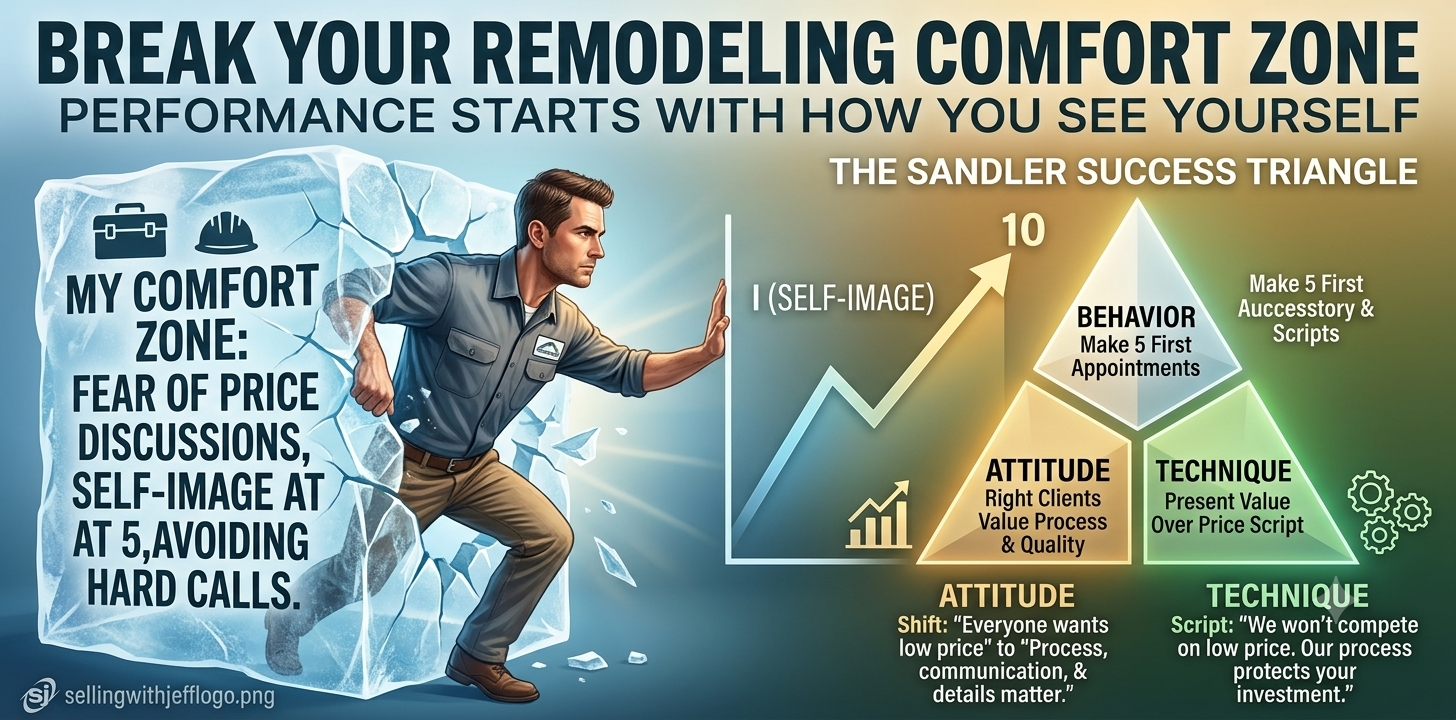
The Sandler Success Triangle helps remodelers see that performance problems rarely start with scripts; they start with how you see yourself. When your self-image sits at a “5,” you unconsciously retreat to your comfort zone, especially when talking about high prices, over-budget designs, or asking for decisions.
In the session, Brad used “roles” (R) and “image” (I) to separate what you do from who you are. Roles are labels like owner, designer, project manager, salesperson, or parent. Every one of those can be taken away: you can change jobs, lose a title, or even a business. Self-image, on the other hand, is built on values like honesty, reliability, and integrity—things only you can give up.
For remodelers, the pain shows up when tough conversations hit those roles. Telling a client their dream kitchen is “not within that price range,” or presenting a proposal that’s higher than expected, feels personally risky. If you secretly see yourself as a “5,” you’ll water down prices, rush past numbers, or avoid clear next steps. That’s self-sabotage, just like Wally the salesperson who sold 20 computers one week, didn’t believe it, and then sold none the next.
The practical move is to protect your “I” at a 10 regardless of the day’s results. When a prospect says, “That’s too expensive,” they’re rejecting a proposal, not your worth. Think of your sales role like a spacesuit: the marketplace can dent the suit, but it doesn’t touch the person inside. This mental separation is what lets people like “Michael at the dance” keep asking confidently, while “Brad at the dance” goes home early.
Use the Sandler Success Triangle to pick one behavior, attitude, and technique
The Sandler Success Triangle says long-term sales success rests on three legs: behavior, attitude, and technique. Remodelers often over-focus on technique—slides, scopes, product knowledge—while under-coaching behavior and attitude, which is why training “doesn’t stick.”
Behavior is what you do: the observable actions on your calendar. For a design-build team, that could be number of first appointments, proactive budget conversations, or follow-up calls after a showroom visit. In the workshop, one salesperson committed to a simple behavior: after every sale, walk to the two houses on either side and the three across the street to introduce himself and leave a card—no pitch, just, “If our crew ever causes a problem, please call me and I’ll fix it.”
Attitude is how you feel and what you believe about your market, your company, and yourself. One participant shifted from “Everyone only cares about low price” to “The right clients care more about process, quality, and communication than price.” That new attitude made higher-margin work feel possible, not scary.
Technique is how you execute. It’s the wording and structure. In the story above, the technique was a short, respectful door-knock script that matched the new attitude. In another example, a remodeler chose a technique of saying up front, “One thing we won’t do today is compete on low price. Our clients hire us for process, detail, and peace of mind.” That clear language supported the behavior of holding margin.
Rather than trying to fix everything, pick one behavior, one attitude, and one technique to focus on for 30 days. That narrow focus is what makes the triangle usable on a busy job calendar.
Rebuild your sales beliefs so price pushback and “no” don’t crush confidence
Your daily results are driven by your beliefs about buyers, money, and selling. If you believe, “Homeowners always shop three bids and pick the cheapest,” you’ll hesitate during budget talks, rush to send proposals, and feel deflated when they push back on price.
Brad presented a belief wheel: beliefs drive judgments, which drive actions, which drive results—and those results reinforce the original beliefs. One remodeling salesperson believed “asking for referrals is intrusive,” so he avoided it, got no referrals, and took that as proof he was right. When he changed the belief to “neighbors appreciate a contractor who protects their street,” he could adopt the non-pushy door-knock behavior and script described earlier. The new belief created better results, which then reinforced the new mindset.
The same shift works for price. Instead of “People think we’re too expensive,” one team reframed to “People don’t understand our process yet.” That belief led to a new behavior: walk clients clearly through design, selections, site protection, and communication standards. The technique was to contrast their detailed process with “lower-caliber contractors” who skip planning and change-order control—anchoring value before price.
Research on mindset in performance fields shows that identity-based framing helps people persevere through discomfort. A famous study by Dr. Rachel White found that young children who pretended to be “Batman working hard” stuck with a boring task far longer than kids who just saw themselves as themselves. That same “Batman effect” applies when a salesperson chooses to act like a calm, expert advisor instead of an anxious order-taker.
Turn theory into a simple daily plan for remodel and construction teams
To break through your comfort zone, turn the Sandler Success Triangle and IR theory into a concrete plan you can see on your schedule. Theory only matters if it shows up in your next client meeting.
First, protect your image. Write down three to five values you refuse to compromise on—honesty, dedication, reliability, integrity were ones Blaine shared in the session. Treat those like the walls of your “castle.” As Brad said, nobody gets into that castle unless you let them. A rough sales call can dent your role, but it doesn’t touch those values.
Second, define one key behavior. For instance, “Every time I present numbers that are above what the client expects, I will sit quietly and let them react instead of talking over the silence.” Another might be, “I will always explain process and scope before I show the total investment.” Put that behavior as a checkbox in your prep notes.
Third, script one supporting technique. That could sound like, “We may not be the lowest price you’ll see, and that’s intentional. Our clients hire us because they want a clean job, predictable communication, and a result that matches the design, not a pile of change orders later.” Practice it until it feels natural.
Finally, revisit your beliefs weekly. As a team, list one unhelpful belief you’ve heard (“Clients won’t pay for project management; they can do it themselves”) and rewrite it into a useful one (“Our best clients pay for professional management because they know what DIY chaos looks like”). Tie each new belief to a behavior, attitude statement, and technique. Over time, those small shifts compound into higher margins, less stress, and a sales culture where people can push past discomfort without sacrificing who they are.