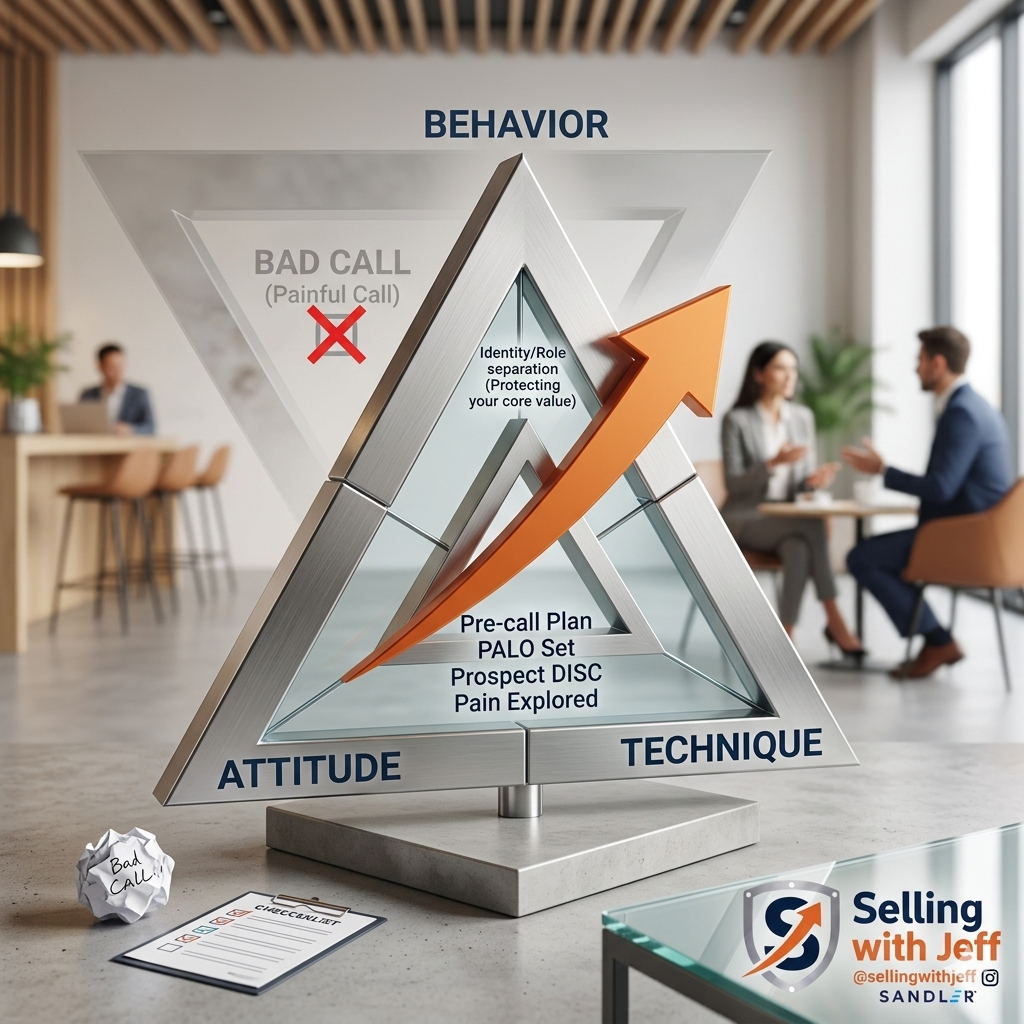
Sandler Success Triangle for Remodeler Sales Mindset
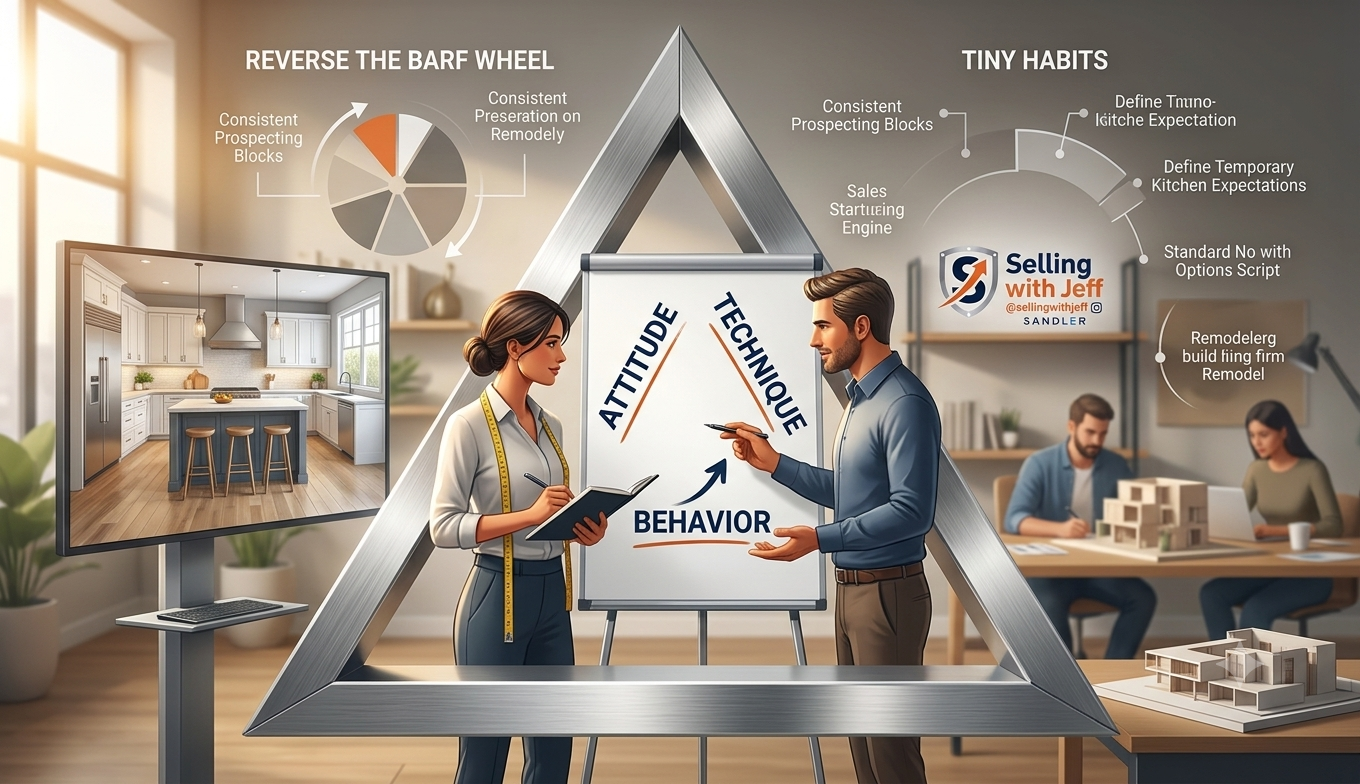
Why mindset for remodelers starts with the Sandler Success Triangle
The Sandler success triangle gives remodelers a simple way to improve sales: start with consistent behaviors, support them with a healthy attitude, and then refine technique. Instead of telling designers to “fix their attitude,” you define specific actions, measure results, and let confidence grow from real wins in the field.
In Sandler, success rests on three legs: behavior, attitude, and technique. For a design‑build firm, behaviors are things like booking weekly prospecting blocks, always defining “temporary kitchen” in writing, or debriefing after every first visit. Attitude is how you feel about those tasks—confident, anxious, or resentful. Technique is the “how” of doing them: the questions you ask, the wording you use, the tools you follow.
Sandler trainers consistently note that performance problems usually start with mindset, not scripts. When self‑image sits at a “5,” salespeople unconsciously retreat to their comfort zone and avoid tough money or scope talks, as described in this Sandler Success Triangle article. For remodelers, that shows up as vague expectations, weak commitments, and “think‑it‑over” stalls.
Reverse the BARF belief wheel to escape the “not good enough” loop
The BARF belief wheel (Belief–Action–Result–Feeling) explains why “just change your attitude” never works. Instead of starting at belief, you work backward from the feeling you want, define the results that would create it, then pick the specific actions that will make those results likely—and only then update the belief.
In the training story, Jeff’s daughter was one of 1,200 athletes invited to try out; 50 reached the final, and only 22 made the national team. Ranked 24th, she concluded, “I’m not good enough.” If she kept that belief, her actions in the next tournament would have been timid, leading to poor results and more proof she wasn’t good enough.
Instead, they reversed the wheel: first, define the feeling (“I belong on the team”), then the results (lead the tournament in defensive stops, ground balls, and fewest shots allowed), then the actions required on each play. Those concrete actions produced standout stats, an offer from Nike, and new beliefs backed by data.
Remodelers can do the same. A designer who quietly believes, “Clients always get mad when I say no,” will dodge hard conversations. Reverse the wheel: choose the feeling (“calm and respected”), define the result (clients understand and accept three clear boundaries per project), then pick actions (using a standard “no with options” script in every meeting).
Make behavior the engine: tiny habits for remodeler sales success
For most people, attitude does not get them out of bed at 4:30 a.m. Behavior does. Jeff’s neighbor, a retired sheriff’s deputy and Ironman triathlete, trains about 330 days a year. On roughly 290 of those mornings, his first thought is, “Why am I doing this?” He still laces up and runs.
The first mile feels terrible. Somewhere around mile two, his mindset shifts and technique smooths out. If he waited to feel motivated, he would never build the endurance required for a 2.4‑mile swim, 112‑mile bike ride, and 26.2‑mile run. Behavior drags attitude and technique along.
Your team’s sales behaviors work the same way. A design consultant might hate calling stalled prospects, but if they block 30 minutes twice a week and simply dial the first number on the list, the first call feels rough, the third is easier, and by the fifth they often book a meeting. Over a quarter, that small habit can reclaim tens of thousands of dollars in otherwise lost design fees.
Pick one keystone behavior per role: production managers doing a 10‑minute pre‑job expectation review, designers using a standard language to define allowances, or marketers confirming the true next step in every nurture email. Measurable behavior, not mood, is what moves the pipeline.
Coach your team like athletes: implementing mindset tools in the business
Leaders can hard‑wire this mindset by coaching designers, salespeople, and production like athletes, not order takers. That starts with clear roles: your people are not just “sales” or “design.” They are decision‑enablement specialists helping homeowners choose whether to remodel, which contractor to trust, and what scope fits their life.
Sandler’s research on self‑concept shows that people rarely perform consistently above how they see themselves long term, as outlined in Sandler Rule #10. If a veteran designer secretly believes they’re a “5,” a single lost job can sink their confidence and make them pull back from necessary money or timeline conversations.
Instead of pep talks, coach through the triangle. With each rep, agree on one behavior to track for 30 days, one supporting attitude statement (“I’m here to help them decide, not to beg for yeses”), and one technique to practice (for example, a specific “up‑front contract” script). Review the numbers weekly.
Small, repeated wins—like converting one extra design agreement out of every four leads or consistently defining “temporary kitchen” expectations—shift beliefs far more than speeches. Over time, a team that once avoided conflict becomes confident guiding high‑stakes, high‑ticket remodeling decisions.