Sandler Role Play: Turn Busy Weeks into Better Wins
Why busy remodelers must practice sales conversations, not just have them
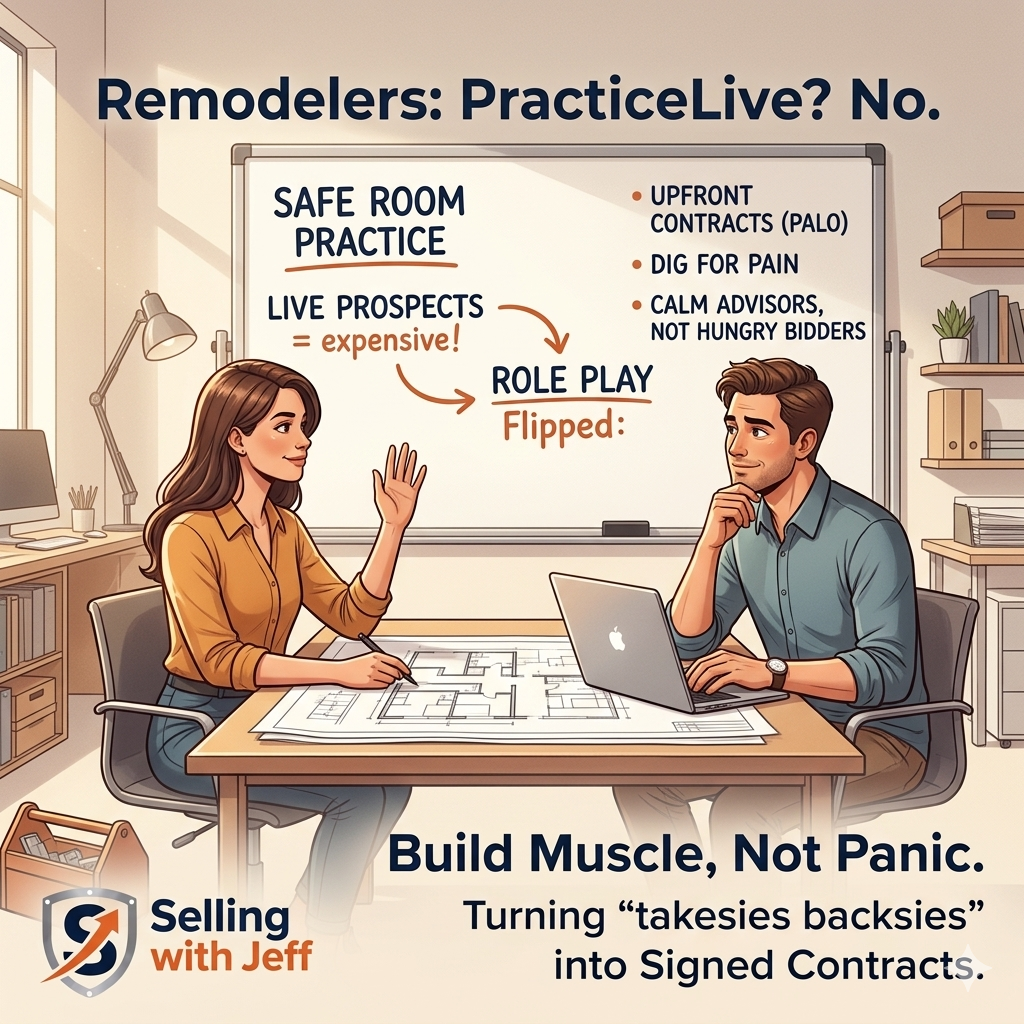
Sandler sales role play is a deliberate practice session where your team reenacts real buyer conversations—budget pushback, timeline pressure, ghosting—so they can make mistakes in a safe room instead of in a $150,000 opportunity. Done well, it turns a “long, hunkin’ week” of calls into repeatable plays your whole team can run.
In the transcript, your designers and salespeople are slammed. People are racing from meeting to meeting, juggling workshops, CDAs, and surprise fires like a broken agreement that turned into a “takesies backsies” nightmare. That’s real remodeling life. The temptation is to keep grinding: more estimates, more site visits, more follow‑ups.
The problem is simple: most remodelers practice live, on prospects.
And that’s expensive.
Survey data shared in Salesforce’s State of Sales report shows reps spend only about 28% of their week actually selling; the rest is admin, prep, and chasing deals that often were never real to begin with. When every hard conversation is improvised, you burn hours and emotional energy trying to recover from avoidable missteps—like promising timelines you can’t hit or tiptoeing around real budget limits.
Role play flips that.
When Amanda walks through how she closed a garage‑to‑guest‑suite project, you can hear it: she had a clear upfront agreement about a $1,000 calendar hold, she revisited the family’s real “pain” (noise between grandparents and kids), and she respected capacity limits instead of saying “yes” to everything. That’s not luck; that’s muscle.
But muscles only grow under deliberate stress.
By carving out an hour for structured Sandler‑style role plays, you let people test language like, “If costs come in higher than we discussed two years ago, what happens to the project?” When they stumble in practice, they refine it. Next time a real client says, “We saved our $100K; where do we sign?” your rep knows how to reset expectations without panicking or discounting.
Think of it the way you think of construction: you would never let a new framer “practice” on a client’s structural wall. You start them in the shop, under supervision, with low‑risk lumber. Sales should be no different.
How Sandler role play builds confidence with budgets, timelines, and tough calls
Sandler role play focuses on three things remodeler reps struggle with the most: setting upfront expectations (PALO), digging into real pain instead of features, and handling money and timeline conversations without sounding desperate. Each scenario in your meeting hits one of those pressure points.
Take the “Pookie’s kitchen” call. Two years ago, the family talked about a $100K kitchen once the kids graduated. Now they’re back, excited and ready: “We’ve got our 100K saved. Where do I sign?” In role play, your seller got to test responses before a real homeowner ever asked.
Instead of blurting out a discounted promise, she slowed down:
- Acknowledged the excitement and history
- Asked how firm that $100K really was
- Introduced reality: materials and labor have climbed since that first conversation
- Used a third‑party example: another similar kitchen recently came in around $115K
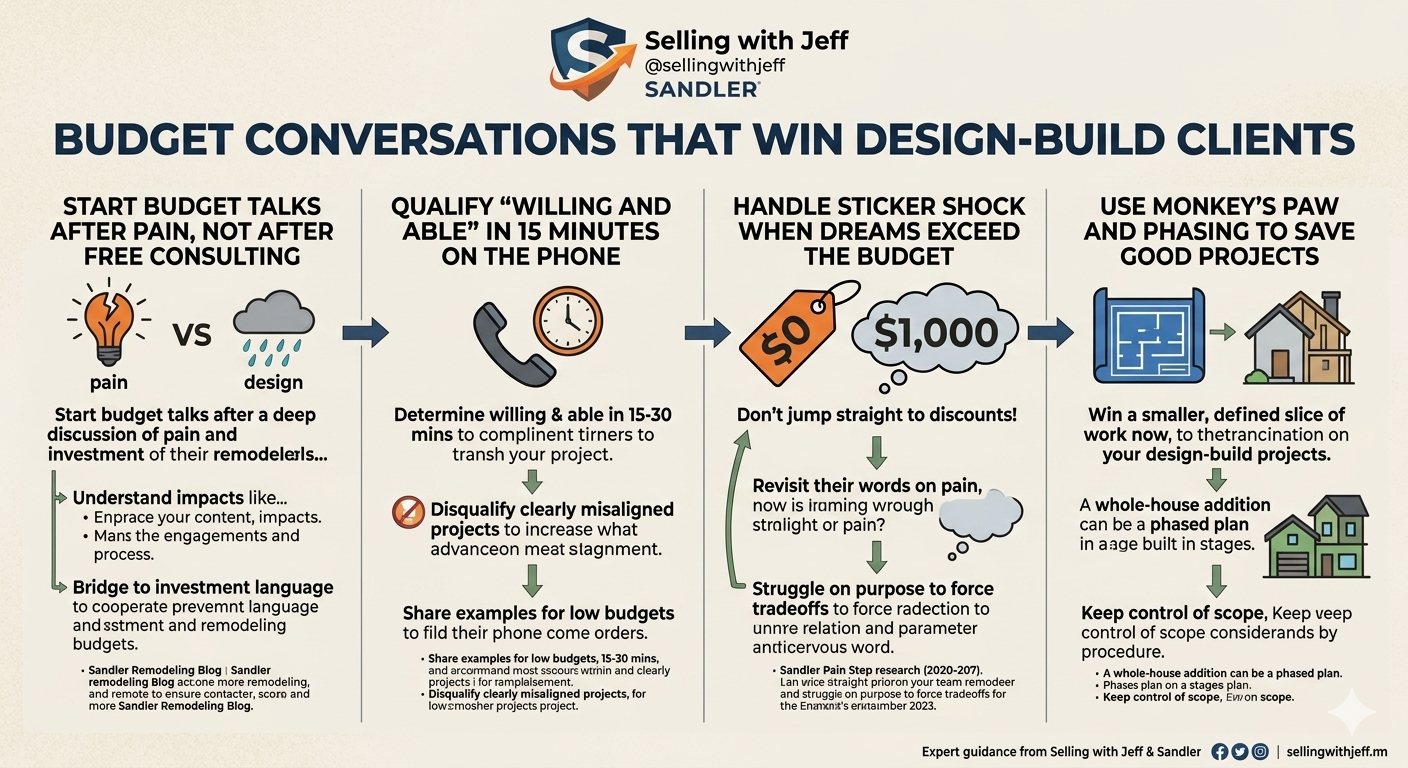
That’s classic Sandler: equal business stature, no commission breath, and clear talk about money up front. There’s no “let me sharpen my pencil” dance. Just an honest range and the option to adjust scope. Research shared by Sandler shows that upfront contracts—simple agreements about purpose, time, agenda, and possible outcomes—reduce no‑shows and stalls because buyers know what will happen next.
You see the same pattern with timelines. Amanda admits she likes saying yes. Her default is, “Yeah, of course, we can do that.” But in the workshop she’s proud of, she instead said: “My biggest fear is we’d skip due diligence on this complicated garage if we rush. Would you be open to design now and construction a bit later?” That’s textbook no‑pressure selling: protect quality, name your concern, and invite the client to collaborate.
Role play gave her team a place to celebrate that boundary and dissect the language. Next time someone demands “as soon as humanly possible,” her peers have a script in their heads that balances urgency with capacity.
Even the painful scenarios become assets.
When Lori practices the call where a big design‑phase project goes on hold because a spouse might take a job back in Ohio, she gets to rehearse empathy and business clarity: confirming one last design invoice, pausing work, and scheduling a specific follow‑up date after the interview. That protects margin and relationship at the same time.
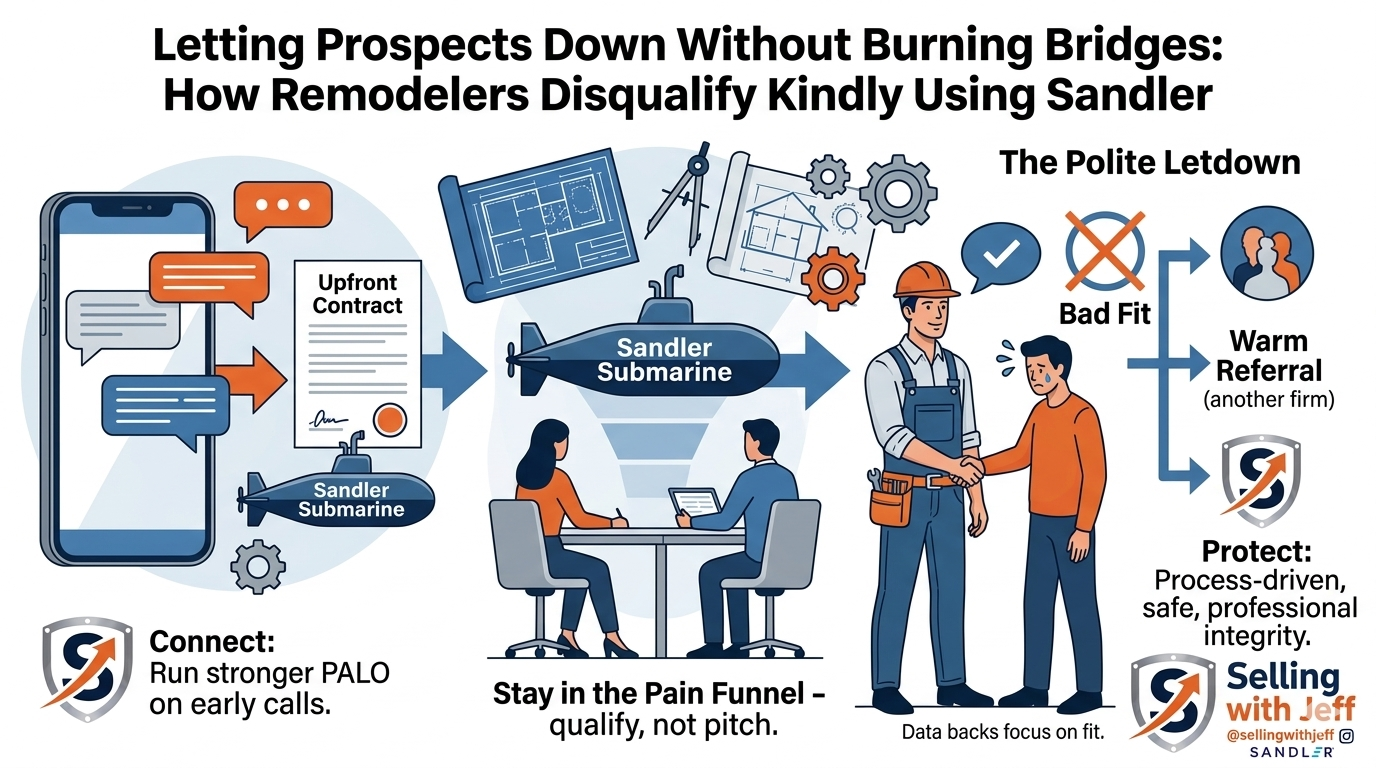
External guides on the Sandler sales process highlight the same three “greatest hits” techniques: the Up‑Front Contract, the Pain Funnel, and Negative Reverse Selling. You can see all three in your team’s role plays:
- Upfront contracts when people set clear next steps (“Tuesday the 17th, 9 a.m., we’ll recap priorities and decide on the CDA.”)
- Pain Funnel questions when Lori explores clients’ past bad experiences with handymen so she can anchor the new project around avoiding those outcomes.
- Negative Reverse when Sarah asks, “What would influence your gut to feel good—or icky—about this decision?” instead of pitching harder.
Practiced together, these skills create reps who sound like calm advisors, not hungry bidders.
A simple role play plan your design-build team can start this month
A practical Sandler role play plan for a remodeling firm doesn’t need scripts as thick as construction documents. You need a short, repeatable rhythm that fits into a packed production and sales calendar—and focuses on real deals already in your pipeline.
Here’s a simple format you can run twice a month in under an hour.
1. Pick three real scenarios, not hypotheticals
Use what your team is actually facing, just like in the transcript:
- The “ghosted, then came back” couple who couldn’t agree on a master bath budget
- The loyal prospect whose project exploded in scope until a new‑build started to look smarter
- The price‑shopping homeowner saying, “You’re our favorite, but another company is cheaper. What can you do so I can sign today?”
Write each scenario in 4–5 bullet points: backstory, pain, money, and the hard question (“What can you do on price?” or “We’re putting everything on hold.”). Skip long prose. Your goal is to drop people into the emotional moment fast.
2. Assign clear roles: Buyer, Seller, Observer
Each rep should cycle through all three. The buyer’s job is to stay in character and apply realistic pressure: budget limits, conflicting spouses, or fears about repeating past bad experiences. The seller’s job is to use Sandler tools: upfront contracts, pain questions, and equal‑stature money talk. The observer notes what helped or hurt.
Amanda’s group did this well. Notice how often observers said things like, “You were honest and upfront about cost” or “I was still wondering what the priorities were.” Those comments are gold. They turn fuzzy “that felt good” reactions into specific adjustments.
3. Hard‑code an upfront contract into every role play
For each scenario, specify what a successful upfront contract sounds like before anyone starts. For example:
- “We’ll spend 20 minutes recapping what’s changed in two years, 20 minutes aligning scope with today’s budget, and decide together whether it makes sense to move into conceptual design. Worst case, you get clarity and we part as friends; best case, we lock your calendar with a $1,000 hold.”
Then have the observer score: Did the seller actually set Purpose, Agenda, Time, and Outcomes? If not, they restart and try again. That repetition wires the skill in.
4. Capture winning phrases in a shared playbook
Any time someone lands a line that clearly works—“I’d like to work with you, but I don’t need to work with you,” or “What would influence your gut to feel good about this decision?”—record it in a shared document or CRM note template. That becomes your internal language guide.
A 2025 guide on modern Sandler selling points out that the best teams don’t just “know the steps”; they standardize language so a buyer hears the same calm, confident approach whether they talk to Jen, Amanda, or the newest hire.
5. Measure one behavior, not just closed deals
Tie your role play practice to a single observable behavior that should improve within 30–60 days. For remodelers, two powerful ones are:
- Percentage of first meetings where a clear next step and date are set (upfront contract success rate)
- Number of opportunities with a documented “decision process” note: who’s involved, how they’ll decide, what “gut feeling” or trust looks like for them
Track those in your CRM and review them alongside your win rate. If you see contracts moving faster and fewer “I need to think about it” stalls, your role plays are doing their job.
When your week is already “busy, busy,” practice feels optional. But the teams that make a non‑negotiable habit of Sandler‑style role play don’t just have nicer meetings; they create a consistent client experience that protects margin, reduces drama, and turns more of those long, hunkin’ weeks into signed, well‑scoped, drama‑free projects.