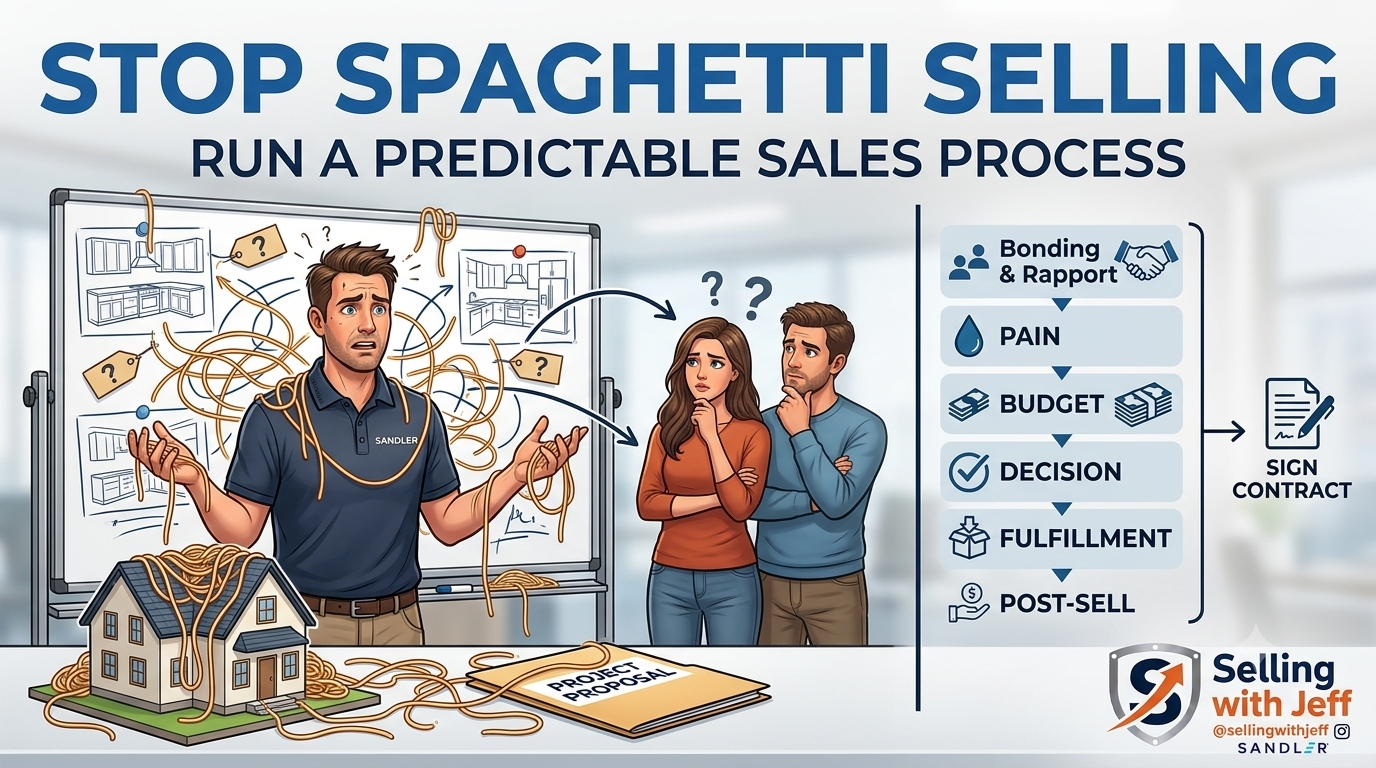

Why hiding the price wrecks your remodeling presentations
A disciplined remodeling sales presentation opens with the real all‑in investment, reconnects to the client’s pains, and ends with a clear yes or no. When you hide the number until the end, you trigger sticker shock, stall decisions, and waste design hours on prospects who were never really committed.
Think about the last time you walked a couple through drawings, selections, and process for 90 minutes before finally revealing, “So the total is about $250,000.” You saw it: eye contact stops, they lean back, and someone says, “Wow. We need to think about it.” That isn’t feedback; it’s escape. National surveys show 37–78% of renovation projects go over the homeowner’s planned budget, and up to two‑thirds of owners take on debt to finish the work (Houzz / KESQ data; Clever Real Estate via Yahoo). If you wait until the end to talk money, you collide with that anxiety at the worst possible moment.
The Sandler stance is blunt: when final presentations fail, the problem is rarely your slides. It’s the sequence. Saving the number for dessert is a process failure that rewards “happy ears,” clogs your pipeline with maybes, and erodes margin as you chase people who were never structurally qualified.
Run an ultimate PALO that puts money on the table first
In Sandler terms, your final meeting needs an “ultimate PALO” — a purpose, agenda, logistics, and outcome contract built for decision, not theater. After a quick re‑bond, you review their pains in their language, not yours: cramped kitchen, embarrassment when guests see it, frustration that they’ve waited 15 years. You confirm you still have the problem set right before you talk about solving it.
Then you set the agenda and logistics in clear, equal‑stature language: “We’ve got about 60 minutes. I’ll walk you through how we propose to solve these problems and what it will cost. At the end, best case, we all agree to move forward. Second best, we all agree it’s not the right fit. Worst case is ‘we’ll think about it’—can we agree to avoid that?” This is not a lecture; it’s a question‑based contract.
Now the critical step: you lead with price. “Based on everything we’ve designed together, you’re at about $250,000 all‑in.” Then you stop and let three to five seconds of silence do its diagnostic work. One recent custom‑home analysis showed builders who lead with the full number see fewer “no decision” outcomes and cleaner pipelines because money issues surface early (Sandler custom home study).
Use scope changes, not discounts, to fix budget gaps
Once the number is on the table, your job is not to apologize for reality or start chopping price. Your job is to let the client own the trade‑offs. In the transcript example, the husband says, “I don’t want to spend a quarter of a million dollars,” while his wife has been choosing premium finishes. That’s not just a budget issue; it’s a scope and spousal split.
Here’s the move: “You told me you didn’t want to be at $250,000. Right now, based on your selections, that’s exactly where the project lands. We really have two options. One, we keep everything as designed and accept that investment. Two, if you have a number you need to hit, you tell us, and as we review the specs you can choose what comes out to get there. I’ve already priced this as aggressively as I can.”
This protects your margin and their ownership. In one remodeling survey, 35% of homeowners who blew their budget did it by upgrading to higher‑end materials mid‑project (Houzz & Home Study). So you force those material and scope decisions into the presentation, before construction. You refuse the trap where the client says, “You’re the expert—just tell us what to cut,” because you know you’ll choose the wrong thing and own the blame every time they walk into that room.
Turn “we need to think about it” into a real decision
If you’ve run the submarine correctly—real pain, real budget, real decision process—the final presentation is not a discovery call; it’s a decision call. The “ultimate PALO” is your tool for turning vague maybes into adult yes/no conversations, even when the couple clearly needs a sidebar.
When you sense that look between spouses, don’t cling to control. Offer it: “Would it be helpful if I stepped out for five minutes so the two of you can talk privately?” That five‑minute huddle keeps you from hearing, “We’ll get back to you next week,” which usually means, “We’re leaving you on emotional read.” Many remodelers report that when they intentionally create this space, the couple reaches a decision in the room—yes at full scope, yes with agreed cuts, or a clean no.
Your metric isn’t how many people say yes; it’s how few leave undecided. Sandler data on qualified pipelines shows that when you truly qualify and close before you present, 50–80% of presented opportunities close, and the rest disqualify quickly instead of dying in “no decision” purgatory (Sandler remodeling analysis). That’s what a disciplined, price‑first presentation does: it protects your time, your margin, and your crew by insisting on a real decision at the end of the meeting.