
Remodeling Sales Mindset: Stop Over-Educating Clients
Why your remodeling beliefs quietly kill good deals
A healthy remodeling sales mindset means you stop trying to impress or educate homeowners and focus on uncovering their pain, budget, and decision process. When you switch from explaining to asking, you protect your time, avoid unpaid consulting, and win profitable projects with more referrals.
Most remodelers were raised on beliefs that backfire in sales: “Don’t talk about money,” “Don’t ask why,” “The customer is always right,” and “Be helpful.” Those sound polite, but in a large, risky purchase your job is to qualify, not to play the polite tour guide.
Remodeling also sits in a tough quadrant: homeowners need the work but don’t really want to go through months of dust, disruption, and big checks. If your core belief is “my value is teaching them everything,” you’ll talk for an hour, solve their problem for free, and still hear, “We’ll think it over.”
Use curiosity, not lectures, in client conversations
In your transcript, the “heater story” illustrates the trap. Before training, the kid knew nothing about heaters, so he just asked questions and explored with the customer—and sold a truckload. After “heater school,” he lectured about filaments and wattage, and sales dropped.
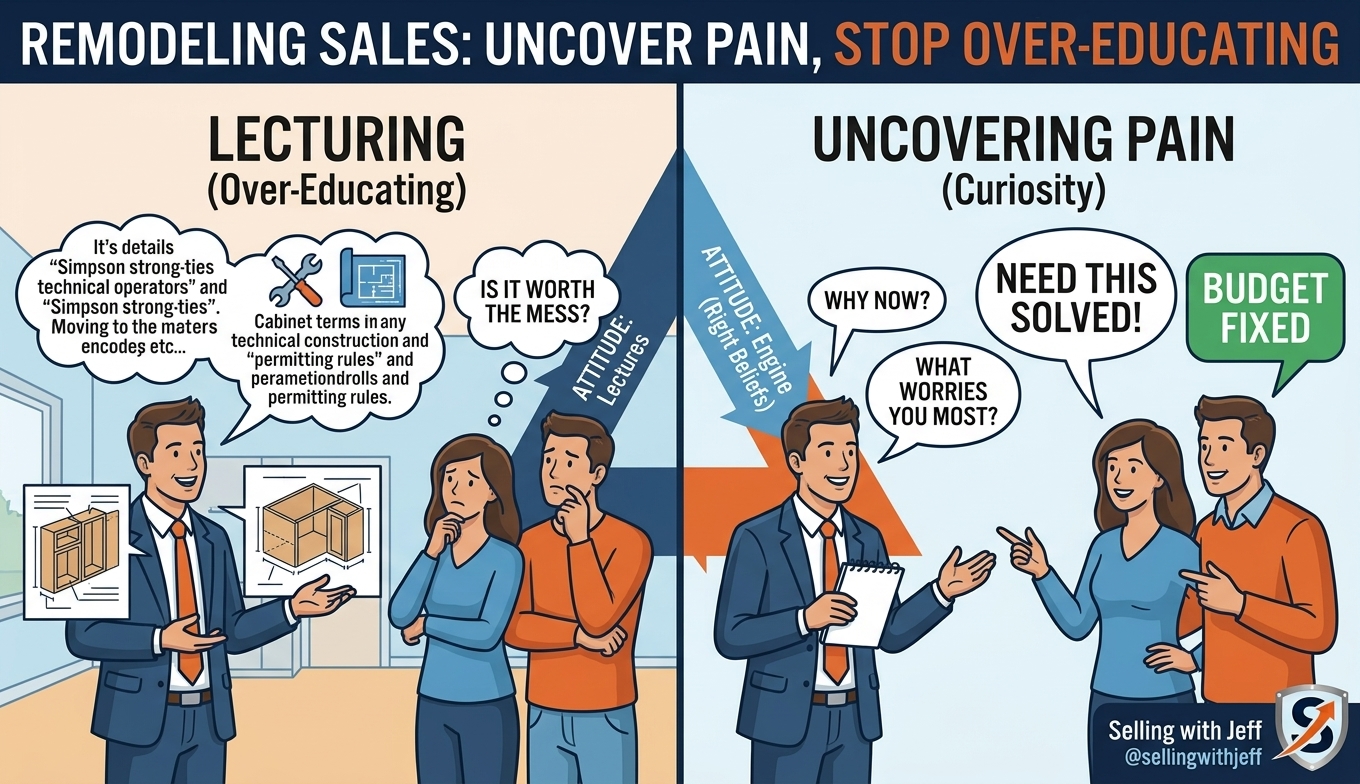
Remodelers repeat this daily. You explain Simpson strong-ties, cabinet construction, or permitting rules because it feels helpful and proves expertise. But the homeowner often wants something simpler: “Will this solve my problem, fit my budget, and be worth the mess?”
Curiosity fixes this. Instead of blocking (“ChatGPT is wrong,” “That won’t work here”), use a “Yes, and” mindset borrowed from improv: “Yes, that’s interesting—what did you like about that idea?” Then dig into why they looked it up, what’s worrying them, and what outcome they really want. You’ll discover pain and motivation instead of arguing over facts.
Apply Attitude–Behavior–Technique to every sales step
Sandler’s Success Triangle—Attitude, Behavior, Technique—explains why new tactics alone don’t fix weak sales. Many remodelers chase the perfect script while still clinging to beliefs like “I need to be liked” or “I must solve every problem I see.”
Technique is the visible part: using a paolo, setting an upfront contract, asking about budget, or mapping the decision process. Behavior is whether you actually do those things: Did you bring pain questions? Did you insist (politely) on both spouses being at the visit?
Attitude is the engine. If your belief is “I’m here to educate,” you will skip pain, budget, and decision steps even if you know them. If your belief is “I’m here to see whether they qualify for my solution,” you’ll naturally ask harder questions and walk from bad fits, which protects margin and time.
Shift from free education to paid value and referrals
Over-explaining leads straight to unpaid consulting and lost deals. The ball‑bearing furniture story shows how one extra “smart” detail can spook a buyer. In remodeling, dumping technical detail that isn’t tied to pain, budget, and decisions creates the same risk—and makes you sound like every other salesperson.
A more productive belief is: “I’d rather be rich than right, and I’m entitled to unlimited referrals.” That shifts your focus from proving you know everything to creating such a clear, low‑stress decision that clients want to introduce you to neighbors and friends.
Practically, that means: educate lightly and only inside step six—after you’ve built rapport, uncovered pain, clarified budget, and confirmed decision process. Until then, ask short, soft questions: “Why now?” “What worries you most?” “How would you feel if…” You’ll close fewer free “heater classes” and more profitable, referral‑rich projects.