Remodeling Questioning Techniques to Stop Budget Surprises

See yourself as the doctor, not the waiter
Effective remodeling questioning techniques mean you stop taking “orders” and start guiding decisions. Instead of reacting to every wish, you slow the conversation, diagnose the real problem, and agree on clear money guardrails before you draw or price anything. That’s how you avoid late-stage sticker shock and protect trust.
Your pain is familiar: a client keeps adding ideas, you keep saying yes, and by the time you show the final number, you’re 20–30% over what they felt comfortable spending. Research cited in Sandler remodeling content shows roughly 78% of renovation projects go over budget. If you act like a restaurant server—“Sure, we can add that”—you feed that statistic.
Start seeing yourself as the doctor or attorney in the room. Doctors don’t say, “Whatever you want.” They take a history, run tests, explain trade-offs, and sometimes say no. Your job is the same: diagnose before you prescribe. That stance gives you permission to ask hard questions about problems, budget, and decision rules without sounding pushy.
Run a mini Sandler Submarine on every client change
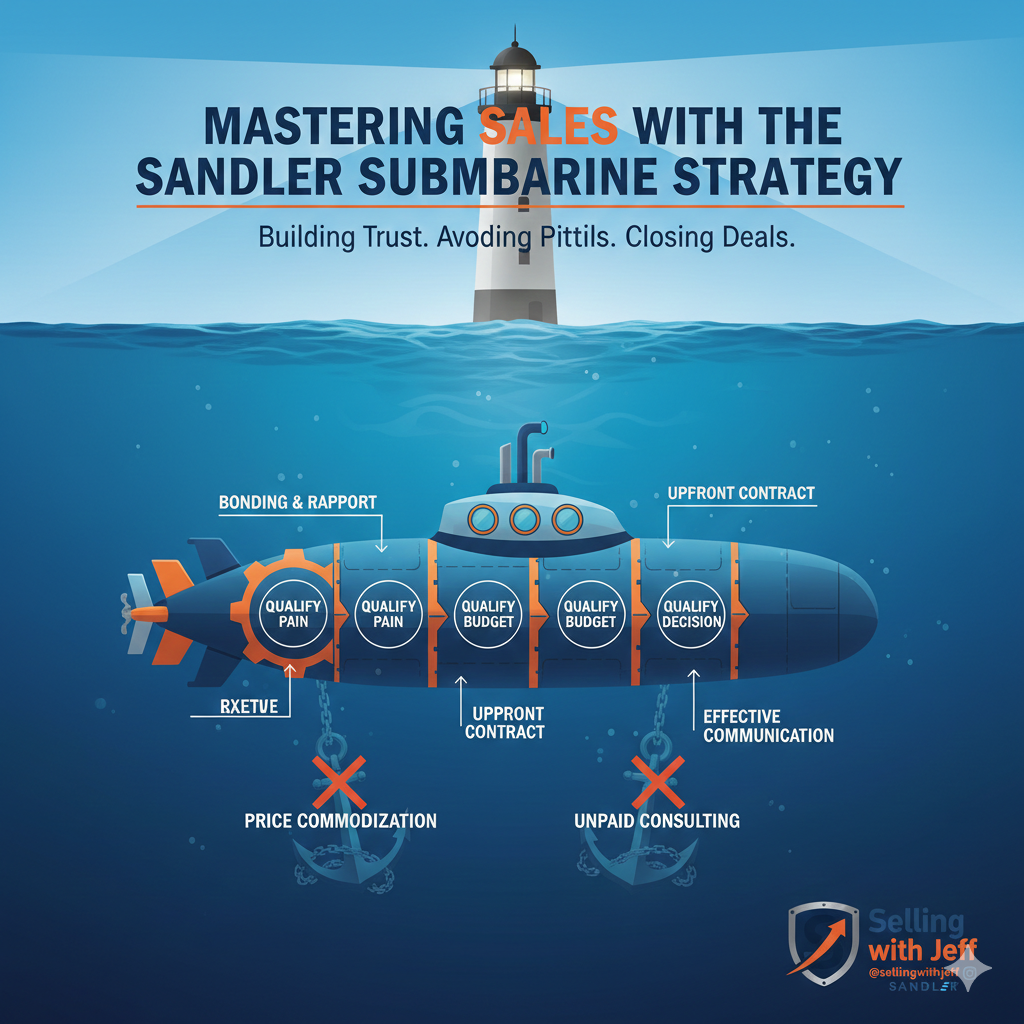
A practical way to operationalize this is to run a mini Sandler Submarine every time the client changes scope. Before you touch your software or sketchpad, you walk through Bonding & Rapport, PALO, Pain, Budget, Decision, and only then Fulfillment and Post-Sell—just on that one change.
In the transcript example, even something as small as fancy doorknobs gets a full pass through the Submarine: What problem are the new knobs solving? How much additional money are they willing to allocate (“We can go up to $2,000”)? What’s the timing and decision process around approving it? Only when those compartments are watertight do you design and price.
Industry data shared in another Sandler article shows 80–91% of residential renovations exceed their initial budgets, with overruns often 10–33% above estimates, largely due to fuzzy scope and mid-project changes. A mini Submarine on every change forces clarity early, when it’s cheap, instead of late, when it’s painful.
Use reversing and pain questions to get the real story
Most designers get into trouble not because they don’t ask any questions, but because they ask soft, “What do you want?” questions and then assume they understand the answer. The fix is two Sandler tools: reversing and the Pain Funnel.
Reversing simply means you answer a client’s question with a question so you can clarify intent. If they ask, “Is crown molding expensive?” you don’t launch into a price lecture. You say, “Great question—what were you hoping to invest in that part of the project?” or, with a negative reverse, “You probably don’t want to add much for trim, do you?” Then you stay quiet and let them talk.
Once they float an idea, you run a mini Pain step instead of racing to design. “Interesting—what problem is that going to solve for you?” “What’s not working about your current space that makes this important now?” Specific answers (“We’re embarrassed to entertain,” “We need privacy”) give you leverage later when you prioritize scope inside a finite budget.
Protect budget and trust with no‑surprise conversations
The downstream cost of weak questioning is broken trust. When a client expects a number near the early “ballpark” and you show up 30% higher, they don’t blame their wish list—they blame you. That’s when projects stall, margins get slashed, or the client walks.
Your protection is a no-surprises rule tied to strong questioning. Every time scope shifts, you ask: “Before we design this, how much additional money are you willing to earmark for it?” You restate what you heard: “So if we came back with something you love at $550k, not a penny over, you’d be comfortable moving ahead?” Then you document that line in a follow-up email so everyone sees the same number in writing.
Because homeowners typically underestimate costs by about 22% on average (reported in remodeling research referenced by Sandler), your job is not to avoid tough budget talks—it’s to have them earlier, more often, and with better questions. Done consistently, that discipline makes your designs boringly predictable on price—and that “boring” is exactly what closes profitable work.