
Over-Budget Remodel? Reset Scope Without Losing Trust
Why remodel budgets explode after early ‘ballpark’ numbers
Handled well, remodeling budget conversations turn a scary over‑budget surprise into a planning session you lead with confidence. You explain how the scope changed, invite the client to help fix it, and protect your margins instead of discounting out of fear or embarrassment.
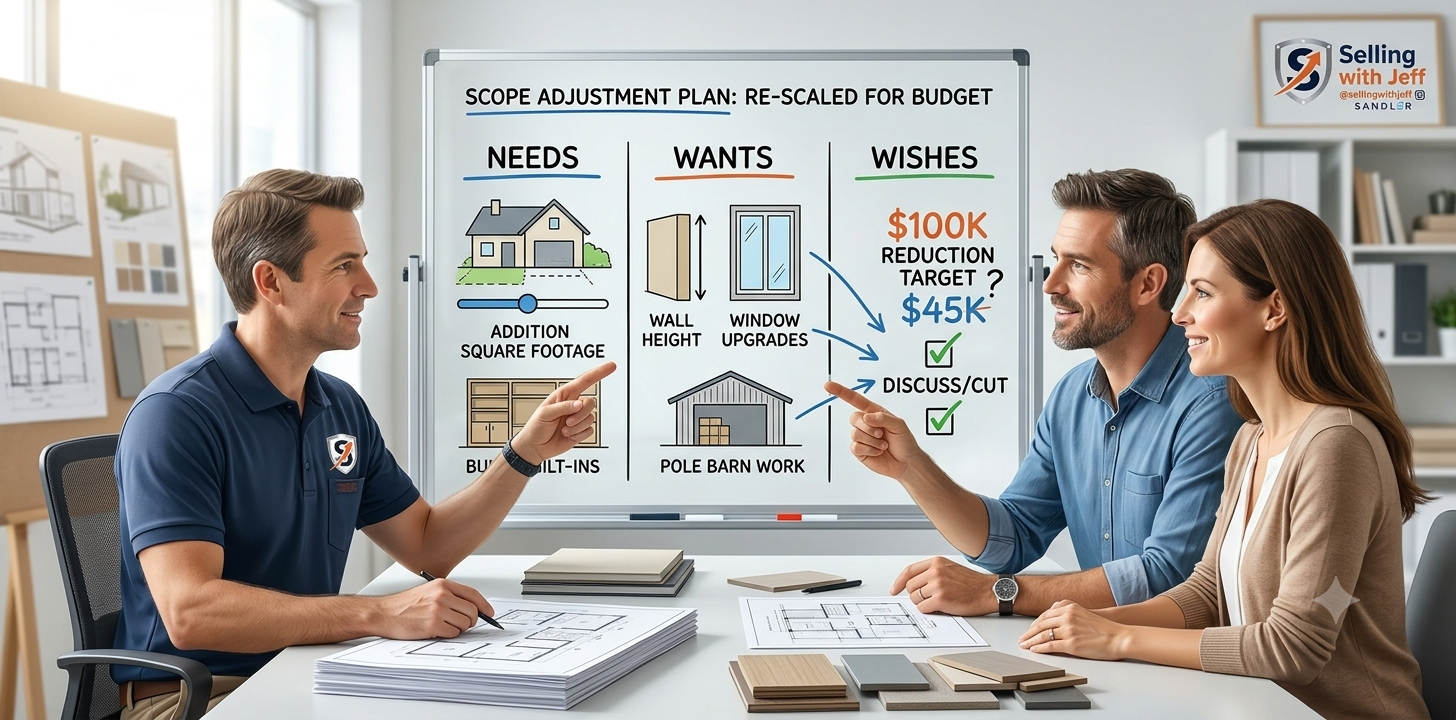
In the transcript scenario, Kyle’s clients are 30–40% over the top of the original ballpark after design. That’s common. Scope grew: bigger additions, taller walls, upgraded windows, extra built‑ins, work on a pole barn. The “problem” isn’t that you priced it wrong; it’s that the project is now a different project than the one the first number was based on.
National data backs up how sensitive these moments are. A Modernize survey of more than 150,000 homeowners found that the top reasons not to hire a contractor were pushy sales tactics (37.93%), unclear quotes (32.6%), and poor communication or listening (31.42%). Price matters, but the way you talk about it and how clearly you connect price to scope matters just as much. (Modernize Homeowner Insights)
So, when a design comes in far above the early range, your job is not to defend a number or cave on margin. Your job is to guide a high‑stakes decision. As Sandler likes to say in remodeling, you’re in the decision‑making business, not the proposal‑sending business. (Sandler Remodeling Blog)
Own broken process: how to open the over‑budget conversation
The worst way to start an over‑budget meeting is by dodging or justifying. A better way is to calmly own any process gaps and then reframe the situation as a shared problem the two of you will solve together.
In the transcript, Jim broke process by doing design work without a paid PSA for a long‑time client. The recommended opener was simple and disarming: “Because you’ve been such a good client, I broke our process. I didn’t do what we usually do, and now we’re both in an uncomfortable spot. That’s on me.” That kind of ownership lowers defenses and rebuilds trust instantly.
You can adapt that structure:
- Acknowledge: “We both got excited and added more than the original ballpark assumed.”
- Own your part: “I could have paused sooner and said, ‘We’re moving beyond our first range.’”
- Name the reality: “The design we’ve created together now costs more than we initially discussed.”
- State the goal: “Let’s figure out how to get you everything you need and as much of what you want as your budget allows.”
Notice what you’re not doing: apologizing for fair pricing or jumping to discounts. You’re treating the overage as a scope issue, not a moral failure. That’s critical if you want to protect margin and stay confident in front of a savvy buyer—especially one who negotiates for a living.
Re-scope collaboratively using needs, wants, and wish lists
Once the client says, “We have to cut $100,000,” your instinct may be to start pitching ideas: drop the 10‑foot ceilings, delete built‑ins, cheapen finishes. That feels helpful but often backfires, because you’re guessing what matters most in their lifestyle.
Instead, move from adversarial to collaborative. A powerful Sandler‑style frame is: “We’ve run ourselves into a problem. I need your help.” Then:
- Lay out the upgraded scope. List, in plain language, everything added since the ballpark: extra square footage, wall height, window changes, outbuilding work, built‑ins, premium finishes.
- Sort by category together. Ask them to classify each item as:
- Need (must have)
- Want (important but flexible)
- Wish (nice‑to‑have if budget allows)
- Guardrails, not line items. When they ask, “What does the pole‑barn work cost?” resist turning the estimate into a price menu. Explain that projects are like Lego bricks that stack on each other; instead, you’ll use their need/want/wish list to hit the overall target.
- Let them choose what to cut. When they say, “You’re the expert—tell me what to remove,” gently push back: “I’m the construction expert, but you’re the expert on how you live. I don’t want to rip out something that really matters to you.”
This process matches how Sandler’s pain funnel works: you don’t assume; you ask layered questions until the client tells you what truly hurts and what they’re willing to change. (Sandler Pain Funnel) In practice, once clients are forced to choose, many either accept a higher total or cut far less than the initial “We must remove $100K” demand.
Keep clients engaged between PSA, design, and construction
Over‑budget shocks are more likely when there are long, quiet gaps in your process. The transcript team spotted two risky windows: after signing a PSA but before design starts, and after design is complete but before the build contract is signed.
A simple fix is to assign meaningful “homework” during every waiting period:
- Before design starts (1–4 weeks): Have clients build a digital or physical idea book—photos, floor plans, finishes they love. Designers like Michelle pointed out that clients often can’t verbalize preferences, but they can react to pictures. This speeds up design and surfaces budget‑breaking tastes earlier.
- Between design meetings: Ask them to pre‑shop tile, counters, plumbing fixtures, or flooring at preferred vendors. Provide a checklist so their time produces usable selections instead of random screenshots.
- Before construction: Send a short weekly update email, even if it’s just three lines: where permits stand, expected start window, and what they can be working on now.
Industry research shows homeowners don’t just choose on price; they heavily weigh communication, listening, and professionalism. One Modernize study found that unclear quotes and poor communication were deal‑killers for roughly a third of homeowners. (Modernize 2026 Insights)
By giving structured homework and predictable updates, you keep clients busy, reduce “How’s it coming?” calls that slow design down, and make it far easier to have a calm, fact‑based conversation if the evolving design outgrows the first ballpark.