
Mastering Client Conversations: SVIC and Pain Funnel Techniques
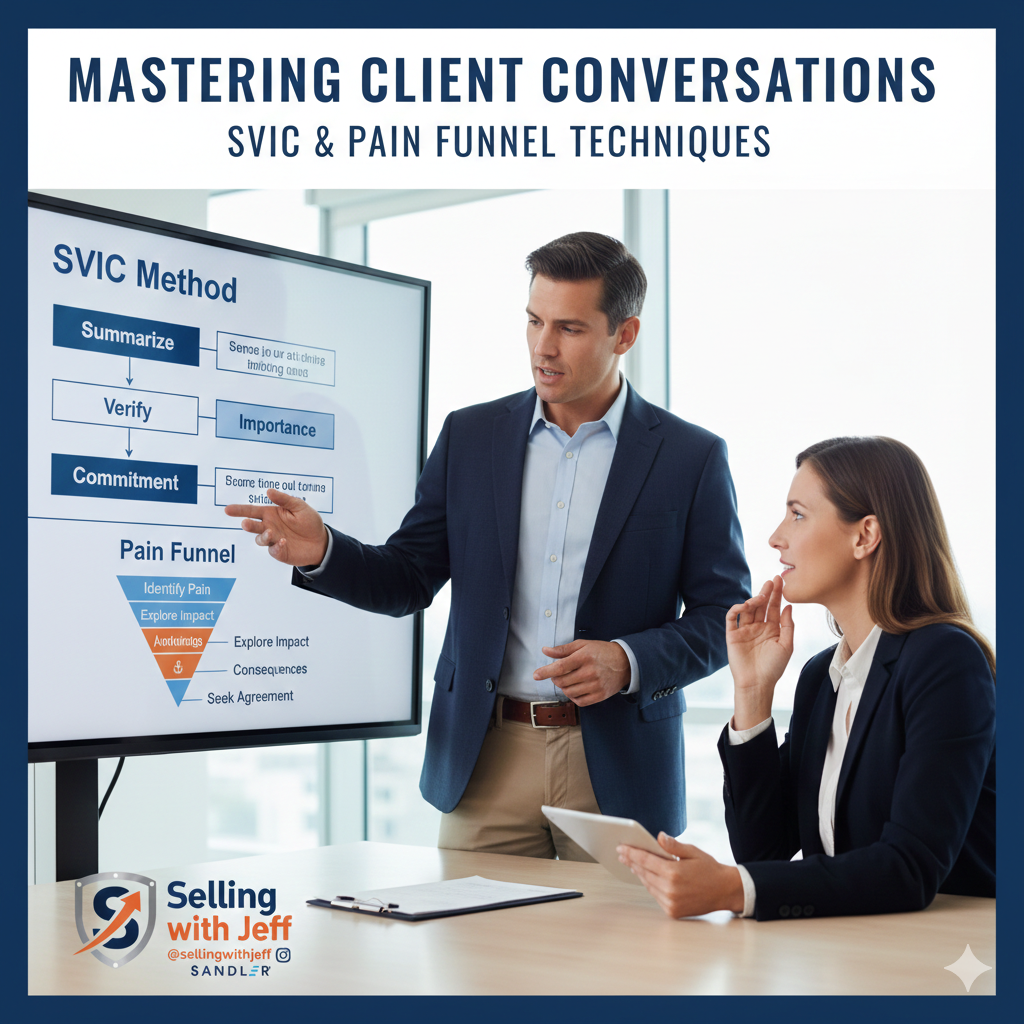
Understanding the SVIC Method: A Comprehensive Guide
The SVIC method—Summarize, Verify, Importance, and Commitment—is a powerful tool for sales professionals looking to enhance their client conversations. This structured approach ensures that you fully understand your client's needs and that they are equally clear about the solutions you offer.
Summarize: Begin by summarizing what the client has said. This shows that you are actively listening and values their input. For instance, "So what I hear you saying is that you want to improve your team's sales performance but are concerned about the time commitment involved."
Verify: Next, verify that your understanding is correct. Ask the client, "Is that right?" or "Did I miss anything?" This step confirms that you're both on the same page.
Importance: Gauge the importance of the issue at hand. Ask questions like, "On a scale of 1 to 10, how crucial is this for you?" This helps prioritize the client's needs and allows you to focus on what matters most to them.
Commitment: Finally, assess their level of commitment. Inquire, "How committed are you to solving this issue?" This step ensures that the client is ready to take action, making the sales process more efficient and effective.
Implementing the Pain Funnel: Techniques and Benefits
The Pain Funnel is another essential technique that helps uncover the underlying issues your clients face. It involves asking a series of progressively deeper questions to get to the root of their problems.
Identify the Pain: Start with broad questions like, "What challenges are you currently facing in your sales process?" This opens up the conversation and allows the client to share their primary concerns.
Explore the Impact: Once you identify the pain, delve deeper to understand its impact. Ask, "How is this issue affecting your team's performance?" This helps quantify the problem and makes it more tangible.
Acknowledge the Consequences: Discuss the consequences of not addressing the pain. For example, "What would happen if this issue remains unresolved?" This step highlights the urgency and importance of finding a solution.
Seek Agreement: Finally, seek agreement on the need for change. Ask, "Do you agree that addressing this issue should be a priority?" This ensures that the client is aligned with you on the necessity of taking action.
Practical Examples of SVIC and Pain Funnel in Action
Let's consider a practical example to see how the SVIC method and Pain Funnel can be applied in a real-world scenario.
Imagine you are meeting with a client who is unhappy with their current sales training program. You begin with the SVIC method:
Summarize: "It sounds like your team is not seeing the desired results from your current training program."
Verify: "Is that correct?"
Importance: "On a scale of 1 to 10, how important is it for you to improve your training outcomes?"
Commitment: "How committed are you to investing in a new training solution?"
Next, you move into the Pain Funnel to explore their concerns further:
Identify the Pain: "What specific issues are you facing with the current training program?"
Explore the Impact: "How is this lack of effective training impacting your sales performance?"
Acknowledge the Consequences: "What do you foresee happening if this issue continues?"
Seek Agreement: "Do you agree that finding a better training solution should be a top priority?"
Actionable Steps to Integrate SVIC and Pain Funnel into Your Sales Process
Integrating the SVIC method and Pain Funnel into your sales process can significantly improve your client interactions and outcomes. Here are some actionable steps to get started:
Training and Practice: Ensure that your sales team is well-trained in both techniques. Regular role-playing sessions can help them become comfortable with the methods.
Create Templates: Develop templates for common scenarios that your team can use as a starting point. This makes it easier to remember the steps and apply them consistently.
Feedback and Refinement: Encourage your team to provide feedback on their experiences using these techniques. Use this feedback to refine your approach and make continuous improvements.
Monitor and Measure: Track the impact of these methods on your sales outcomes. Use metrics like conversion rates, client satisfaction, and sales cycle length to measure success.
By mastering the SVIC method and the Pain Funnel, you can enhance your sales conversations, build stronger client relationships, and drive better sales outcomes. These techniques provide a structured approach to understanding and addressing your clients' needs, ensuring that you can deliver the best possible solutions.