Lead Intake That Protects Margin for Remodelers

Why lead intake is a sales call, not admin work
A strong lead intake process for remodelers is a short qualifying sales call, not a glorified receptionist task. Its job is to confirm fit, uncover basic pain, and book the right next step with the right person—without quoting prices or giving away consulting on the first touch.
Most remodeling and custom home firms treat intake as an afterthought: a friendly person answers the phone, grabs name and address, and promises that “someone will call you back.” That’s how you end up driving across town for low-value repair requests, misaligned projects, or homeowners who think a $400,000 scope costs $150,000. Sandler research shows that poor qualifying is one of the biggest drivers of stalled deals and endless unpaid estimating (Sandler).
For high-end residential work, intake is your first filter against bad-fit projects. Your intake person should:
- Respond quickly but not frantically. For complex projects, answering within 24 business hours is usually enough; you’re not selling $10,000 bathrooms.
- Use an automated email with a calendar link as the default response to web inquiries. Many contractors see 80–90% of homeowners book their own 15‑minute call when given an easy link.
- Do light pre-call research: look up the address on Zillow, scan LinkedIn, and use Google Street View. If it’s a $250,000 house asking for a $1.5M addition, that’s a red flag.
Treating intake as sales also protects your brand. When a homeowner’s first live interaction is organized, confident, and clear about next steps, they feel they’re dealing with a professional firm—not “Chuck in a Truck.” That sets you apart long before you ever put together a proposal.
How to qualify remodeling leads without talking budget
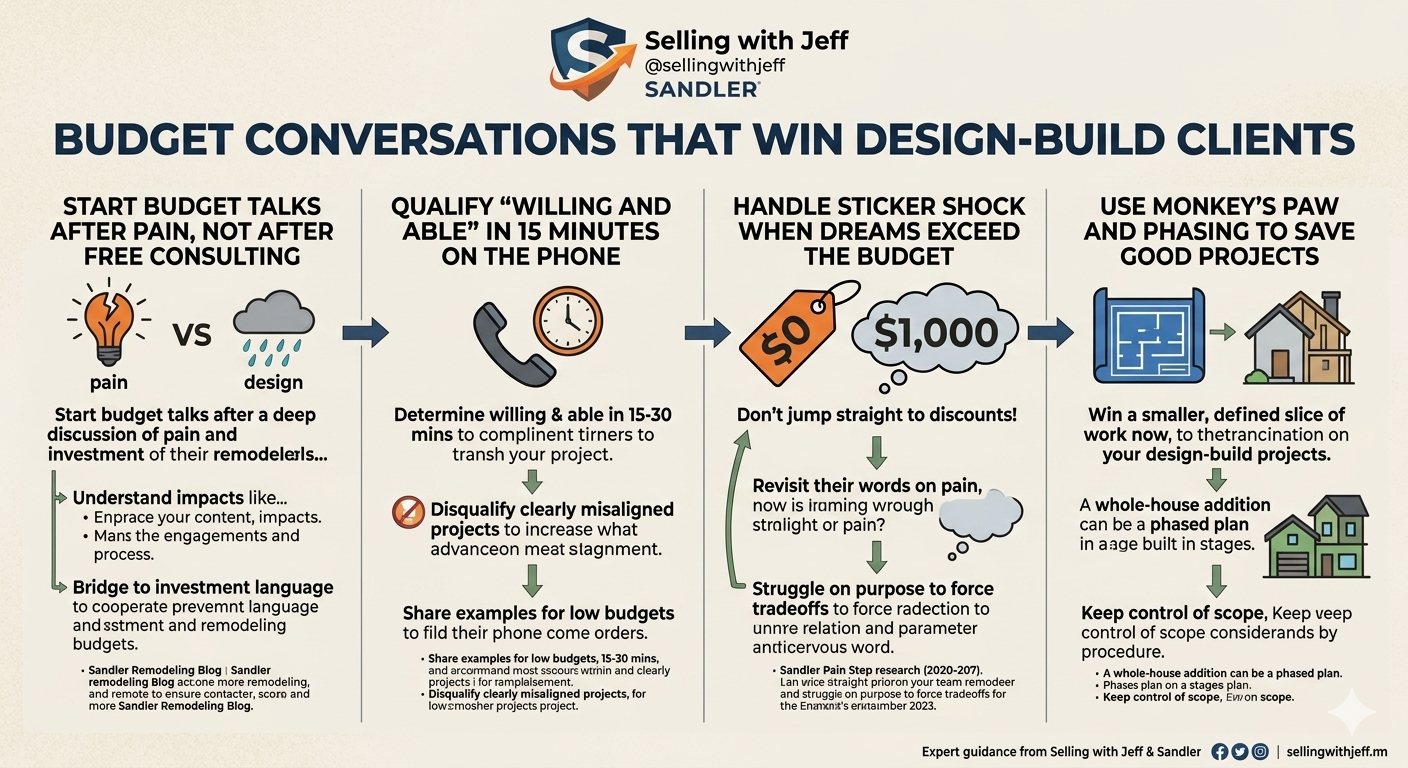
The fastest way to wreck trust in a new lead intake call is to push hard on budget numbers before you’ve explored why the prospect wants the project in the first place. Early budget talk is almost always wrong and almost always low, especially in remodeling where HGTV has trained homeowners to expect fantasy pricing.
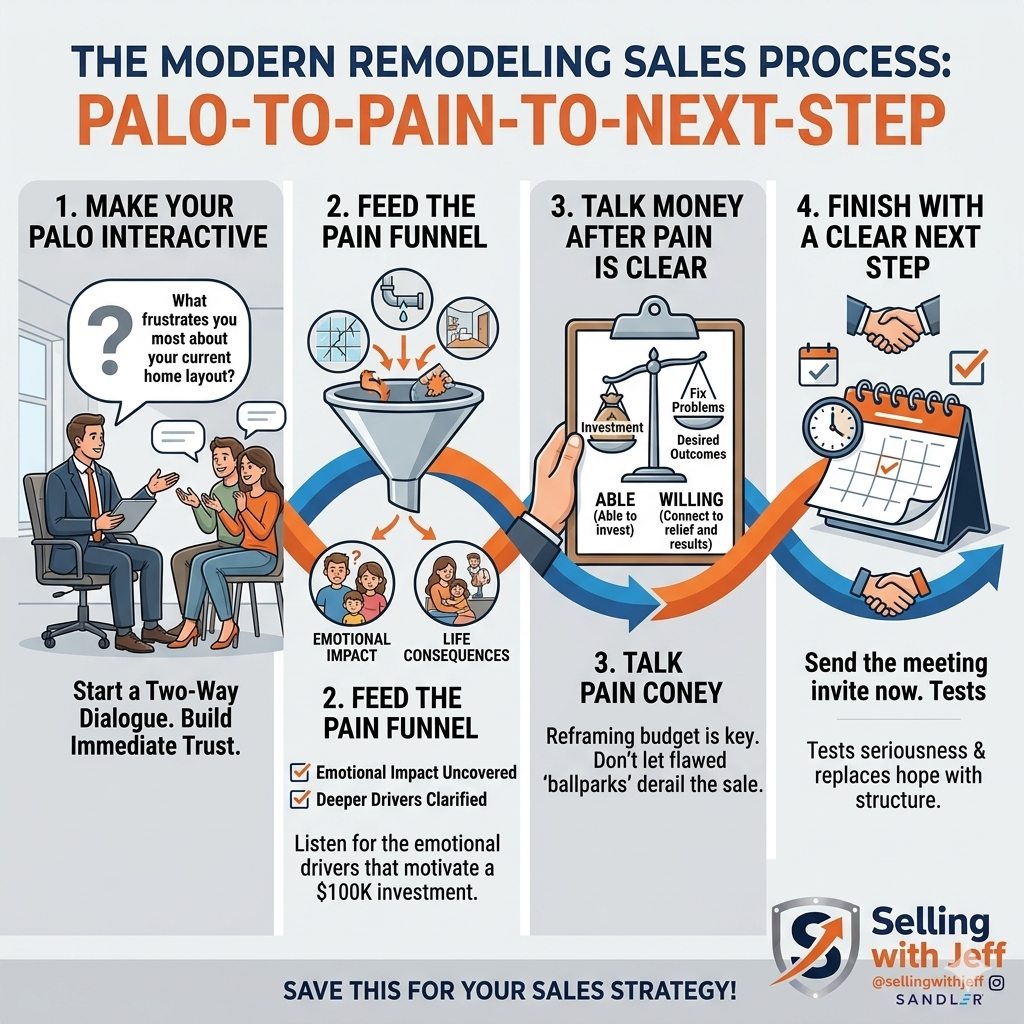
Instead, have your intake person focus on three things: fit, pain, and process. Fit means basic CAPs (your ideal client profile): location, project type, and scope size. Pain is the reason they reached out: “What’s going on with the kitchen / bath / backyard that made you contact us now?” Process is who else they’re talking to and where they are in those conversations.
Notice what’s missing: price. Budget is important, but at intake it’s a trap. If you disqualify based on a casual number the homeowner throws out, you’ll walk away from real projects. One Sandler client put $85,000 as their kitchen budget on a form and ended up spending $185,000 once they fully understood what they wanted and what it solved for their family. That story plays out in renovation after renovation.
If a form asks for budget, treat that number as soft data, never as a reason to stay home. Once your sales pro has run a full discovery—including a deep pain conversation and clear expectations about design, timeline, and disruption—then you can qualify or disqualify on money. Until then, your intake goal is simpler: decide whether the problem is one you’re equipped to solve and whether the client broadly matches your target profile.
Design a simple intake script that books better meetings
A good intake script sounds human, but it follows a clear structure every time. Think of it as a mini Sandler call: set expectations, ask a few smart questions, and agree on what happens next. Done right, this 12–15 minute conversation saves your sales team hours and improves close rates.
Start with a short upfront contract:
“These calls usually last about 12–15 minutes. I’ll ask a few questions to understand what you’re hoping to do and make sure we’re a good fit. At the end, either we’ll decide it’s not a match, I’ll recommend someone else, or we’ll schedule a visit with our owner/project consultant. Does that work?”
Then move to light pain and fit questions:
- “What made you reach out about the project now?”
- “Tell me a bit about the space as it is today—what’s not working?”
- “Have you spoken with anyone else yet? Where are you in those conversations?”
That last question is critical. If you’re first in, it’s often smarter not to rush a site visit. Let another contractor shatter the prospect’s unrealistic price expectations. When your salesperson comes in second or third, the homeowners have already been “price-shocked,” which makes an honest budget discussion much easier.
Finally, use a simple decision tree: if the project location, type, and basic scope fit your model and the caller has a real problem you solve, book a meeting. If they want minor repairs and you don’t have a service division, refer them out. One Sandler remodeling client built a strong referral partnership with a chimney-wrapping company during storm season, then later bought that firm after their referrals drove 80% of its revenue.
Stop free work and concessions from killing profit
Unstructured lead intake doesn’t just waste time; it starts a pattern of free consulting and unilateral concessions that follow the job all the way through production. Every time you say, “Sure, we can do that,” without discussing cost or trade‑offs, you train the client to ask for more at no charge.
In Sandler terms, a unilateral concession is when you give something and get nothing in return—no money, no schedule relief, no scope reduction, no referral. Once clients learn that small changes and extra meetings are “just included,” they keep wringing more value out of you like water out of a mop. Over months on a large project, this behavior can erase your profit.
Your protection starts at intake. If a caller pushes for free design ideas, feasibility opinions, or ballpark pricing, your intake person should acknowledge the request and gently reset expectations: “Totally fair question. Before we talk about costs or specific solutions, we’ll need to understand your space and priorities in more detail. That’s what the first visit with our consultant is for.” This mirrors Sandler’s approach of treating objections as information, not a cue to discount (Sandler remodeling insights).
Later, when a client asks for added scope, your project managers must be comfortable saying, “Happy to explore that—have you thought about what you’re willing to invest in adding it?” That single question signals that nothing is free. Sometimes you’ll trade time, referrals, or scope instead of money, but you always trade something.
When lead intake, sales, and production all follow the same rule—no free work without a clear exchange—you protect margin, keep projects healthy, and still deliver an exceptional client experience.